


Best Roofing Materials for Minnesota Homes (2026 Asphalt vs Metal vs Cedar vs Synthetic)
 14min Read
 Posted 2.27.2026
Minnesota weather is brutal on roofs. Hail in June, wind-driven rain in July, 90°F attic temperatures in August, ice dams in January, and wild freeze-thaw swings every shoulder season. The roofing material you choose has to survive all of that — not just for a season, but for 20 to 50+ years. This guide breaks down the four materials we install and inspect most across the Twin Cities metro — architectural asphalt shingles, standing-seam metal, cedar shakes, and synthetic (composite) shingles — with real Minnesota-specific pricing, lifespan, wind ratings, and insurance implications. By the end you’ll know which material fits your budget, your home’s style, and your tolerance for future storm deductibles.
Why material choice matters more in Minnesota than almost anywhere else
NOAA’s Storm Events Database shows Minnesota averages 35–50 severe hail days per year, with hail ≥1″ documented in every metro county. The Storm Prediction Center ranks the Upper Midwest in the top tier nationally for hail frequency. Add straight-line wind events (derechos have hit the metro three times in the last decade) and a climate that cycles between -30°F and +95°F, and you have the country’s toughest proving ground for roofing materials.
What that means practically: a roof material that scores well in Arizona heat tests or Florida hurricane ratings may still fail in Minnesota because the dominant threat here is impact (hail) combined with thermal cycling (ice-dam-to-bake-oven swings). Your material decision should prioritize, in order: impact resistance (UL 2218 Class 4), wind rating (ASTM D7158 Class H or better), ice-dam tolerance, and only then aesthetics.
The 4 materials we actually install in the Twin Cities metro
1. Architectural (dimensional) asphalt shingles — the 85% answer
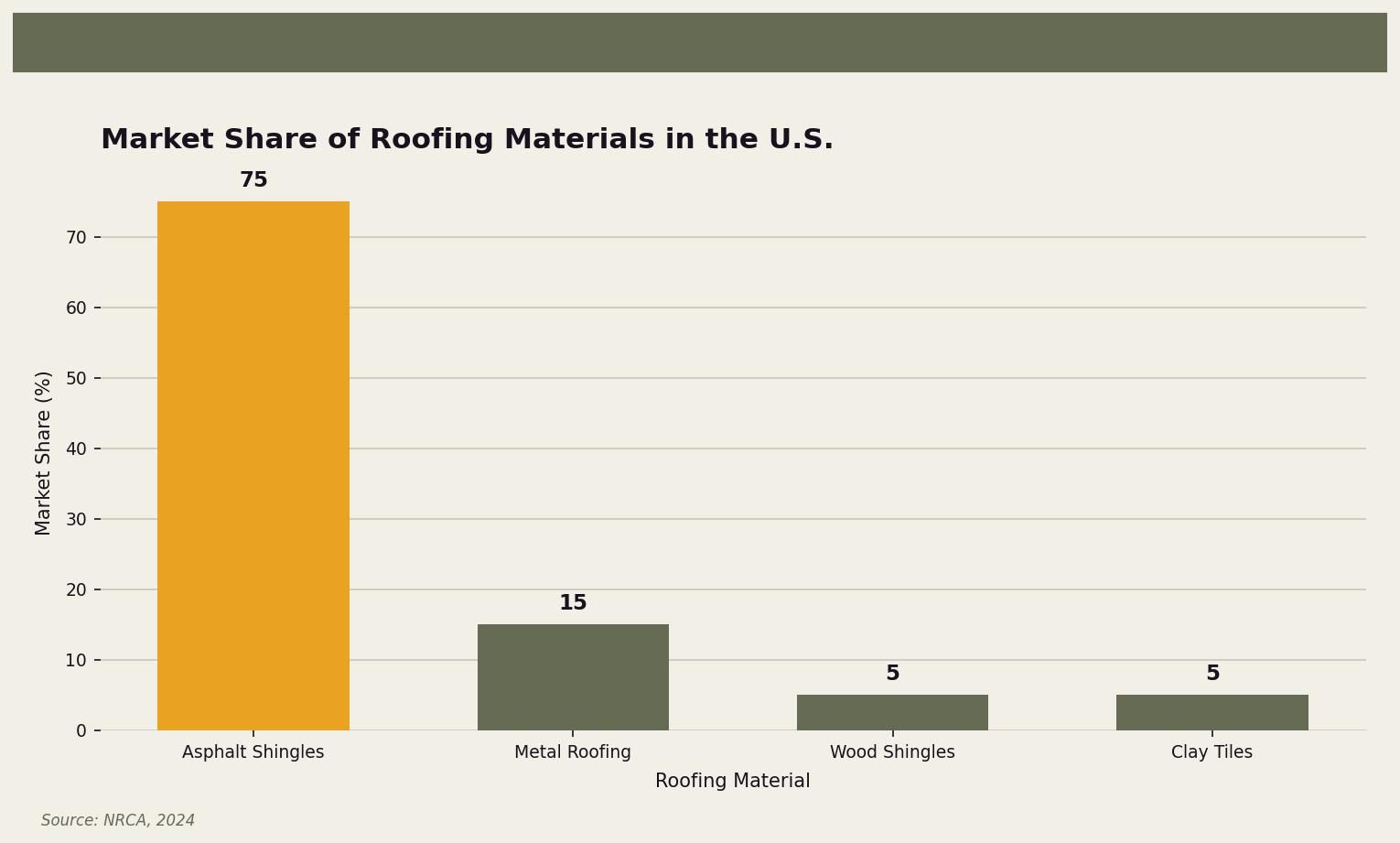
Per the NRCA and Asphalt Roofing Manufacturers Association, asphalt shingles cover roughly 75% of U.S. residential roofs, and in Minnesota that number is closer to 90% because the material handles hail impact better than clay tile or cedar, costs less than metal, and every insurance carrier in the state writes policies around it without friction. Within asphalt there are three tiers: 3-tab (avoid — 25-year warranty, 12-year real life), architectural (the standard), and luxury/designer (Presidential, Grand Sequoia, Camelot).
What to specify in MN: UL 2218 Class 4 impact-rated shingles (GAF Timberline AS II, Owens Corning Duration Storm, Malarkey Legacy Scotchgard, CertainTeed NorthGate), ASTM D7158 Class H wind rating (150 mph), and a full manufacturer system warranty (Golden Pledge, Platinum Preferred, or SELECT Roofing System) — which requires installation by a certified contractor like a Minnesota roofing contractor who carries GAF Master Elite, Owens Corning Platinum, or CertainTeed SELECT credentials.
2. Standing-seam metal — the 50-year roof
Metal roofing has gone from “barns and cabins” to mainstream residential in MN over the last 10 years, driven by Class 4 ratings on stone-coated steel and standing-seam panels, and by homeowners who plan to stay 20+ years. Standing-seam 24-gauge steel with Kynar 500 PVDF finish carries a 40–50 year warranty, sheds snow cleanly (fewer ice dams when detailed correctly), and is nearly always the ENERGY STAR cool-roof qualifier that can shave 10–20% off summer AC costs.
Trade-offs: 2–3x the installed cost of asphalt, louder rain pattern if attic insulation is thin, and denting from golf-ball-size hail (though panels rarely leak even when visibly dented — cosmetic vs functional is a common insurance fight). Not every carrier offers a Class 4 discount on metal — ask your agent before signing a contract.
3. Cedar shakes and shingles — beautiful, but insurance-risky in MN
Cedar is gorgeous on Cape Cods, historic homes, and Lake Minnetonka estates. But in 2026 Minnesota, cedar is getting harder to insure. Several major carriers (State Farm, Allstate, American Family) have non-renewed cedar-roofed homes in hail-prone zip codes over the past three years, and replacement cost has roughly doubled since 2019. Fire rating is a second issue — natural cedar is only Class C unless pressure-treated, and some HOAs now require Class A.
If you must have the cedar look, consider synthetic cedar (see below) — it’s visually very close at 30 feet, carries Class 4 impact and Class A fire, and is insurable statewide without surcharges.
4. Synthetic / composite shingles — the premium aesthetic play
Synthetic shingles (DaVinci, Brava, F-Wave, EcoStar) are molded polymer or rubber composite that mimics cedar shake, natural slate, or clay tile. They’re typically Class 4 impact, Class A fire, Class H wind, and carry 50-year warranties. Installed cost runs $14–$22 per sq. ft. — roughly between premium asphalt and standing-seam metal — making them the best choice for homes where curb appeal and replacement cost value matter more than pure price.
Minnesota materials comparison — the quick grid
| Material | Installed cost / sq. ft. | Real MN lifespan | Impact rating | MN insurability (2026) |
|---|---|---|---|---|
| Architectural asphalt (Class 4) | $8 – $12 | 25 – 30 yrs | UL 2218 Class 4 | Excellent — 10-35% premium discount |
| Standing-seam metal (24 ga.) | $14 – $24 | 40 – 50 yrs | UL 2218 Class 4 (most) | Good — check carrier for discount |
| Cedar shake | $12 – $18 | 20 – 30 yrs | None standard | Poor — many carriers non-renew |
| Synthetic (DaVinci / Brava) | $14 – $22 | 40 – 50 yrs | UL 2218 Class 4 | Excellent — Class A fire + Class 4 |
| 3-tab asphalt (budget) | $5 – $7 | 12 – 18 yrs | Class 1 (weak) | OK but no impact discount |
How each material performs in MN’s 4 worst-case scenarios
| Scenario | Asphalt (Class 4) | Standing-seam metal | Cedar shake | Synthetic composite |
|---|---|---|---|---|
| 1.75″ hail (common MN storm) | Passes — minor granule loss | Cosmetic dents, no leaks | Splits, fractures, often totaled | Passes — rebounds |
| 80 mph straight-line winds | Passes (Class H = 150 mph) | Passes if clips correct | Nails back out — shingle loss | Passes (Class H) |
| Ice dam with 6″ ice sheet | OK if ice-&-water shield is code | Excellent — sheds snow fast | Wicks moisture into wood | Excellent — non-porous |
| 40-year UV exposure | Granules fade by year 20 | Kynar finish holds 40+ yrs | Graying begins year 5 | Color-stable 30+ yrs |
Cost over 40 years — the math your neighbor doesn’t do
Sticker price lies. The real question is lifetime cost per year of service. For an average 2,400 sq. ft. MN home (24 roofing squares), here’s what you actually pay over 40 years of ownership assuming one storm-related replacement with a $2,500 deductible:
| Material | Upfront (2,400 sq ft) | Replacements in 40 yrs | Est. deductible outlay | 40-yr total | Cost / year |
|---|---|---|---|---|---|
| 3-tab asphalt | $14,400 | 2.5 – 3 times | $6,250 – $7,500 | ~$50,000 | $1,250 |
| Class 4 architectural | $24,000 | 1 time (insurance) | $2,500 | ~$27,000 + premium savings | $675 |
| Standing-seam metal | $45,000 | 0 (cosmetic dents only) | $0 – $2,500 | ~$47,000 | $1,175 |
| Cedar shake | $36,000 | 1.5 – 2 (high deductible) | $5,000 – $10,000 + surcharges | ~$60,000+ | $1,500+ |
| Synthetic (DaVinci) | $42,000 | 0 – 1 | $0 – $2,500 | ~$44,000 | $1,100 |
Takeaway: Class 4 architectural asphalt has the lowest 40-year cost per year of service for most MN homes. Metal and synthetic pull ahead only for owners who stay in the home the full 40 years and value zero storm hassles. Cedar is the most expensive option over time once insurance friction is priced in.
What we ask homeowners before we quote
- How long do you plan to own the home? Under 10 yrs → Class 4 asphalt. 10–25 yrs → premium asphalt or synthetic. 25+ yrs → metal or synthetic.
- What’s your HOA / historic district requirement? Historic districts often require cedar-look or slate-look — that steers you to synthetic.
- Who is your insurance carrier? State Farm, Allstate, and AmFam have the most generous Class 4 discounts. Some carriers require a specific product list.
- What’s your roof pitch and complexity? Low-slope sections (under 4/12) need metal or modified bitumen, not shingles.
- Are you planning solar? Pair metal with standing-seam-clamp solar mounts, or plan a 25+ year shingle before panels go on.
Manufacturer warranties — what “Lifetime” actually means
“Lifetime” in shingle marketing is a legal term of art, not a literal lifetime. It means as long as the original homeowner owns the home, transferable once (typically 10 years in). The real warranty you want is the full system warranty — GAF Golden Pledge (50 yr non-prorated labor + material), Owens Corning Platinum Protection (50 yr), CertainTeed SureStart PLUS (50 yr). These require a certified installer and a roof-system install (underlayment, ice & water shield, ridge vent, starter strip, hip/ridge cap — all from the same manufacturer). Shortcut any of those and you get a stripped-down material-only warranty.
A common mistake: homeowners assume a 50-year warranty means a 50-year roof. In Minnesota it doesn’t — the warranty has pro-rated material value after year 10, and most MN shingle roofs are insurance-replaced around year 15–20 after a qualifying storm. The warranty’s real value is workmanship coverage during those first 10 years. Read more in our complete guide to Minnesota roofing contractors.
Installation details that matter more than the shingle brand
- Ice-and-water shield from eave to 24″ past the heated wall line — MN code minimum, and the #1 ice-dam defense.
- Synthetic underlayment (not 15# felt) — tears less during tear-off and breathes better.
- Starter strip on eaves AND rakes — most wind-blow-offs start at an un-stripped rake edge.
- 6 nails per shingle minimum — MN high-wind zone spec. Never 4.
- Continuous ridge vent with matched intake — 1:1 intake-to-exhaust ratio. Without intake, the vent does nothing and your attic bakes.
- Step flashing replaced, not reused — never caulk old step flashing back in.
- New pipe boots (rubber + metal collar) — the old ones dry-rot in 10–12 yrs.
The “25% rule” still applies — material choice doesn’t change it
Minnesota Building Code R908.3 prohibits roof coverings from being installed over existing roofing when more than 25% of a roof section needs repair within a 12-month period. That rule applies regardless of material — asphalt, metal, cedar, or synthetic. If a storm damages more than 25% of any individual roof plane, the entire plane must be torn off and replaced to current code. See our full breakdown in the 25% rule explained.
Which material is right for your MN home?
- Typical suburban 2-story (Maple Grove, Plymouth, Woodbury): Class 4 architectural asphalt with Golden Pledge / Platinum warranty.
- Lake cabin or craftsman (Lake Minnetonka, Stillwater): Synthetic cedar or real cedar if insurance cooperates.
- Modern farmhouse / new construction (Medina, Chanhassen): Standing-seam metal accents + architectural asphalt on main field, or full metal.
- Historic district home (Summit Ave, Linden Hills): Synthetic slate or DaVinci.
- Ranch / rambler with 4/12 pitch: Class 4 architectural — metal only if you plan to stay 25+ years.
Bottom line
For nearly every Twin Cities homeowner, Class 4 architectural asphalt installed as a full manufacturer system is the best combination of cost, lifespan, insurability, and curb appeal. Metal is the premium long-haul play. Synthetic wins on aesthetics without cedar’s insurance headaches. Cedar is beautiful but increasingly risky. Whatever you choose, the installer matters more than the material — ask for manufacturer certification, a full system warranty, proof of MN contractor license (look it up at mn.gov/dli), and a written scope that matches the code requirements above.
If you’d like a free roof inspection and a side-by-side materials quote for your specific home, contact Owl Roofing — we’re a GAF Systems Plus Certified and Minnesota-licensed and insured Minnesota contractor serving Shoreview, Minneapolis, St. Paul, and the surrounding metro.
What Owl Roofing Customers Actually Say
Real, verified Google reviews from real customers Owl Roofing maintains a 5.0 Google rating with 30+ five-star reviews.
Noah is the real deal. After our insurance denied our roof claim and the first roofer walked away, Noah showed up the next day and said he thought he could get us a new roof. He delivered. He got us a roof covered by insurance after it had already been declined. We came up with a nickname for him: “The Roof Whisperer.”
— Tyler Moberg, verified Google review
I am an Independent Insurance Agency owner and have worked with Noah on several roof projects. The homeowners have been extremely satisfied with the quality of work and craftsmanship Noah and his crews have provided. From filing the claim to replacing the roof and cleaning up the job site, Noah and his crew are the best!
— Fred Zappa, Independent Insurance Agency Owner
We used Owl Roofing for a repair on our roof in Brooklyn Park, and I was blown away by how good they were. Every member of the team communicated well about the process. Their price transparency was super helpful. They got the work done very fast, and the team was professional and very kind.
— Matt Brown, Brooklyn Park (verified Google review)
Noah and his team are outstanding! His clear communication, professionalism, and workmanship are top-notch. I recommend Owl Roofing to all my clients, friends, and family.
— Christine Westlund, verified Google review
It didn’t feel like dealing with a big company — it felt like working with people who actually care about the homes and community in the North Oaks and Shoreview area. Great people, great communication, and really solid work.
— Cody Warren, verified Google review
Frequently asked questions
What is the longest-lasting roof material for Minnesota?
Standing-seam metal with a Kynar 500 PVDF finish lasts 40–50 years in Minnesota, the longest of any mainstream residential material. Synthetic composite (DaVinci, Brava) is a close second at 40–50 years. Premium Class 4 asphalt realistically lasts 25–30 years.
Do I get an insurance discount for Class 4 shingles in Minnesota?
Yes — most MN carriers (State Farm, Allstate, American Family, Farmers, Liberty Mutual) offer 10%–35% off the roof portion of your homeowners premium for UL 2218 Class 4 impact-rated shingles. Confirm the discount and the approved product list with your agent before signing a contract.
Is metal roofing too loud for Minnesota homes?
No — when installed over solid decking with standard MN attic insulation (R-49 or better), a standing-seam metal roof is no louder than asphalt during rain. The “loud metal roof” myth comes from uninsulated barns and pole buildings.
Will my insurance drop me for having a cedar shake roof?
Possibly. Several major MN carriers have non-renewed cedar-roofed homes in hail-prone zip codes since 2022. Others require a higher wind/hail deductible or exclude cosmetic damage. Ask your agent for current underwriting rules before investing in a cedar replacement.
How much does a new roof cost in Minnesota in 2026?
For an average 2,400 sq. ft. home: $14,000–$22,000 for 3-tab, $19,000–$29,000 for architectural Class 4, $34,000–$52,000 for synthetic composite, and $34,000–$58,000 for standing-seam metal. See our full Minnesota roof replacement pricing guide for size-by-size breakdowns.
Can I mix roofing materials on one house?
Yes, and it’s common. Standing-seam metal on porch roofs, bay windows, and dormers paired with architectural asphalt on the main field is a popular modern-farmhouse look in MN. Just make sure the transition flashing is done correctly — that’s where leaks start.
What is the best roofing material for ice dams in Minnesota?
Metal sheds snow the fastest, which reduces ice-dam risk dramatically. But ice dams are primarily caused by heat loss from the house, not by the roofing material. Proper attic insulation (R-49+), air sealing, and balanced ventilation prevent ice dams on any material. Code-compliant ice-and-water shield at the eave is the second line of defense.
