



Attic Ventilation and MN Code R806: Balanced Airflow Explained
 13min Read
 Posted 3.25.2026
🦉 Attic Ventilation Calculator
Find the vent area (NFA) your attic needs under Minnesota code.
Based on the standard 1/300 rule (Minnesota code, R806): 1 sq ft of net free vent area per 300 sq ft of attic floor, split roughly 50/50 between soffit intake and ridge exhaust. Assumes ~56 sq in NFA per 8×16 soffit vent and ~18 sq in per linear foot of ridge vent — check your product’s rating. Poor ventilation is a top cause of Minnesota ice dams.
Get a Free Ventilation Assessment →Attic ventilation is the single most misunderstood element of a Minnesota roof. Done right, it extends shingle life, prevents ice dams, keeps the attic deck dry through high-humidity summers, and helps the insulation system perform at its rated R-value. Done wrong — and most older Minnesota homes have it wrong — ventilation becomes either a source of heat loss in winter, a conduit for ice dam formation, or a mold-growth chamber that quietly destroys the underside of the roof sheathing. The Minnesota adoption of International Residential Code Section R806 sets the baseline, but code compliance is just the starting point. What actually matters is balanced airflow across the entire attic.
- MN R806 requires 1 sq ft of net free ventilation area per 300 sq ft of attic floor (or 1:150 without a vapor retarder).
- Balance: 50-60% of that area as intake (soffits), 40-50% as exhaust (ridge or high).
- Clear airflow path is required — baffles (chutes) keep insulation from blocking soffits.
- Avoid mixing vent types (ridge + gable + power fan) — it short-circuits airflow.
- Good ventilation prevents ice dams, extends shingle life, and qualifies the roof for manufacturer warranty coverage.
What Attic Ventilation Actually Does
Attic ventilation has two primary jobs, one in winter and one in summer. In winter, cold outside air sweeps through the attic from the soffits up to the ridge, carrying away moisture and heat that rise from the living space below. A cold, dry attic means no condensation on the underside of the roof deck, no wet insulation, and no warming of the snow above — which means no ice dams at the eave. In summer, the same airflow pulls hot air out of the attic, dropping attic temperatures from 140-160°F (common on dark shingle roofs without ventilation) to 100-120°F, which extends shingle life, reduces air-conditioning load, and protects stored attic belongings.
Crucially, attic ventilation is not “airflow as much as possible.” It’s balanced airflow along a defined path. More is not better if the geometry is wrong.
The R806 Calculation: 1:300 or 1:150?
MN R806.2 specifies the Net Free Ventilation Area (NFVA) requirement: 1 square foot of venting for every 300 square feet of attic floor area, provided a Class I or II vapor retarder is installed on the warm-in-winter side of the ceiling. Without a vapor retarder, the ratio doubles to 1:150. The NFVA calculation requires at least 40% of the total venting at or near the ridge (high point) and at least 40% at or near the eaves (soffits/low point). This is the regulatory formulation; the practical expression is the 50-60/40-50 intake-exhaust balance.
Example Calculation
A 2,000 sq ft rambler attic (assuming vapor retarder present):
- Total NFVA required: 2,000 ÷ 300 = 6.67 sq ft = 960 sq inches.
- Intake (soffit) portion: 55% × 960 = 528 sq inches.
- Exhaust (ridge) portion: 45% × 960 = 432 sq inches.
- Typical continuous ridge vent: 18 sq inches of NFVA per linear foot. Needed: 432 ÷ 18 ≈ 24 linear feet of ridge vent.
- Typical vented soffit: 9 sq inches NFVA per linear foot. Needed: 528 ÷ 9 ≈ 59 linear feet of vented soffit.
Ventilation Component Types
| Component | Role | Typical NFVA | MN Notes |
|---|---|---|---|
| Continuous ridge vent | Exhaust at high point | ~18 sq in/linear foot | Preferred; combined with baffle to exclude wind-driven snow |
| Vented soffit (aluminum/vinyl perforated) | Intake at low point | 5-9 sq in/linear foot | Must be kept clear with baffles (chutes) in attic |
| Gable-end vents | Exhaust (when used with gable intake) or intake (with ridge) | Varies | Often conflict with ridge vents — short circuit airflow |
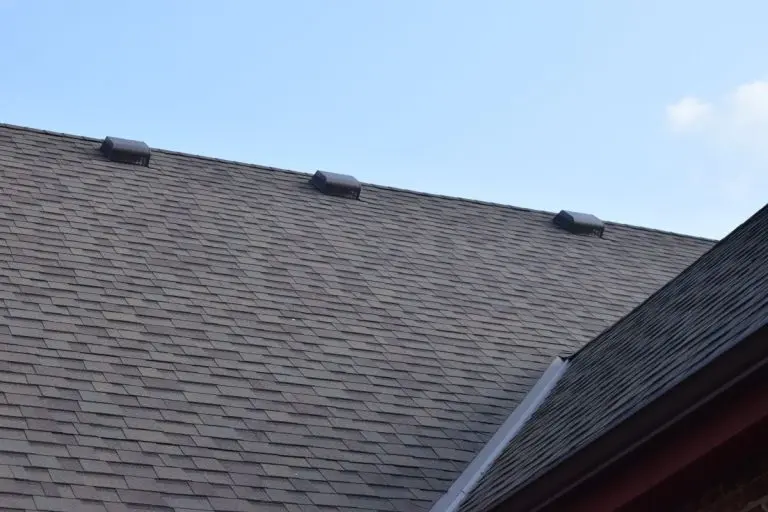
| Roof turbines (“whirlybirds”) | Wind-driven exhaust | ~50-60 sq in active | Legacy solution; ridge vent generally preferred |
| Static box vents (roof pots) | Exhaust | ~50 sq in each | Cheap; multiple units required for full NFVA |
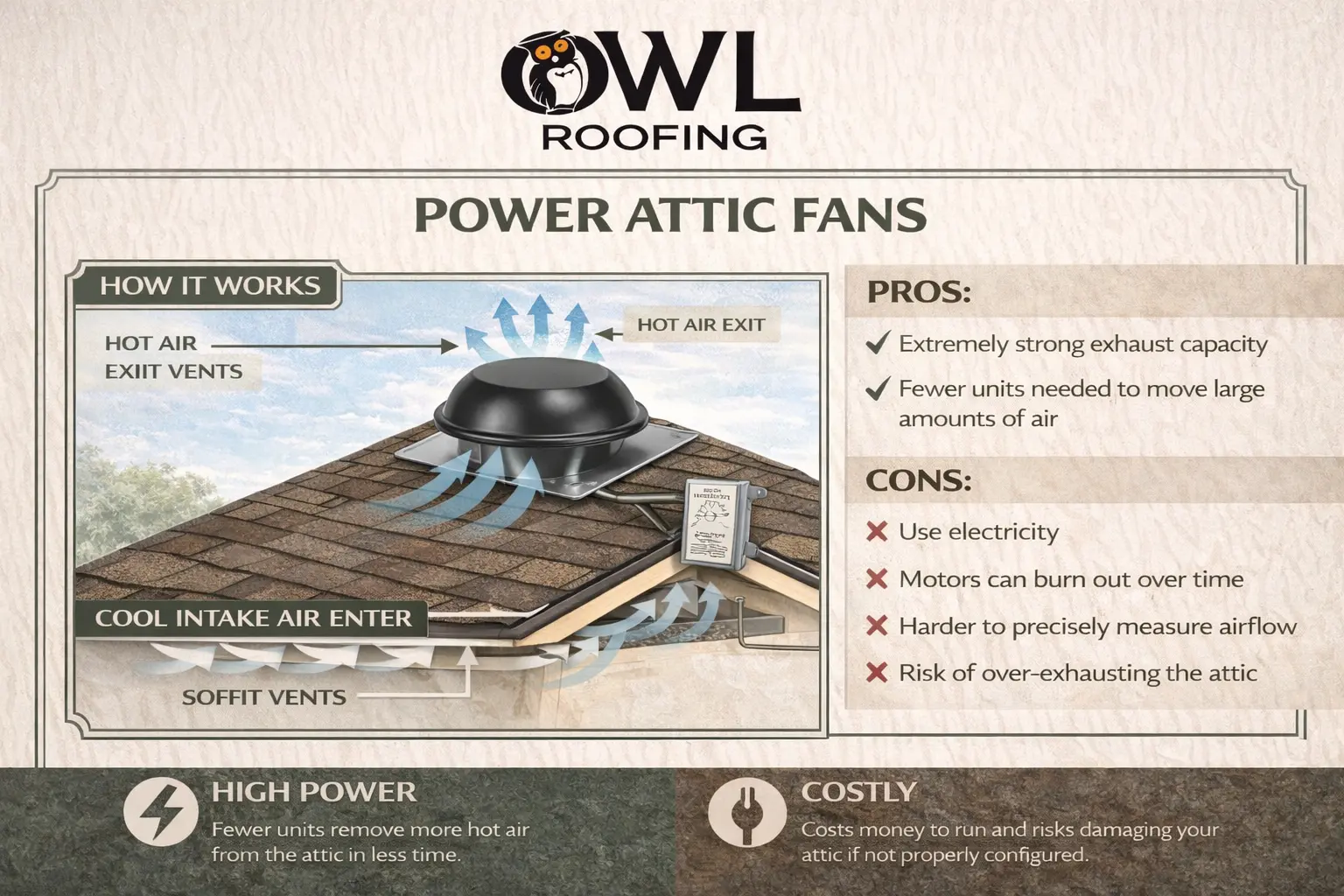
| Power attic fans (electric) | Forced exhaust | High (600-1500 CFM) | Generally discouraged — pulls conditioned air from house, unbalances system |
| Smart vents / edge vents | Intake (alternative to soffit) | 9-10 sq in/linear foot | Used when no soffit overhang exists |
The Most Common MN Ventilation Mistakes
- Blocked soffit intakes. Attic insulation is blown into the eave cavity, stuffing the soffit openings. Without clear intake, the ridge vent becomes useless. Fix: install rafter baffles (chutes) at each rafter bay.
- Mixing ridge and gable vents. Both are exhaust. Installing both means the ridge pulls air from the gable rather than the soffits, creating a dead zone in the middle of the attic. Fix: seal gable vents or remove ridge vent, but not both exhausts on the same attic.
- Power attic fans with insufficient intake. Powerful fans pull air from whatever path is easiest — often through ceiling penetrations, drawing conditioned air out of the house. The result: higher utility bills and no attic benefit. Fix: disable the fan and install passive balanced ventilation.
- Bath fan vents terminated in the attic. Moisture is dumped directly into the attic instead of outside — enormous moisture load. Fix: vent bath fans through roof or gable with proper termination.
- Soffit-only ventilation (no ridge). Air goes in, nowhere to go out. Common on low-slope roofs and retrofits. Fix: add ridge vent or roof-mounted exhaust.
Signs of Attic Ventilation Problems
| Symptom | Likely Cause | Urgency |
|---|---|---|
| Frost on roof deck underside in winter | Excess attic humidity from living space; poor ventilation | High — mold and rot risk |
| Black staining on roof sheathing | Mold growth from chronic condensation | High — remediation before replacement |
| Chronic ice dams every winter | Warm attic; likely air sealing + ventilation issues | Medium-high |
| Attic temperature 150°F+ in summer | Inadequate exhaust or blocked intake | Medium — shortens shingle life |
| Premature shingle failure (10-15 years) | Chronic overheating from poor ventilation | Already happening — address at replacement |
| Musty odor from attic hatch | Moisture accumulation, possible mold | High |
Ventilation’s Role in Shingle Warranties
Every major shingle manufacturer — GAF, Owens Corning, CertainTeed, IKO — requires balanced ventilation as a condition of warranty coverage. GAF’s Golden Pledge warranty, available only through GAF Master Elite contractors, explicitly requires balanced intake/exhaust ventilation per ARMA guidelines. Owens Corning Platinum warranties require the same. A roof installed over an under-ventilated or unbalanced attic can have its warranty voided if premature shingle degradation is traced to heat damage.
What this means practically: if you’re having a roof replaced in Minnesota, ventilation assessment should be part of the scope. A good contractor measures net free area of existing vents, identifies imbalances, and either corrects them as part of the reroof or prices the correction as an add. Cutting corners here saves $500-$1,500 on the project but exposes tens of thousands in warranty value. See our guide on GAF Master Elite certification for more on manufacturer-tier warranties.
Vented vs. Unvented Attic Assemblies
Newer construction and certain retrofits use “unvented” or “conditioned attic” assemblies — where the attic is sealed from outside air and insulated at the roof deck rather than the ceiling. This is a valid alternative to traditional venting and is recognized under IRC R806.5, but it demands rigorous air sealing, closed-cell spray foam or equivalent insulation at the roof deck, and careful moisture management. Most Minnesota homes remain traditional vented attics, and conversion to unvented requires significant design and construction work. Don’t attempt a hybrid — either vent properly per R806, or commit fully to a sealed assembly.
Cost to Correct Ventilation at Roof Replacement
| Ventilation Upgrade | Typical Incremental Cost | Notes |
|---|---|---|
| Add continuous ridge vent (60 lf ridge) | $400 – $800 | Replace ridge caps with vent + shingle cap |
| Install rafter baffles/chutes | $250 – $500 | Per attic; ensures soffit intake path |
| Replace solid soffit with vented soffit | $8 – $16 per linear foot | Only needed if current soffit is solid |
| Disable/remove power attic fan | $100 – $250 | Often recommended, rarely refused |
| Seal unused gable vents | $150 – $400 | Prevents short-circuit with ridge vent |
| Add smart vent / edge vent (no soffit overhang) | $8 – $14 per linear foot | Retrofit for homes without soffits |
Ventilation and Insurance Claims
When a roof is replaced under insurance after a storm, MN code compliance for ventilation is part of the re-roof — this falls under “Ordinance or Law” coverage in most HO-3 policies. If your existing ventilation is non-compliant, the reroof should bring it to code, and the carrier should pay for the upgrade under that coverage. A good contractor documents existing NFVA, itemizes the corrections, and ensures the Xactimate estimate reflects the full ventilation scope. Missing this is common; a local roofer familiar with MN code will not leave it out.
Frequently Asked Questions
How do I tell if my attic is properly ventilated?
Check for three things: soffit vents that are clear and unobstructed (stick your head in the attic and see daylight at each rafter bay), exhaust at the ridge or high on the roof, and no moisture symptoms — no frost on the underside of the deck in winter, no mold staining, no wet insulation. If any of those fail, ventilation needs attention.
Should I install a power attic fan?
Generally, no. Power attic fans often pull conditioned air from the house (through ceiling penetrations and bypasses) rather than from the soffits, which raises utility bills and can draw moist indoor air into the attic. Passive balanced ventilation — ridge vent plus soffit intake — outperforms powered fans in almost every Minnesota scenario.
Can I combine ridge vents and gable vents?
Not recommended. Both are exhaust vents. Combining them creates a short-circuit where the ridge pulls air from the gable rather than from the soffits, leaving a dead zone in the middle of the attic. Pick one path and commit.
How much does it cost to fix attic ventilation in MN?
Varies widely. Adding baffles and a continuous ridge vent during a roof replacement typically runs $500-$1,500 incremental. Replacing solid soffits with vented soffits on an existing home can run $2,000-$5,000 depending on eave length. Disabling a power fan costs $100-$250.
Does poor ventilation void my shingle warranty?
It can. Most major manufacturers require balanced intake/exhaust ventilation as a condition of full warranty coverage. Premature shingle failure traced to heat damage from inadequate ventilation can result in warranty denial.
What is NFVA and why does it matter?
Net Free Ventilation Area is the actual open airflow area of a vent, accounting for screens and louvers. It’s less than the gross physical opening. MN R806 NFVA requirements (1:300 with vapor retarder, 1:150 without) govern how much venting must be present.
Do bath fans and kitchen exhausts tie into attic ventilation?
No. Bath and kitchen exhausts must terminate outside the attic — through the roof, gable, or sidewall with proper termination — not dumped into the attic airspace. Bath fans venting into the attic are one of the most common sources of chronic moisture and mold problems in Minnesota attics.

Recent Articles
Explore The Blog