




Attic Ventilation in Minnesota: Ridge Vents vs. Soffit Vents and the 1:300 Rule
 12min Read
 Posted 5.02.2026
🦉 Attic Ventilation Calculator
Find the vent area (NFA) your attic needs under Minnesota code.
Based on the standard 1/300 rule (Minnesota code, R806): 1 sq ft of net free vent area per 300 sq ft of attic floor, split roughly 50/50 between soffit intake and ridge exhaust. Assumes ~56 sq in NFA per 8×16 soffit vent and ~18 sq in per linear foot of ridge vent — check your product’s rating. Poor ventilation is a top cause of Minnesota ice dams.
Get a Free Ventilation Assessment →Walk a Twin Cities attic in February with a thermal camera and you’ll usually find one of two things. Either the underside of the roof deck is uniformly cold (which is what you want), or there’s a band of warm spots running across the lower third of the deck where moist interior air is hitting the cold sheathing and condensing into frost. That second pattern — frost on the deck — is the early warning sign of a ventilation problem that ends in rotted plywood, premature shingle failure, and persistent ice dams.
Most homeowners assume their attic vents are working because they exist. But the math actually matters. Minnesota code, the International Residential Code, and every shingle manufacturer’s warranty all require a balanced ratio of intake to exhaust ventilation, calculated against the attic floor area. Get the math wrong — too few vents, unbalanced intake and exhaust, or vents in the wrong places — and you get the symptoms above. Get it right, and you have a roof that lasts the full warranty period and an attic that stays dry through every Minnesota winter.
At Owl Roofing in Shoreview we calculate ventilation on every reroof inspection. Noah Bergland and our crews have walked enough attics to know the patterns: under-ventilated 1980s ramblers, 1990s two-stories with gable vents fighting against power vents, recent additions where soffit baffles got buried under blown-in insulation. This guide walks through what works, what doesn’t, and how to read a ventilation scope on a reroof bid.
TL;DR
Minnesota IRC R806 requires 1 square foot of net free vent area for every 300 square feet of attic floor, split roughly 50/50 between intake (soffit) and exhaust (ridge). For a 1,500-square-foot attic that means 5 sq ft total NFA — about 2.5 sq ft of soffit and 2.5 sq ft of ridge. Most older Twin Cities homes are dramatically under-ventilated by this metric. The fix on a reroof: continuous ridge vent + continuous soffit vent + baffles to keep insulation out of the soffit airflow path. Don’t mix powered and passive systems on the same attic.
The 1:300 rule explained
IRC R806.2 requires a minimum vent area of 1/150 of the attic floor area, which can be reduced to 1/300 if the venting is balanced (50% intake low, 50% exhaust high) and a Class I or II vapor retarder is installed on the warm side of the ceiling. Almost every modern Minnesota home qualifies for the 1:300 reduction.
What that means in practice: for every 300 square feet of attic floor, you need 1 square foot of “net free area” (NFA) of ventilation. Half should be intake (soffit), half should be exhaust (ridge or near-ridge).
“Net free area” is the open area that actually allows air to pass — not the gross area of the vent. A continuous soffit vent might have a stated NFA of 9 square inches per linear foot. A perforated metal soffit panel has dramatically less than that. Always ask for NFA, not “linear feet of vent.” The full code text is published by the International Code Council; Minnesota state amendments are at the Department of Labor and Industry.
Quick math example
For a 1,800-square-foot attic in a Twin Cities two-story:
- Required total NFA: 1,800 ÷ 300 = 6 sq ft (864 sq in)
- Intake (soffit) target: 432 sq in NFA
- Exhaust (ridge) target: 432 sq in NFA
- For continuous soffit vent at 9 sq in NFA per linear foot: 48 lf required
- For continuous ridge vent at 18 sq in NFA per linear foot: 24 lf required
Most homes have approximately the right ridge length but woefully insufficient soffit intake. That’s the single most common ventilation problem we find on Twin Cities reroofs.
Soffit vents (the intake side)
Soffit vents pull cold outside air into the attic at the eave. The cold air rises along the underside of the roof deck, picks up moisture and warm air from below, and exits at the ridge. Without intake, ridge vents do nothing — there’s no makeup air for the exhaust to pull through.
Continuous soffit vent
The standard for new construction and quality reroofs. A continuous strip of perforated aluminum or vinyl runs the full length of the eave on the underside of the soffit. Stated NFA: typically 9 sq in per linear foot. Actual performance once painted, dirty, and partially blocked by insulation: closer to 6 sq in per linear foot.
Round soffit vents
Older Twin Cities homes often have 4-inch round vents drilled at intervals along the soffit. NFA per vent is small (~5 sq in actual). Almost never enough to satisfy code. We typically replace these with continuous strips during a reroof when the soffit is being worked on anyway.
Soffit baffles
Baffles are foam or cardboard channels installed in the rafter bay above the soffit to keep blown insulation out of the airflow path. Without baffles, blown cellulose or fiberglass packs into the soffit and chokes the intake airflow. We install baffles in every rafter bay during attic insulation upgrades. They cost almost nothing and they’re the difference between a working ventilation system and a clogged one.
Ridge vents (the exhaust side)
Ridge vents run continuously along the peak of the roof, hidden under the ridge cap shingles. Hot, moist air rising to the peak exits through the slot. NFA: typically 18 sq in per linear foot for quality products like GAF Cobra or Owens Corning ProEdge.
For ridge vents to work, the ridge cut has to be open. We’ve torn off enough roofs to find ridges where a previous installer cut the slot too narrow, didn’t cut at all, or filled the slot with caulk. Always specify “open ridge cut to manufacturer specification” on the scope of work for a reroof.
Ridge vent advantages over older alternatives:
- Continuous airflow along the entire ridge — no hot spots
- Hidden under cap shingles — no aesthetic compromise
- Self-balancing with soffit intake — no fan or wind dependency
- 50+ year service life when properly installed
Box vents, gable vents, and power vents
Box vents (turtle vents, mushroom caps)
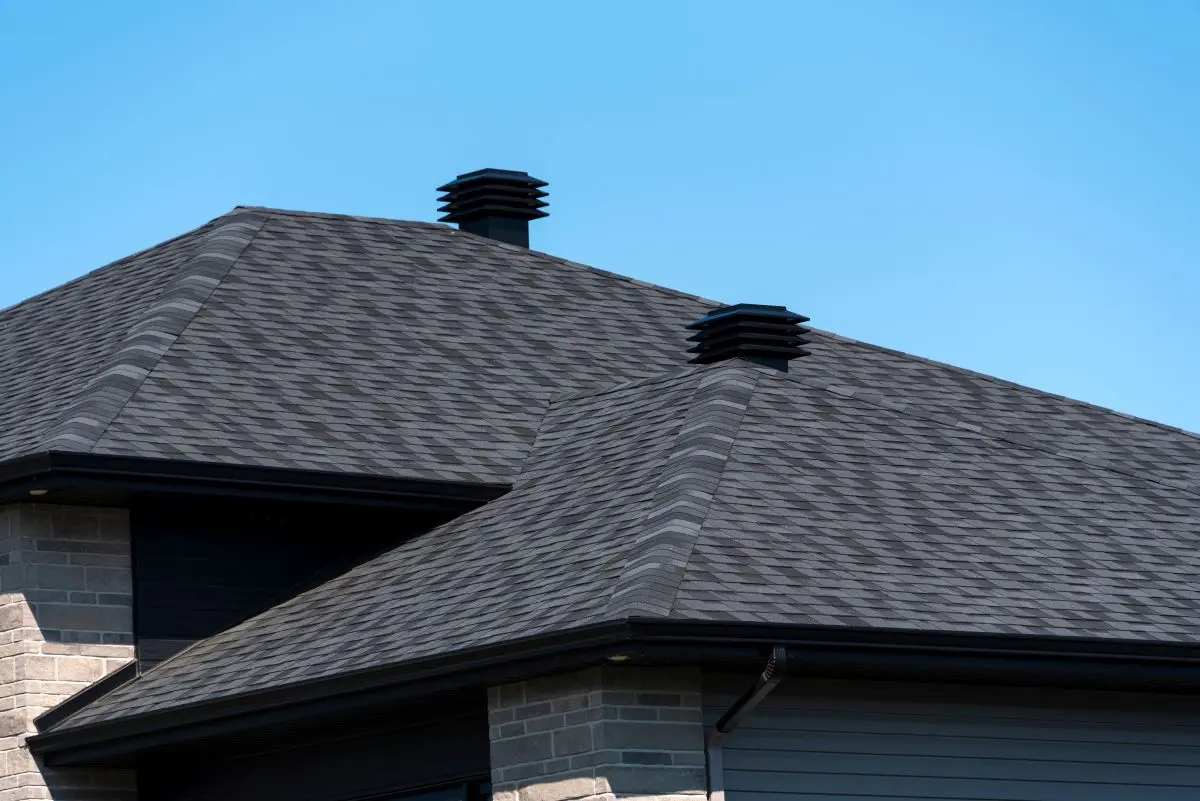
Square or low-profile metal vents installed near the ridge. NFA per box: 50–80 sq in. Older homes used multiple box vents in place of continuous ridge ventilation. They work but provide less continuous airflow than a ridge vent. We sometimes use them on hipped roofs with short ridges where ridge venting alone can’t meet the math.
Gable vents
Vents in the gable end walls of the attic. Functional on older homes without ridge venting, but they short-circuit ridge venting if both are installed on the same attic. The exhaust pulls air sideways from the gable rather than up from the soffit, defeating the convection loop. If you have ridge venting going in on a reroof, the gable vents should be sealed off from the inside.
Power attic ventilators
Solar or electric fans that pull air out of the attic. They sound great in theory but cause more problems than they solve in cold climates. The fan creates negative pressure that can pull conditioned air from the home below into the attic — heating the attic, increasing energy use, and worsening the original moisture problem. We don’t recommend power ventilators for Minnesota homes, and most modern building science consensus agrees.
How to size a system for your specific home
Step one: measure your attic floor area. For a simple rectangular attic this is just length × width. For complex attics (T-shape, multiple wings, additions) you may need to break it into sections.
Step two: divide by 300 to get total required NFA in square feet. Multiply by 144 to convert to square inches.
Step three: split 50/50 between intake and exhaust.
Step four: divide intake target by 9 (NFA per lf of continuous soffit) to get required soffit linear feet. Divide exhaust target by 18 (NFA per lf of ridge vent) to get required ridge linear feet.
If your roof has more ridge length than the math requires, that’s fine — fully venting all available ridge is standard practice. If your roof has less ridge length, supplement with box vents or off-ridge static vents to make up the exhaust target.
Common Twin Cities ventilation mistakes
- Insulation blocking soffit baffles. Adding R-49 cellulose to an attic without installing baffles first packs the cellulose into the soffit and stops intake airflow.
- Mixing ridge and gable vents. The ridge vent short-circuits to the closest gable vent rather than pulling makeup air from the soffit.
- Mixing ridge and power vents. The power vent pulls air down through the ridge, reversing the intended airflow.
- Insufficient ridge cut width. Manufacturer specs the slot width (typically 2 inches total, 1 inch per side of the ridge board). Narrow slots cripple performance.
- Ignoring vapor barrier. If the ceiling below doesn’t have a vapor retarder, code requires the higher 1:150 ratio. Many older homes need either a retrofit air seal or significantly more vent area.
Cost of fixing ventilation on a reroof
For a typical 2,500-square-foot Twin Cities home with reroof work happening anyway, adding or upgrading ventilation runs $300–$1,200 in additional cost:
- Continuous ridge vent installation: $150–$400
- Soffit baffle installation in every rafter bay: $100–$300
- Soffit vent strip replacement (if needed): $300–$800
- Sealing gable vents (if needed): $50–$150
This is one of the highest-ROI elements of any reroof. Done correctly, it eliminates ice dam formation, extends shingle life, prevents deck rot, and keeps the attic insulation effective. Done wrong, the new shingles fail prematurely and the homeowner blames the wrong cause.
What real homeowners say
“Owl walked us through the actual math on the ventilation. Our previous roof had three turtle vents and no soffit intake. They installed continuous ridge, opened up the soffits with baffles, and the attic stayed dry through the worst week of last winter — no frost on the deck, no ice dams.” — North Oaks customer
Frequently asked questions
What’s the Minnesota code requirement for attic ventilation?
IRC R806.2 as adopted by Minnesota requires 1:300 NFA-to-attic-floor ratio when ventilation is balanced and a vapor retarder is installed; 1:150 otherwise. The full code is published by the Department of Labor and Industry.
Do I need both ridge vents and soffit vents?
Yes. Ridge vents alone don’t work — they need soffit intake to provide makeup air. Soffit alone is also insufficient because there’s nowhere for the warm air to exit at the peak.
Can I use box vents instead of a ridge vent?
Yes if your roof has limited ridge length, but ridge vent provides more continuous, balanced exhaust. We default to ridge vent on every reroof where the ridge length supports it.
Should I add a power attic fan?
No. Power vents create more problems than they solve in cold climates. Passive ridge-and-soffit ventilation works better and lasts longer.
Why does my attic still have frost when there’s already a ridge vent?
Almost always insufficient soffit intake. The ridge vent is trying to exhaust, but no air is coming in at the eave, so warm humid interior air leaks past the ceiling and condenses on the cold deck.
Where to start
If you’re planning a reroof, ask your contractor to measure your attic, do the 1:300 math, and write a ventilation scope into the bid. Look for: continuous ridge vent specification, soffit baffle count, soffit vent NFA, gable vent disposition, and any power vent removal.
Request a free Owl Roofing quote and we’ll walk the attic and write the scope. You can also explore our ice dam prevention pillar, our attic insulation guide, our roofing services, and our brand library.