


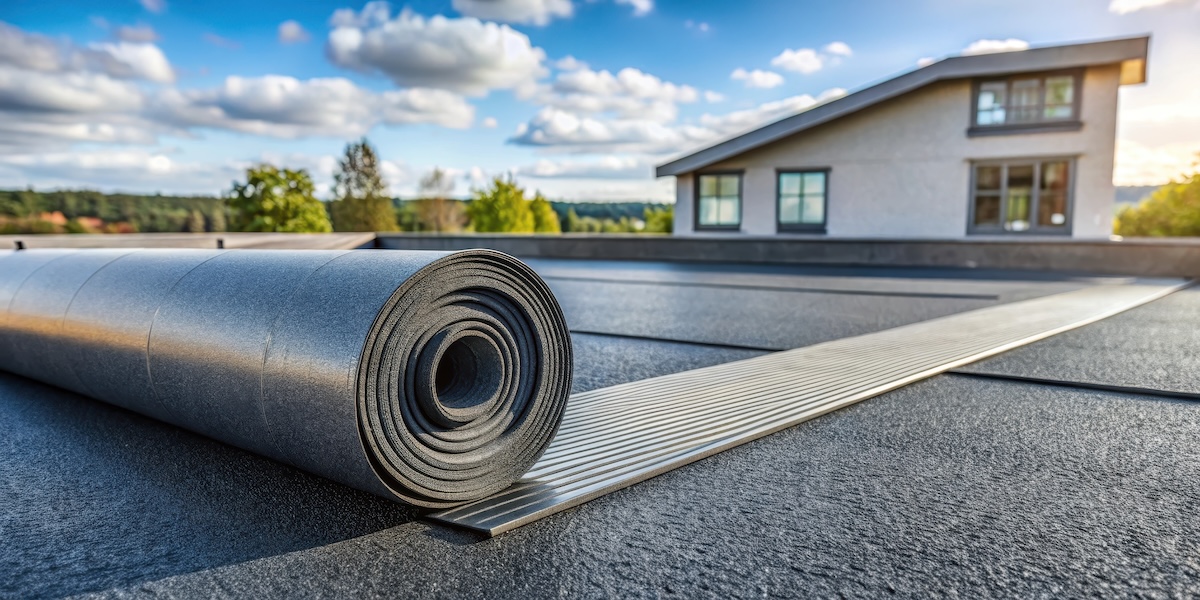
Flat and Low-Slope Roofing in Minnesota: TPO, EPDM, and Modified Bitumen
 11min Read
 Posted 3.30.2026
Flat and low-slope roofs are more common in Minnesota than homeowners realize. They appear on mid-century split-level rooftops, contemporary additions, porches and sunrooms, garages, dormers, and the vast majority of commercial, industrial, and multi-family properties. In all cases, the engineering is fundamentally different from a pitched shingle roof: water doesn’t shed by gravity alone, so the entire roof surface must be continuously waterproof. In Minnesota’s freeze-thaw climate, with winter snow loads approaching 50 psf in the metro and 60+ psf up north, the material and installation choices on a flat roof have outsize consequences. A well-detailed flat roof can last 25-35 years; a poorly installed one can fail in 5.
- Three dominant systems in Minnesota residential: TPO (single-ply thermoplastic), EPDM (single-ply rubber), and modified bitumen (torch-down or peel-stick).
- Minimum slope per IRC R905.8-R905.11 varies by material (typically 1/4″:12″ for TPO/EPDM, 1/4″:12″ for modified bitumen).
- Standing water (“ponding”) voids most manufacturer warranties — slope and drainage matter.
- Typical MN residential flat-roof cost: $18-$26 per square foot installed.
- Expect 25-35 year lifespan for TPO/EPDM; 15-25 for modified bitumen in MN.
What “Flat” Actually Means
No flat roof is truly flat. Building codes require at least 1/4 inch of slope per foot (roughly 2% grade) to drain water — often described as “1/4 in 12.” What most homeowners call a “flat roof” is technically a low-slope roof. Slopes below 2:12 (pitched roof territory) require flat-roof material systems — the shingles used on steeper roofs fail on low slopes because water moves too slowly and wind-driven rain can get beneath the exposed fasteners. IRC Section R905.8 governs the minimum slopes and material requirements for Minnesota low-slope installations.
The Three Dominant Residential Flat-Roof Systems
| System | Description | MN Lifespan | Typical Cost ($/sq ft) | ||
|---|---|---|---|---|---|
| TPO (thermoplastic polyolefin) | White single-ply membrane, heat-welded seams, mechanically fastened or adhered | 20-30 years | $20-$24 | ||
| EPDM (rubber, “rubber roof”) | Black synthetic rubber membrane, taped or glued seams, fully adhered or ballasted | 25-35 years | taped or glued seams, fully adhered or ballasted | 25-35 years | 8-$22 |
| Modified bitumen (torch-down / self-adhered) | Asphalt-based roll material, granule-surfaced, heat-welded or peel-stick | 15-25 years | granule-surfaced, heat-welded or peel-stick | 15-25 years | 8-$22 |
| PVC single-ply | Similar to TPO, heat-welded, chemical-resistant | 25-35 years | $22-$26 | ||
| Built-up roofing (BUR, “tar and gravel”) | Multiple asphalt ply layers + gravel aggregate surface | 15-25 years | Multiple asphalt ply layers + gravel aggregate surface | 15-25 years | 8-$22 |
| Liquid-applied (silicone, acrylic) | Sprayed or rolled coating, sometimes over existing roof | 10-20 years | $6-$10 |
For most Twin Cities residential flat-roof applications (porch roofs, dormers, small commercial awnings), TPO and EPDM are the dominant modern choices. TPO’s reflective white surface is popular for summer cooling. EPDM’s black surface is forgiving of installation quirks and extremely durable. Modified bitumen — the modern descendant of tar-and-gravel — is common on small residential flats and renovation-grade commercial.
TPO: The Cool White Choice
TPO membranes are thermoplastic single-ply sheets, typically 45 or 60 mil thickness, available in white, tan, or gray. Seams are heat-welded with a hot-air welding tool, creating a monolithic membrane with essentially no weak seams. TPO reflects 70-85% of solar energy, which significantly reduces summer cooling loads — a real benefit in Minnesota’s warming summers. Hail resistance is moderate (UL 2218 Class 3-4 available); wind resistance is excellent when mechanically fastened at 6-12″ on center with proper plate spacing.
Caution: early-generation TPO (pre-2010) had field performance issues — some formulations degraded at seams after 7-10 years. Modern TPO formulations are significantly improved, but choose a reputable manufacturer (GAF EverGuard, Carlisle Sure-Weld, Firestone UltraPly) and pay attention to membrane thickness (60 mil preferred over 45 mil in MN’s freeze-thaw).
EPDM: The Long-Lifespan Rubber
EPDM has the longest residential track record of the modern flat-roof systems — widely installed in North America since the 1970s, with documented 30+ year field performance when properly installed and maintained. The membrane is a synthetic rubber (ethylene propylene diene monomer), extremely flexible across temperature extremes (-40°F to 300°F), and highly resistant to UV degradation. Seam treatment is the weak point: early EPDM installations used contact-cement seams that failed over decades. Modern EPDM uses specialized seam tape or adhesive, with performance improving significantly.
Black EPDM absorbs solar heat, which is a disadvantage for summer cooling but can reduce ice dam formation at the eaves of connected pitched roof sections in winter. For Minnesota flat roofs where summer cooling is less critical than winter performance, EPDM is often preferred over TPO.
Modified Bitumen: The Asphalt Descendant
Modified bitumen is the modern version of traditional asphalt roofing, reformulated with polymer modifiers (SBS or APP) for improved flexibility and durability. It comes in rolls 3-feet wide with a granule-surfaced top layer (like a shingle), installed either by torch-down (heat-welded) or self-adhered (“peel-and-stick”) methods. Modified bitumen is popular for residential flats because the granular surface tolerates occasional foot traffic better than membranes, and the installation is visually familiar to traditional shingle roofers.
Drawbacks: shorter MN lifespan than TPO or EPDM (often 15-20 years before significant wear), and torch-down installation carries fire risk (several multifamily fires in Minnesota over the past decade have been traced to torch-down installation near combustible materials). Self-adhered modified bitumen eliminates the fire risk and is increasingly the preferred format for residential work.
Drainage: The Most Ignored Flat-Roof Design Element
Almost every flat-roof failure in Minnesota traces back to drainage. The slope may be adequate on paper but compromised by building settlement, failed insulation board, or ponding at low spots. “Ponding water” — standing water 48+ hours after a rainstorm — is explicitly excluded from most manufacturer warranties. It’s also a fast track to freeze-thaw damage: ponded water freezes, expands, stresses the membrane, and cycles repeatedly through 100+ freeze-thaw events per winter in MN.
Remediation options: tapered insulation (polyiso boards cut to provide positive slope to drains), cricket fabrication around drains and HVAC curbs, and regrading the entire deck (expensive). A good MN flat-roof contractor will evaluate slope and ponding before bidding any replacement; ignoring this step guarantees short service life.
Snow Load and MN Requirements
Minnesota Building Code requires structural design for the ground snow load applicable to the jurisdiction — typically 42-50 psf in Twin Cities metro, 60+ psf up north. Roof snow load is calculated as a multiple of ground snow load depending on exposure, slope, and geometry. On a flat or low-slope roof, snow can accumulate depths of 3-6+ feet in heavy winters, particularly where drifting occurs against walls and HVAC penthouses. The roof structure must be designed to carry this, and the roofing material must handle saturation, re-freeze cycles, and occasional roof-snow removal (shoveling). Mechanical-rated membranes and 60-mil TPO are preferred over lighter options for this reason.
Common Flat-Roof Problems in MN Homes
- Ponding water visible 48+ hours after rain — slope defect.
- Blisters or bubbles in the membrane from trapped moisture under the membrane.
- Seam separations at welded or taped joints — typically age-related or installation defect.
- Edge metal detachment where perimeter flashing has pulled free from the substrate.
- Punctures from foot traffic, ladder contact, dropped tools, or airborne debris.
- HVAC curb leaks at the transition between roof membrane and mechanical units.
- Parapet wall leaks where flashing meets walls above the roof plane.
- Ice dam migration from adjoining pitched roofs into flat-roof areas.
Repair vs. Replace Decision
| Condition | Repair Approach | Replace When |
|---|---|---|
| Isolated puncture | Patch with compatible membrane, heat-welded or adhered | If membrane is >20 years old or brittle |
| Seam failure (single seam) | Re-weld or re-tape; apply cover strip | If multiple seams are failing |
| Ponding water | Tapered insulation to re-slope; may require full replacement | If structural slope is inadequate |
| Perimeter flashing failure | Re-flash edges; replace metal trim | If deck is compromised |
| Blistering (widespread) | Cut-and-patch blisters, re-adhere or overlay | Typically signals end-of-life |
| Liquid-applied overlay (coating) | 10-year extension on existing sound membrane | Don’t coat over compromised substrate |
Liquid-Applied Coatings: Extension, Not Replacement
Silicone or acrylic liquid-applied coatings have grown popular as a cost-effective way to extend a flat roof’s useful life by 10-15 years. A coating restores UV protection, seals minor seam and edge failures, and forms a new monolithic membrane over the existing. Key caveats: the existing roof must be structurally sound (no widespread blisters, no ponding, no active leaks — coating won’t fix those). Surface prep is critical; coating over a dirty, oily, or oxidized surface will delaminate quickly. Costs run $4-$8 per sq ft — a fraction of the cost of full replacement.
Maintenance Schedule
- Spring inspection (April-May): Clear winter debris, inspect membrane condition, check drains and scuppers.
- Fall inspection (October-November): Clear leaves and organic debris before freeze; verify snow-removal path access.
- Post-storm inspection: Check for hail impacts, wind-lifted seams, flying debris punctures.
- Annual seam audit: Walk every seam; press and probe for adhesion; document findings for future reference.
- Drain cleaning (twice yearly minimum): Remove leaves, shingle seeds, and debris from drains and scuppers.
- HVAC service coordination: Protect membrane during HVAC service; repair any damage promptly.
Insurance and Flat Roofs
Flat-roof damage from sudden covered perils (hail, wind, falling trees) is typically covered under standard MN HO-3 policies and commercial equivalents. However, ponding-water damage, maintenance-related deterioration, and issues attributable to inadequate slope are generally excluded. When filing a post-storm claim, document the storm date, specific impacts visible on the membrane, and tie the damage to the weather event with NWS or NOAA records. See our MN storm damage guide for the full claim workflow.
Frequently Asked Questions
How long does a flat roof last in Minnesota?
Modern TPO and EPDM systems typically last 25-35 years with proper installation and maintenance. Modified bitumen runs 15-25 years in MN. Lifespan shortens significantly with ponding water, inadequate slope, or poor maintenance.
Which is better in Minnesota: TPO or EPDM?
Both are excellent. TPO’s white reflective surface is better for summer cooling. EPDM has the longer field track record (50+ years) and is more forgiving of installation quirks. For residential MN applications without significant summer cooling concerns, EPDM is often the preferred choice.
What does a flat roof cost in the Twin Cities?
Typical residential replacement: $18-$26 per square foot installed, depending on system (TPO, EPDM, mod-bit), thickness, insulation work, edge details, and HVAC curb complexity. A 1,000 sq ft flat section typically runs $18,000-$26,000.
Can I put a new flat roof over an old one?
Sometimes, but usually not recommended in Minnesota. Overlay creates weight load, traps moisture beneath, voids most manufacturer warranties, and hides substrate problems. Full tear-off with fresh insulation and membrane is the standard best practice.
Is ponding water really a problem?
Yes. Ponding water voids most manufacturer warranties, accelerates membrane degradation, stresses structure, and in MN freezes repeatedly through winter — a major driver of premature failure. Any pond lingering more than 48 hours requires correction.
Can I walk on my flat roof?
Yes, for inspection and occasional service, on most commercial-grade membranes. Avoid concentrated weight (ladders, equipment) and use walkway pads in any area that receives frequent foot traffic. Membrane punctures from foot traffic are a common maintenance issue.
Are flat roofs covered by homeowners insurance for hail?
Yes, generally, for sudden covered perils. Carrier coverage depends on policy specifics; some policies add roof-age depreciation schedules that affect older flat roofs more harshly. Document hail damage promptly and have a licensed roofer prepare an itemized scope.
