How Long Does Insurance Take to Pay a Roof Claim? (MN Guide)
 8min Read
 Posted 4.18.2026
Most Minnesota homeowners receive their first insurance payment on a roof claim within 2–4 weeks of filing. However, the total time from storm to cash-in-hand can range from 3 weeks to 3+ months depending on your insurer, claim complexity, supplemental negotiations, and whether your contractor finds hidden damage during the job. Understanding how the payment process works — and where it commonly gets stuck — helps you stay in control of the timeline.

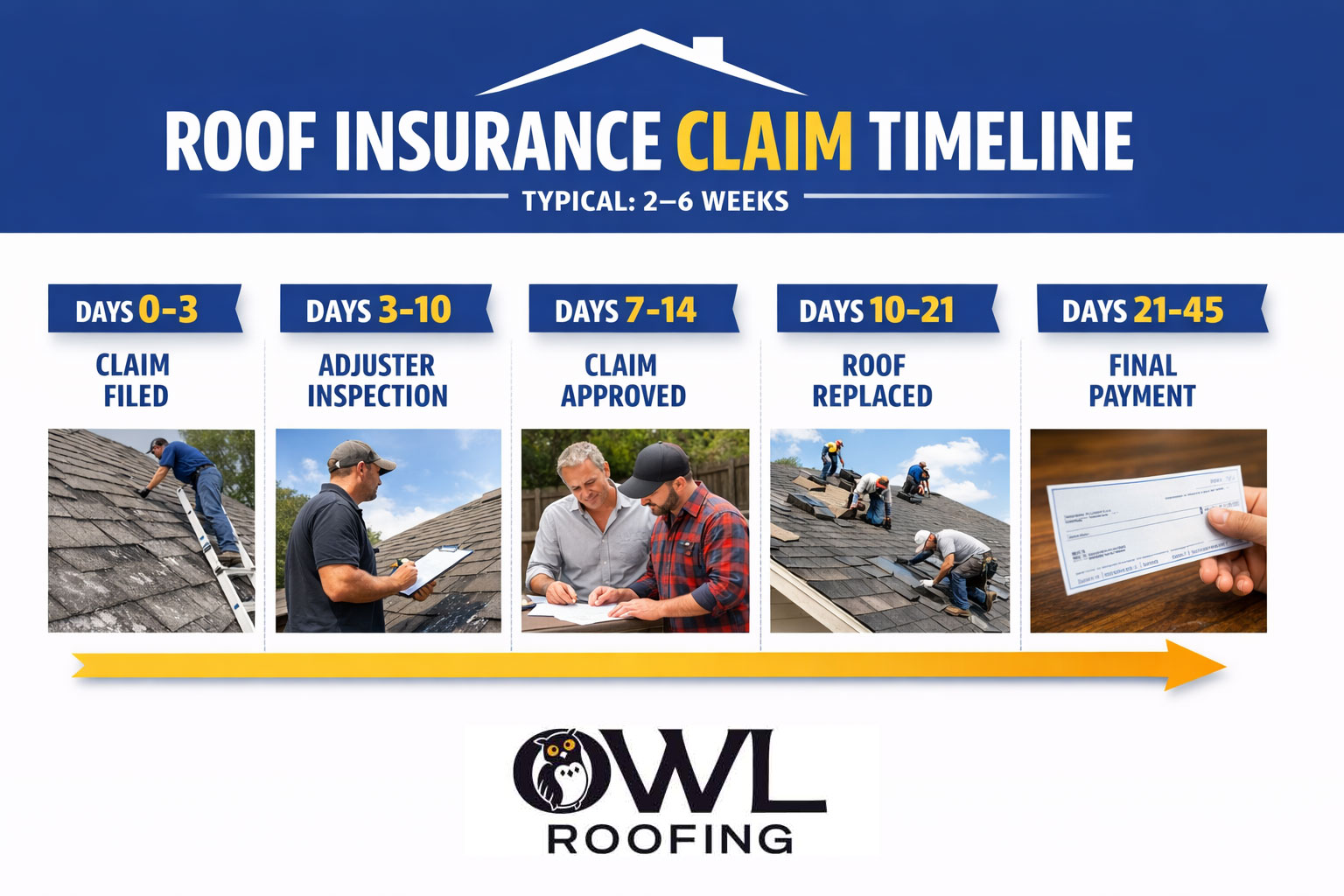
The Typical Roof Insurance Claim Payment Timeline
| Phase | Typical Duration | Notes |
|---|---|---|
| File the claim | Day 1 | File as soon as possible; MN statute of limitations is 2 years |
| Insurance adjuster visit | 5–14 days after filing | Can be in-person or virtual (drone/satellite) |
| Claim approval/denial | 3–7 days after adjuster visit | Insurer must act within 10 business days (MN Statute 72A.201) |
| First ACV payment issued | 7–14 days after approval | ACV = Actual Cash Value (replacement cost minus depreciation) |
| Roof installation complete | Varies by scheduling | Peak season (May–July) can add 2–6 weeks for scheduling |
| Supplemental claim submitted | Within 30–60 days post-install | If contractor finds additional damage during tear-off |
| Recoverable depreciation released | 7–21 days after documentation | Second check issued when replacement is complete |
What Are ACV and RCV? Understanding the Two-Payment System
Most homeowners insurance policies use a two-payment structure that confuses a lot of people:
- ACV (Actual Cash Value): The first check. This is the replacement cost of your roof minus depreciation. On a 15-year-old asphalt roof, the insurer calculates how much of the roof’s useful life has already been “used up” and deducts that amount. If your roof would cost $15,000 to replace and is 60% depreciated, your ACV check is ~$6,000.
- RCV (Replacement Cost Value): The second check — the “recoverable depreciation.” After your new roof is installed and you submit proof of completion (typically the contractor’s invoice), the insurer releases the remaining depreciation amount. In the example above, that’s the other ~$9,000.
This is why you should never pocket the ACV check and skip the replacement. The second check is often 40–60% of the total claim value, and it’s only released when the work is done. Understand more about this in our guide on whether insurance pays for full replacement or repair.
Minnesota Insurance Law: What Your Insurer Is Required to Do
Minnesota has specific statutes protecting policyholders from unreasonable claim delays. Under Minnesota Statute 72A.201, insurers must:
- Acknowledge your claim within 10 business days of receiving it
- Begin investigating within 10 business days of receiving your signed proof of loss
- Accept or deny the claim within 15 business days of receiving all required information
- Pay the approved claim amount within 5 business days of written settlement agreement
If your insurer is taking significantly longer than these timeframes at any stage, you have the right to file a complaint with the Minnesota Department of Commerce Insurance Division. In our experience, a polite reference to these statutory deadlines often resolves delays quickly.
What Causes Roof Insurance Claim Delays?
Not all delays are the insurer’s fault. Here are the most common reasons claims take longer than expected:
| Cause of Delay | Who’s Responsible | How to Fix It |
|---|---|---|
| Incomplete documentation at filing | Homeowner | File with photos, date of storm, contractor estimate |
| Adjuster backlog during storm season | Insurer | Follow up weekly; reference MN Statute 72A.201 |
| Disputed damage amount | Negotiation phase | Have your contractor provide a detailed scope; request re-inspection |
| Supplemental damage found during tear-off | Normal process | Contractor submits supplement; allow 2–4 weeks for approval |
| Missing or delayed proof of completion | Homeowner/contractor | Submit invoice and photos immediately after completion |
| Mortgage company endorsement required | Bank/lender | Contact lender early; they must co-sign checks for mortgaged properties |
The Mortgage Company Issue: Why Your Check Goes to the Bank
If you have a mortgage, your insurance check will likely be made out to both you and your mortgage lender. This surprises homeowners every storm season. The lender has a financial interest in your home and requires this to ensure the insurance money is actually used for repairs.
To release the funds:
- Contact your mortgage servicer’s insurance loss department as soon as you have an approved claim
- They will typically set up an escrow account and release funds in draws as work is completed
- Some lenders require an inspector to verify completion before releasing the final draw
- Smaller claims (typically under $10,000–$15,000 depending on lender) are often released immediately without escrow
This process can add 2–4 weeks to your timeline. Contact your lender on day one of your claim — don’t wait until the check arrives.
What Is a Supplemental Claim and How Does It Affect Payment?
A supplemental claim is filed when your contractor discovers additional damage during the tear-off that wasn’t captured in the original adjuster scope. This is extremely common — storm damage to decking, ice-and-water shield, attic insulation, and satellite mounts is often only visible once shingles are removed.
Supplemental claims add time but are legitimate and frequently approved. An experienced storm damage contractor — like Owl Roofing — will document all additional damage with photos and submit a detailed supplement to your insurer. Approval typically takes 7–21 days. We handle the entire supplement process on your behalf so you don’t have to negotiate directly with the adjuster.
How to Speed Up Your Roof Insurance Claim Payment
- File immediately after the storm — don’t wait weeks. The adjuster inspection happens faster when damage is fresh.
- Get a contractor inspection before the adjuster arrives — your contractor’s scope of damage puts you in a stronger negotiating position.
- Be present for the adjuster inspection — or have your contractor present on your behalf (Owl Roofing attends adjuster meetings for our customers as standard practice).
- Respond to insurer requests within 24 hours — delays in returning signed forms or documentation slow the clock.
- Submit proof of completion immediately after the job — the day the roof is done, send the invoice and photos to trigger the RCV release.
- Contact your mortgage company early — get the endorsement process started before the check even arrives.
Read our complete walkthrough of the claim process in our step-by-step roof insurance claim guide. Also important: in Minnesota, you have 2 years from the date of the storm to file a claim — but don’t use that as a reason to delay.
Frequently Asked Questions
- How long does insurance take to pay a roof claim? First check (ACV) typically within 2–4 weeks of filing; final check after completion, another 1–3 weeks.
- How long does an adjuster take? 5–14 days in normal season; up to 3 weeks during MN storm season peaks.
- Why two checks? First = ACV (minus depreciation). Second = depreciation released after completion.
- Does my mortgage company co-sign? Yes — contact your lender on day one of the claim to avoid delays.
- What is a supplemental claim? Additional damage found during tear-off; filed by your contractor for review by the insurer.
Don’t Navigate the Insurance Process Alone
Insurance claims are our lane. At Owl Roofing, we’ve helped hundreds of Minnesota homeowners through the full claim process — from the initial inspection and adjuster meeting to supplements, completion documentation, and final payment follow-up. We don’t just put on a roof and disappear; we stay with you through the entire process to make sure you get every dollar you’re owed.
Request your free storm damage inspection → We’ll document the damage, attend your adjuster meeting, and make sure the claim reflects the full scope of what the storm did to your roof.

Recent Articles
Explore The Blog