


How Long Does a Roof Last in Minnesota? Material-by-Material Lifespan Guide (2026)
 9min Read
 Posted 3.10.2026
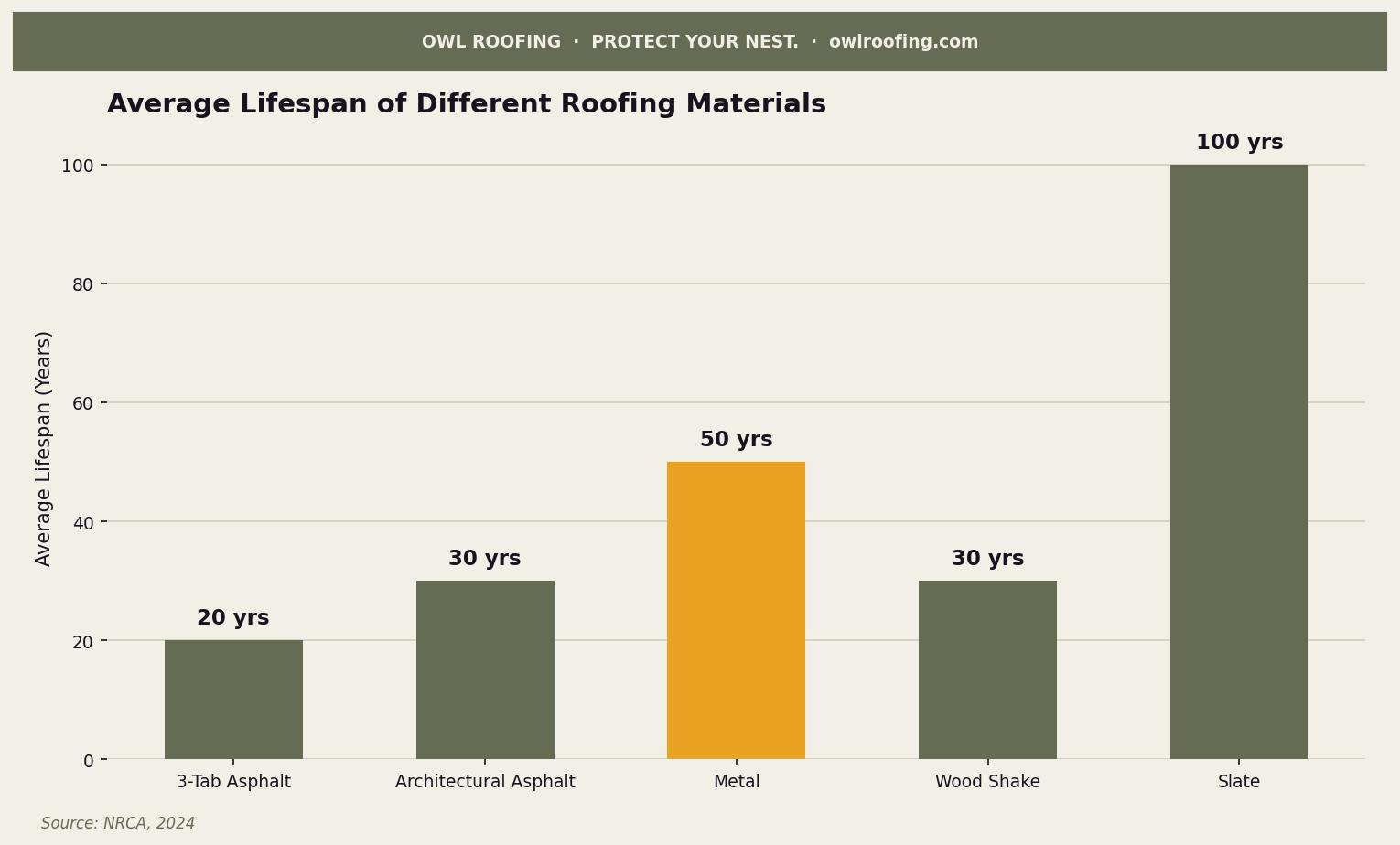
“How long will my roof last?” is the first question nearly every Minnesota homeowner asks Owl Roofing. The honest answer: it depends on the material, the install quality, your ventilation, and — because this is Minnesota — how many bad storm years it sees. This 2026 guide breaks down realistic Minnesota lifespans material-by-material, using data from the National Roofing Contractors Association, manufacturer warranty math, and our own 20+ years installing and replacing roofs in the Twin Cities.
- 3-tab asphalt: 15–18 years in MN
- Architectural asphalt: 22–27 years
- Class 4 impact-rated asphalt: 25–30 years
- Cedar shake: 25–35 years
- Standing-seam steel: 45–60+ years
- Concrete / clay tile (rare in MN): 50+ years
- Slate: 75–150 years
Why Minnesota lifespans run shorter than national averages
National averages for residential roofing assume a roof experiences between 40 and 80 freeze-thaw cycles per year. In the Twin Cities metro, NOAA’s climate record shows 60–80 freeze-thaw cycles per year with 23+ days below 0°F. Combined with the Midwest hail corridor’s averaged 8–12 hail events per summer, the stress load is measurably higher.
Three specific Minnesota factors drag life down:
- Thermal cycling fatigue — sealant strips bond and un-bond repeatedly, eventually losing adhesion.
- Hail impact history — even sub-claimable hail still degrades granule coverage, shortening life 2–5 years.
- Ice dam cycling — standing water backs up under shingles, fatigues the underlayment, and often goes undetected for years.
Detailed lifespan table — by material and quality tier
| Material | Manufacturer warranty | Realistic MN life | Common failure mode |
|---|---|---|---|
| 3-tab asphalt | 20–25 years | 15–18 years | Tab lift, granule loss, sealant failure |
| Architectural asphalt (standard) | “Lifetime” limited | 22–27 years | Granule loss, hail, thermal splitting |
| Architectural + Class 4 (impact) | “Lifetime” + SureStart | 25–30 years | Granule loss, sealant fatigue |
| Premium architectural (thicker) | “Lifetime” algae-resistant | 27–32 years | Eventual sealant fatigue |
| Synthetic slate | 50 years | 35–45 years | UV fade, fastener fatigue |
| Synthetic shake (DaVinci, CeDUR) | Lifetime limited | 40–50 years | Color fade, impact |
| Cedar shake (real) | 30–40 years | 25–35 years | Split, rot, algae — MN hard on it |
| Metal — exposed fastener | 30–45 years | 25–35 years | Fastener back-out, seal washer failure |
| Metal — standing seam | 40–60 years | 45–60+ years | Finish fade (cosmetic) |
| Concrete tile (rare in MN) | 50 years | 40–50 years | Freeze-thaw spalling |
| Clay tile | 50–100 years | 40–60 years | Freeze fracture, weight/structure |
| Natural slate | 75–150 years | 75–120 years | Flashing fails before slate |
| EPDM (flat/low-slope) | 20–30 years | 18–25 years | Seam failure, UV degradation |
| TPO (flat/low-slope) | 20–30 years | 18–25 years | Seam failure, membrane punctures |
Asphalt shingles — why “lifetime” doesn’t mean forever
Roughly 85% of Minnesota residential roofs are asphalt shingles, per ARMA market data. The word “lifetime” in manufacturer warranties is a marketing term — it typically means the roof is warranted for as long as the original buyer owns the home, prorated after 10–15 years. A GAF Timberline HDZ roof installed in 2010 with a “lifetime” warranty is typically down to minimal residual coverage by year 20.
Getting the full posted warranty requires two things: manufacturer-certified installer status (GAF Master Elite, Owens Corning Platinum, CertainTeed SELECT ShingleMaster), plus proper ventilation and use of the manufacturer’s full component system. Miss either one and you’re on the base “limited” warranty, often 25 years.
Metal roofing — why Minnesota is ideal territory
Standing-seam steel is the best-performing residential roof material in MN. With Galvalume or Kynar-coated steel, you effectively get one roof installation for the life of the home. The upfront cost (2.5–3× architectural asphalt) is offset by longevity, energy performance, and typical 15–25% insurance premium discounts on Class 4 steel systems.
| Metal roof type | MN lifespan | Relative cost |
|---|---|---|
| Exposed-fastener ag panel (barn-style) | 25–35 years | 1.5× asphalt |
| Standing seam — painted steel | 45–55 years | 2.5× asphalt |
| Standing seam — Galvalume | 50–60+ years | 2.7× asphalt |
| Standing seam — aluminum | 50+ years | 3× asphalt |
| Metal shake/shingle simulation | 40–50 years | 2.8× asphalt |
| Copper standing seam | 100+ years | 7–10× asphalt |
How each material handles Minnesota-specific threats
| Threat | Asphalt | Metal | Cedar | Synthetic |
|---|---|---|---|---|
| 1.25″ hail | Fair (Class 4: Good) | Good (dimpling cosmetic) | Fair | Excellent |
| 2″ hail | Poor to Fair | Fair (dents) | Poor | Good |
| 90 mph wind | Good w/ Class H | Excellent | Fair | Excellent |
| 120 mph wind | Fair | Excellent | Poor | Good |
| Ice dam cycling | Fair | Excellent (sheds) | Poor (rots) | Good |
| UV exposure | Fair (fades) | Good (Kynar) | Fair | Good |
| Biological (algae/moss) | Fair (AR shingles: Good) | Excellent | Poor | Excellent |
What you can do to extend your Minnesota roof life
- Get proper ventilation. Undersized attic ventilation is the #1 premature-failure driver. Target the 1:300 ratio with balanced 50/50 intake and exhaust per MN Residential Code R806. Read our ventilation guide.
- Address ice dams annually. Heat-loss prevention (insulation + air sealing) beats heat cable after-the-fact. See ice dam prevention.
- Inspect yearly. Catch pipe boot cracks, lifted ridge caps, and flashing gaps before they leak. Use the 40-point MN checklist.
- File hail claims promptly. Letting functional damage sit under a winter of ice dams turns a replaceable roof into a deck + framing repair.
- Keep gutters clean and discharging away from foundation. Fascia rot is the stealth killer of Minnesota roof edges.
Signs your Minnesota roof is approaching end-of-life
- Granules filling your gutters every rainfall
- Curled, clawed, or cupped shingle edges on south/west slopes
- Exposed shiny fiberglass mat visible from ground
- Multiple pipe boots cracked or daylight visible
- Nails backing out — causing “nail pop” stains on ceilings below
- Ice dams forming in the same eave areas every winter
- Interior staining that returns after being painted over
What Owl Roofing Customers Actually Say
Real, verified Google reviews from real customers Owl Roofing maintains a 5.0 Google rating with 30+ five-star reviews.
Noah is the real deal. After our insurance denied our roof claim and the first roofer walked away, Noah showed up the next day and said he thought he could get us a new roof. He delivered. He got us a roof covered by insurance after it had already been declined. We came up with a nickname for him: “The Roof Whisperer.”
— Tyler Moberg, verified Google review
I am an Independent Insurance Agency owner and have worked with Noah on several roof projects. The homeowners have been extremely satisfied with the quality of work and craftsmanship Noah and his crews have provided. From filing the claim to replacing the roof and cleaning up the job site, Noah and his crew are the best!
— Fred Zappa, Independent Insurance Agency Owner
We used Owl Roofing for a repair on our roof in Brooklyn Park, and I was blown away by how good they were. Every member of the team communicated well about the process. Their price transparency was super helpful. They got the work done very fast, and the team was professional and very kind.
— Matt Brown, Brooklyn Park (verified Google review)
Noah and his team are outstanding! His clear communication, professionalism, and workmanship are top-notch. I recommend Owl Roofing to all my clients, friends, and family.
— Christine Westlund, verified Google review
It didn’t feel like dealing with a big company — it felt like working with people who actually care about the homes and community in the North Oaks and Shoreview area. Great people, great communication, and really solid work.
— Cody Warren, verified Google review
Frequently asked questions
How long do asphalt shingles really last in Minnesota?
Realistic Minnesota lifespans: 15–18 years for 3-tab, 22–27 years for standard architectural, 25–30 years for Class 4 impact-rated. Warranty numbers are marketing — plan for these real-world figures.
Is a metal roof worth the cost in Minnesota?
For long-term homeowners, yes. A standing-seam steel roof outlasts 2–3 asphalt roofs, earns insurance discounts, and handles MN ice dam cycling better than any other material. Break-even typically occurs around year 25–30.
Does hail always shorten a roof’s life?
Yes, even when no claim is filed. Sub-claimable hail (under 8 impacts per test square) still displaces granules that protect the asphalt from UV. A roof that sees 3 moderate hail summers typically loses 3–5 years of life even without visible failure.
Does roof color affect lifespan in MN?
Slightly. Lighter colors run 10–15°F cooler in summer, which reduces thermal cycling stress. For Minnesota specifically, color has a smaller effect than ventilation or hail history. Pick the color you want — just pay attention to the first two factors.
Can I add years to my existing roof?
Yes. Replacing cracked pipe boots, adding attic insulation to stop ice dams, correcting ventilation, and sealing exposed nail heads can add 3–7 years. Cedar and slate roofs benefit most from ongoing maintenance; asphalt benefits less because sealant strip failure is the terminal issue.
Is a 25-year-old roof automatically bad?
Not automatically — but you’re almost certainly past the effective warranty window. Insurers often start requiring replacement at 20–25 years regardless of visual condition. A professional inspection will tell you where you actually are.
Should I replace my roof preemptively?
If your roof is 22+ years old, functionally intact, and your insurer is still renewing: no, let it ride until damage or a real end-of-life signal. If it’s 22+ years old and your carrier issued a non-renewal notice contingent on replacement: yes, replace before the policy lapses. Always get a written inspection report first.
Schedule a free Minnesota roof age and lifespan assessment with Owl Roofing at our contact page — we’ll tell you exactly where your roof stands.
