




Roof Underlayment in Minnesota: Felt, Synthetic, and Ice-and-Water Shield
 11min Read
 Posted 3.31.2026
Underlayment is the invisible layer between your roof deck and your shingles — and it’s arguably the single most important determinant of how your Minnesota roof performs over the next 25 years. Nobody looks at underlayment after the shingles are installed. No homeowner marketing their house touts “premium underlayment” as a selling point. And yet when a shingle lifts in a windstorm, when an ice dam pushes meltwater back up the roof, when a tree branch punctures a shingle tab, underlayment is what prevents a “weather event” from becoming a “water damage claim.” In Minnesota’s freeze-thaw climate, cutting corners on underlayment is one of the most expensive mistakes a homeowner or contractor can make.
- Modern best practice: synthetic underlayment over the main roof field, ice-and-water shield at eaves, valleys, and penetrations.
- MN R905.1.1 requires ice-and-water shield extending 24+ inches past the interior wall line — code minimum.
- 15# and 30# asphalt felt are being phased out in favor of synthetics; felt is obsolete for MN roofs.
- Full synthetic coverage plus R905.1.1 ice-and-water shield adds ~$500-$1,200 to a typical roof — cheap insurance.
- Ask your contractor explicitly: brand of synthetic, total ice-and-water square footage, location of shield at eaves, valleys, around skylights, pipes, chimneys.
What Underlayment Does
Underlayment is a secondary waterproof layer between the roof deck (typically 7/16″ or 1/2″ OSB or plywood) and the primary roof covering (shingles, metal, etc.). It provides a temporary weather barrier during installation, a long-term secondary barrier against wind-driven rain that gets under shingles, a decking protector against asphalt migration from shingle backs, and a slip barrier for installers on steep pitches. On an ideally installed roof, underlayment never gets wet — the shingles keep water out. In real-world scenarios, underlayment catches every drop that makes it past the primary covering.
The Three Underlayment Categories
| Category | Material | Use in MN |
|---|---|---|
| Asphalt felt (15# / 30#) | Saturated paper; traditional | Obsolete for residential MN roofs; only legacy or budget reroofs |
| Synthetic underlayment | Woven polypropylene / polyethylene | Modern standard for field coverage |
| Self-adhering ice-and-water shield | Rubberized asphalt membrane with adhesive backing | Required at eaves (MN R905.1.1), valleys, penetrations |
Why Asphalt Felt Is Obsolete
Asphalt-saturated felt (15 lb and 30 lb) has been the default roofing underlayment for over 100 years, and until recently was the code minimum. In the past decade it has been functionally displaced by synthetic underlayments, which are superior in nearly every measurable dimension. Felt’s shortcomings matter in Minnesota:
- Moisture absorption. Felt absorbs water, swells, wrinkles, and can telegraph those wrinkles into the shingle pattern.
- Low tear strength. Easily punctured during installation; torn by wind before shingles go on.
- Limited UV exposure tolerance. 30# felt typically limited to 30-day UV exposure; 15# to 14 days.
- Heavy rolls. 30# felt is physically heavy to install on steep pitches; fatigue causes installer mistakes.
- Inconsistent quality. Felt density varies widely among manufacturers; low-grade felt tears during installation.
- Becomes brittle over time. Felt’s flexibility decreases with age, reducing its effectiveness in the decades after installation.
Felt is still permitted by code and still specified on budget reroofs. But any MN roofer pitching felt underlayment in 2026 is either working to a lowest-price bid or unaware of industry standards. For a 25+ year roof asset, the $200-$500 differential to synthetic is trivial.
Synthetic Underlayment: The Modern Standard
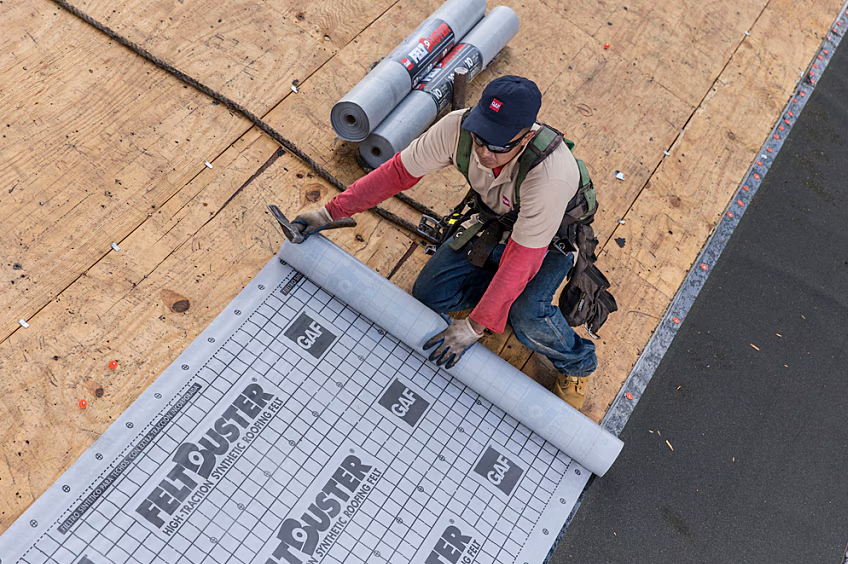
Synthetic underlayments are woven polypropylene or polyethylene sheets, typically engineered to be lightweight (one roll covers 10 squares, vs. one square for 30# felt), high-strength (tear resistance 10-15x felt), UV-resistant (90-180 day exposure rating), and walkable (non-slip surface for installer safety). They’re also water-resistant rather than simply water-impervious — they don’t absorb moisture or wrinkle.
| Synthetic Product | Manufacturer | Key Spec |
|---|---|---|
| Deck-Armor | GAF | Breathable; required for most GAF enhanced warranties |
| Tiger Paw | GAF | Non-breathable; heavier-duty alternative |
| ProArmor | Owens Corning | Matches Platinum Preferred warranty requirements |
| RoofRunner | CertainTeed | 180-day UV tolerance; 40-year material warranty |
| Rhino Roof U20 | InterWrap | Strong residential choice, 100 sq roll coverage |
| Titanium UDL | InterWrap | Higher-grade synthetic; 6-month UV exposure |
For Minnesota residential work, synthetic underlayment is the baseline. GAF Deck-Armor (with breathable construction) is commonly specified under GAF Timberline shingles and is required for most enhanced GAF warranties. The breathable formulation is preferred on unvented or vapor-retarder-compromised roof assemblies.
Ice-and-Water Shield: The Minnesota Essential
Ice-and-water shield (IWS) is a self-adhering rubberized asphalt membrane with peel-and-stick backing. When installed against the roof deck, it forms a waterproof seal around every nail or staple penetration — meaning even if water finds a way beneath the shingles, the shield prevents it from entering the structure. Minnesota adopts IRC R905.1.1, which requires ice-and-water shield installed from the eave edge up the slope to a point at least 24 inches past the interior wall line of the exterior wall — the code minimum.
What homeowners often don’t realize: 24 inches past the wall is the floor, not the ceiling. For homes with deep overhangs (anything more than 6-inch eaves), code-compliant IWS placement requires more than one course of shield. For homes with low-slope sections, extra IWS is essential. For roof architectural features prone to snow accumulation (porch roofs connecting to a main roof, dormer junctions), additional IWS coverage significantly reduces leak risk.
Where Else Ice-and-Water Shield Belongs
- Valleys. Full IWS coverage down the centerline of every valley, extending 18 inches on either side.
- Around all penetrations. IWS surrounding plumbing stacks, bath vents, skylights, and chimney bases — 12+ inches in every direction.
- At sidewall-roof junctions. Where a dormer or upper-story wall meets a lower-roof plane.
- At rake edges on exposed sides. Homes with severe wind exposure can benefit from IWS along rakes.
- Low-slope sections. Any roof section below 4:12 pitch should have full IWS coverage, not just the eave strip.
- Under metal flashings. IWS behind every chimney, skylight, and sidewall flashing ensures water that gets behind the metal still can’t penetrate.
How Much Ice-and-Water Shield Should You Have?
A typical 2,000 sq ft Twin Cities home with moderate eave depth uses 400-700 square feet of ice-and-water shield on a code-compliant reroof. Homes with deep eaves, complex roof geometry, or many penetrations can exceed 1,000 square feet. When comparing contractor estimates, ask each for the total IWS square footage, and specifically where it will be installed. A suspiciously low IWS line item often reveals a bid that’s shortchanging code compliance.
Common Underlayment Brands
| IWS Product | Manufacturer | Thickness / Rating |
|---|---|---|
| WeatherWatch | GAF | Granule-surfaced; fiberglass-reinforced |
| StormGuard | GAF | Film-surfaced; smoother for flashing applications |
| WeatherLock G | Owens Corning | Granule-surfaced; standard choice under OC shingles |
| WinterGuard | CertainTeed | Multiple variants for different substrates |
| Grace Ice & Water Shield | GCP Applied Technologies | Industry reference; high-performance |
| Blueskin | Henry | Premium alternative; often used on commercial |
Underlayment and Manufacturer Warranties
Most shingle manufacturer enhanced warranties — GAF Golden Pledge, Owens Corning Platinum Protection, CertainTeed SureStart Plus — require manufacturer-matched underlayment. Using third-party underlayment under GAF shingles, for example, makes the system ineligible for the 50-year non-prorated warranty tier. This detail matters: an enhanced warranty can be worth $5,000-$15,000 in future service; saving $200 by using a generic underlayment often voids that value.
When hiring a licensed Minnesota roofing contractor, confirm the underlayment and IWS brands they plan to use, and ensure those products match the shingle manufacturer’s specifications for whatever warranty tier you’re pursuing.
Synthetic Underlayment for Metal Roofs
Metal roofs require high-temperature-rated synthetic underlayment (rated for 240°F+ service) because metal surfaces reach much higher surface temperatures than asphalt shingles in summer. Standard residential synthetic can degrade under this heat load. Products like GAF Deck-Armor HT or InterWrap Titanium UDL-30 are formulated for metal applications. Standard 15#/30# felt fails rapidly under metal and should never be used.
Code Compliance Checklist
- Ice-and-water shield installed at eaves, extending at least 24 inches past the interior wall line (MN R905.1.1).
- IWS in all valleys, full width down centerline.
- IWS around all penetrations, 12+ inches in every direction.
- Synthetic underlayment over the remaining roof deck (not felt).
- Underlayment overlapped correctly — top course over bottom course, sufficient side laps per manufacturer specs.
- Underlayment fastened appropriately — cap nails or cap staples, not bare staples that can pull through.
- Shingles installed within the underlayment manufacturer’s UV-exposure window (synthetic: 90-180 days; felt: 14-30 days).
- Manufacturer-matched underlayment used if pursuing enhanced warranty tier.
What Owl Roofing Customers Actually Say
Real, verified Google reviews from real customers Owl Roofing maintains a 5.0 Google rating with 30+ five-star reviews.
Noah is the real deal. After our insurance denied our roof claim and the first roofer walked away, Noah showed up the next day and said he thought he could get us a new roof. He delivered. He got us a roof covered by insurance after it had already been declined. We came up with a nickname for him: “The Roof Whisperer.”
— Tyler Moberg, verified Google review
I am an Independent Insurance Agency owner and have worked with Noah on several roof projects. The homeowners have been extremely satisfied with the quality of work and craftsmanship Noah and his crews have provided. From filing the claim to replacing the roof and cleaning up the job site, Noah and his crew are the best!
— Fred Zappa, Independent Insurance Agency Owner
We used Owl Roofing for a repair on our roof in Brooklyn Park, and I was blown away by how good they were. Every member of the team communicated well about the process. Their price transparency was super helpful. They got the work done very fast, and the team was professional and very kind.
— Matt Brown, Brooklyn Park (verified Google review)
Noah and his team are outstanding! His clear communication, professionalism, and workmanship are top-notch. I recommend Owl Roofing to all my clients, friends, and family.
— Christine Westlund, verified Google review
It didn’t feel like dealing with a big company — it felt like working with people who actually care about the homes and community in the North Oaks and Shoreview area. Great people, great communication, and really solid work.
— Cody Warren, verified Google review
Frequently Asked Questions
Does my Minnesota roof need ice-and-water shield?
Yes, by code. MN R905.1.1 requires ice-and-water shield extending at least 24 inches past the interior wall line at all eaves. Additional coverage in valleys, around penetrations, and at sidewall junctions is strongly recommended best practice.
Should I use felt or synthetic underlayment?
Synthetic. Felt is obsolete for modern Minnesota residential roofs — synthetics are dramatically superior in tear strength, water resistance, UV tolerance, and installer safety. The cost differential is minor ($200-$500 on a typical roof) and almost always worth it.
Can underlayment be exposed to weather before shingles?
Only within its UV-exposure rating. Synthetic typically 90-180 days; felt typically 14-30 days; IWS typically 30-90 days. Exposure beyond the rating accelerates degradation. Contractors should stage work to minimize unprotected exposure.
How much ice-and-water shield should I have?
A typical 2,000 sq ft Twin Cities home uses 400-700 sq ft of ice-and-water shield. Deep-eave or complex-geometry homes can exceed 1,000 sq ft. Ask your contractor to quantify the IWS total and placement in the written estimate.
Does underlayment affect my shingle warranty?
Yes. Most manufacturer enhanced warranty tiers require manufacturer-matched or manufacturer-approved underlayment. Using unapproved products can void the 50-year non-prorated warranty and leave you with the standard prorated tier instead.
Is synthetic underlayment breathable?
Some synthetics are vapor-permeable (GAF Deck-Armor, for example); others are vapor-impermeable. Breathable options help manage attic moisture on certain roof assemblies. Ask your contractor which type is appropriate for your specific roof construction.
Can I install ice-and-water shield as the entire underlayment?
Technically yes — some contractors do this for high-risk or low-slope sections. It’s expensive (IWS is 3-5x the cost of synthetic underlayment per square foot) and usually not necessary on properly sloped roofs. Targeted placement at vulnerable locations is more cost-effective.
