


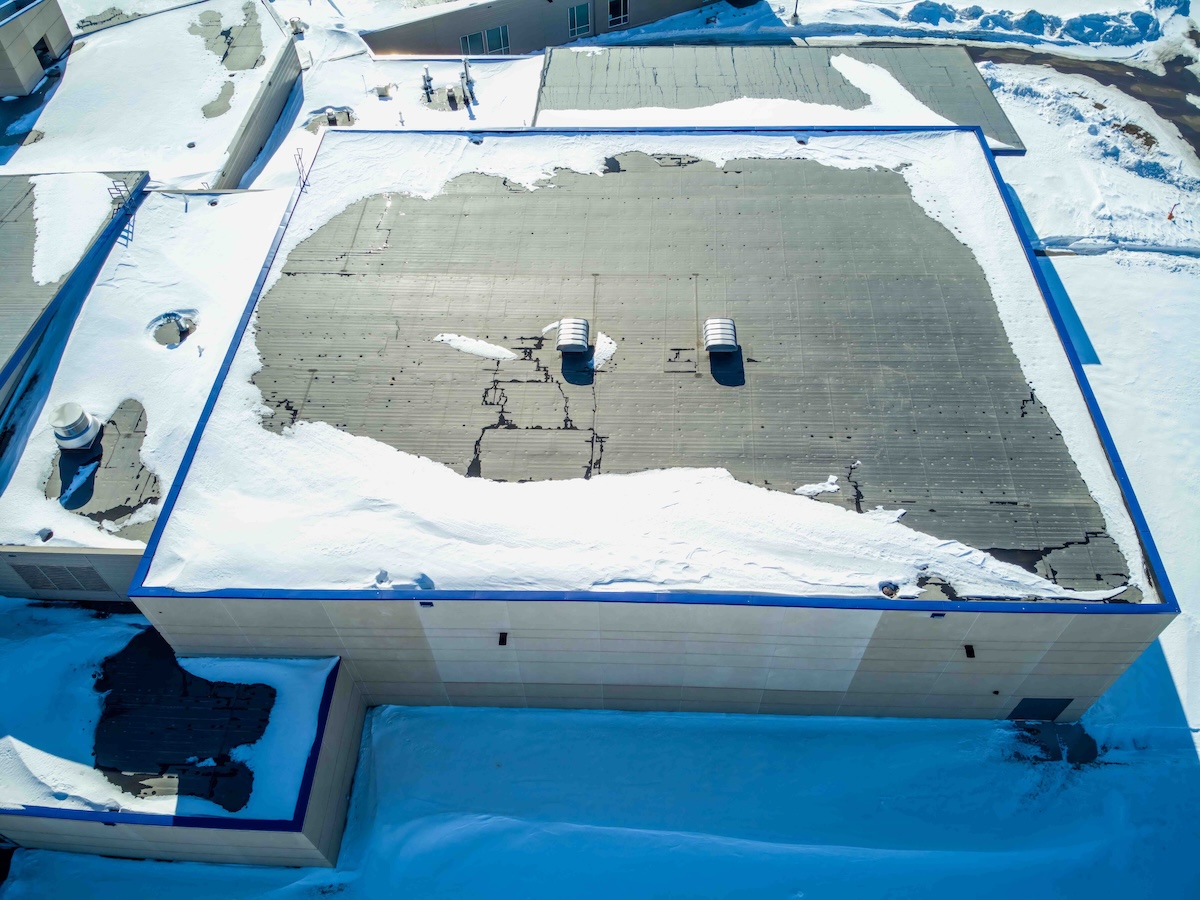
Spray Polyurethane Foam (SPF) Roofing Explained for Flat and Low-Slope Roofs
 9min Read
 Posted 12.26.2025
Quick answer: Spray Polyurethane Foam (SPF) roofing is a liquid-applied, seamless roofing system sprayed directly onto a flat or low-slope roof deck, where it expands and cures into a rigid foam that functions simultaneously as thermal insulation, an air and vapor barrier, and — once covered with a protective topcoat — a fully waterproof roof surface, all in a single integrated system. According to the Spray Polyurethane Foam Alliance (SPFA), the industry’s own trade association, SPF roofing is specifically valued on flat and low-slope commercial roofs because it creates a continuous, seamless, fully-adhered membrane that resists the ponding-water-related leaks that seam-based roofing systems can be more vulnerable to, while also being genuinely lightweight compared to many heavier roofing system alternatives — a real advantage when structural load capacity is a design consideration.
How SPF Is Actually Applied and Cures On-Site
SPF roofing installation involves combining two liquid chemical components — an isocyanate and a polyol resin — which are heated and pumped in a precisely controlled ratio (typically close to 1:1) through a plural-component proportioning system to a spray gun, where the two components mix and are applied directly onto the prepared roof deck. Upon contact, these two components react exothermically (releasing heat as part of the chemical reaction), expanding to roughly 30 times their original liquid volume within just seconds, and curing rapidly into a rigid, closed-cell foam structure. This cured foam bonds to the roof substrate both chemically and mechanically without requiring any separate adhesive layer, creating a genuinely continuous, fully-adhered foam layer across the entire roof surface — a meaningfully different installation approach compared to the mechanically fastened or adhered sheet-based membrane systems covered in our companion pieces on EPDM and built-up roofing.
How SPF Combines Insulation and Waterproofing in One Integrated System
Once the sprayed foam has cured, a protective topcoat — typically an elastomeric coating, often incorporating a granule or aggregate surfacing layer — is applied over the entire foam surface, generally within hours of the foam curing to protect it before significant UV or weather exposure can degrade the unprotected foam. SPFA’s own technical guidance describes this protective coating as specifically inhibiting moisture vapor transmission while also providing UV and general weather protection, fire resistance, and the reflective surface properties relevant to the energy-efficiency and cool-roof principles covered in our companion pieces on roof color and CRRC ratings. This combination — rigid, insulating foam beneath a weatherable, waterproof protective coating — is exactly what allows SPF to function as a genuinely integrated insulation-and-waterproofing system rather than requiring separate, distinct insulation and waterproofing layers the way many traditional low-slope roofing systems do.
The Recoat Cycle: SPF’s Defining Maintenance Requirement
SPF roofing’s maintenance profile differs meaningfully from most other roofing systems in a way that’s worth understanding clearly: it’s specifically the protective topcoat, not the underlying foam itself, that wears and requires periodic renewal over the roof’s service life. SPFA recommends regular inspections — commonly annual, with some guidance suggesting twice-yearly inspection — specifically to monitor the coating’s condition, and recoating is typically needed somewhere in a range of every 5 to 20 years, with the actual interval depending considerably on the specific climate, the particular coating type used, and the total coating thickness originally applied. This recoat-cycle maintenance model is a genuinely different long-term maintenance approach compared to a traditional roofing system that’s simply replaced wholesale once it reaches the end of its service life — with SPF roofing, proper, timely recoating can extend the underlying foam’s functional service life very significantly, since the foam itself, when properly protected by an intact coating, doesn’t degrade the way an unprotected or improperly maintained coating eventually would.
Realistic Lifespan Expectations With Proper Maintenance
SPFA’s own guidance states that an SPF roof, when regularly inspected and recoated on that 5-to-20-year cycle described above, can potentially last the lifetime of the building it’s installed on — a genuinely notable claim among roofing system types, reflecting how thoroughly SPF’s long-term performance depends on ongoing maintenance discipline rather than simply degrading toward an inevitable, fixed replacement date the way some other roofing systems do. More conservative industry guidance cites 20 or more years as a reasonable baseline expectation, with 40 or more years achievable specifically through diligent, consistent recoating and inspection practice over the roof’s service life — meaning the realistic lifespan a specific SPF roof actually achieves depends considerably on how consistently its owner actually follows through on the recoat-cycle maintenance the system requires, rather than being a fixed, predetermined figure independent of maintenance practice.
Where SPF Is the Right Call vs. Where a Membrane System Is a Better Fit
SPF roofing’s particular strengths — a genuinely seamless, fully-adhered surface, integrated insulation and waterproofing in one system, and comparatively light weight — make it a particularly strong fit for flat or low-slope commercial roofs with complex geometry involving numerous penetrations, drains, or irregular surface features, since SPF’s liquid-applied nature allows it to conform continuously around these complex details without the seam and flashing challenges a sheet-based membrane system would face at each individual penetration point. SPF can also be a particularly good fit for roof recover projects, where adding a new SPF layer over an existing, structurally sound roof surface can avoid the cost and disruption of a full tear-off. Conversely, a traditional single-ply membrane system like EPDM or TPO (covered in our companion pieces) may be a better fit for a simpler, more uniform roof geometry where the recoat-cycle maintenance commitment SPF requires isn’t something the building owner wants to take on, or in situations where a specific membrane product’s particular performance characteristics (a specific reflectivity rating, a specific fire rating, or compatibility with an existing roof assembly) make it the more straightforward, well-established choice for that particular project’s specific requirements.
Why Ongoing Owner Commitment Matters More With SPF Than With Some Other Roofing Systems
A building owner considering SPF roofing should understand clearly, before committing to the system, that its favorable long-term lifespan and performance depend genuinely on maintaining the recoat-cycle discipline described above — an SPF roof that’s installed correctly but then neglected, without the periodic recoating its protective topcoat requires, risks the underlying foam becoming exposed to UV and weather degradation considerably sooner than a properly maintained system would experience. This makes SPF roofing a genuinely good fit specifically for building owners prepared to commit to that ongoing inspection and recoating discipline over the roof’s service life, and a potentially less ideal fit for an owner seeking a more genuinely “install and largely forget” roofing solution, even though SPF’s upfront installation and total lifetime cost can compare quite favorably to alternative systems when that maintenance commitment is actually followed through consistently.
Why SPF’s Application Method Requires Specifically Trained, Certified Applicators
Because SPF’s performance depends so heavily on precise chemical ratios, correct ambient temperature and humidity conditions during application, and proper spray technique to achieve consistent foam thickness and density across the entire roof surface, SPFA and equipment manufacturers generally emphasize the importance of using specifically trained, certified applicators for this work rather than treating it as a roofing technique any general contractor can pick up without specialized training. An improperly applied SPF roof — with inconsistent thickness, incorrect chemical ratios producing foam that doesn’t achieve its intended density and insulating properties, or coating applied incorrectly relative to the foam’s cure state — can perform considerably below the system’s genuine potential, making applicator qualification and experience a particularly important factor for a building owner to verify before committing to an SPF roofing project.
Other Questions People Ask
Can SPF roofing be applied over an existing roof without a full tear-off?
Yes, in many cases — SPF’s ability to conform continuously over an existing, structurally sound roof surface is one of its genuine practical advantages for recover projects, though the existing roof’s condition and any moisture already trapped beneath it need proper assessment before proceeding with an SPF recover application.
Does SPF roofing work on steep-slope residential roofs?
SPF is used almost exclusively on flat and low-slope commercial and industrial roofs rather than steep-slope residential applications, since the specific installation and performance advantages it offers are most relevant to the flat and low-slope roofing challenges (ponding water, complex penetrations) that steep-slope residential shingle roofing generally doesn’t face in the same way.
How does SPF roofing cost compare to traditional single-ply membrane systems?
Upfront installation costs are generally comparable to or sometimes higher than traditional membrane systems, but SPF’s combined insulation-and-waterproofing function and potential for a very long total service life with proper recoating can make its total lifetime cost competitive, particularly on complex roof geometries where a membrane system’s installation cost would otherwise be pushed up by extensive detail work.
People Also Ask
What is spray polyurethane foam roofing?
A liquid-applied, seamless roofing system sprayed directly onto a roof deck, expanding into rigid foam that provides insulation, then covered with a protective, waterproof topcoat — see the full explanation above.
How does SPF roofing work on a flat roof?
The sprayed foam creates a continuous, fully-adhered layer that conforms to the roof’s actual geometry, including complex penetrations and drainage details, resisting ponding-water leaks that seam-based systems can be more vulnerable to.
How long does SPF roofing last?
With proper maintenance and recoating on a typical 5-to-20-year cycle, SPFA states an SPF roof can potentially last the lifetime of the building, with more conservative estimates citing 20-plus years as a baseline and 40-plus years achievable with diligent maintenance.
Sources
- Spray Polyurethane Foam Alliance (SPFA), commercial roofing and installation/maintenance technical resources
SPFA’s detailed technical maintenance manuals (SPFA-127) and coating renewal guidance (SPFA-122) are members-only publications this page’s research could not directly access; guidance here is drawn from SPFA’s publicly available resources referencing that underlying technical documentation. Last updated September 2026.
