


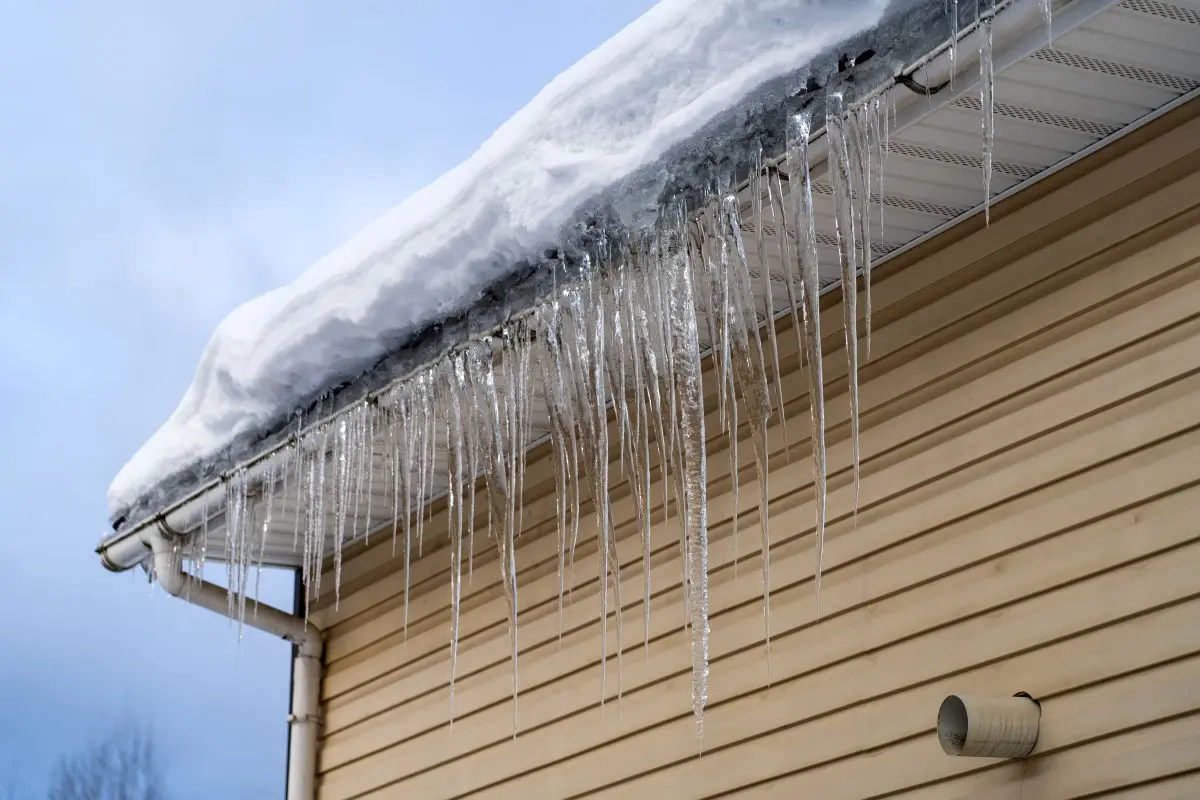
Ice Dam Prevention in Minnesota: Insulation, Ventilation, and Code
 14min Read
 Posted 3.23.2026
🦉 Attic Insulation R-Value Calculator
See how your attic stacks up against Minnesota’s R-49 requirement.
Minnesota energy code requires R-49 for attics (R-60 is the DOE recommendation for our climate zone). “Inches to add” assumes blown cellulose at ~R-3.5 per inch on top of what’s there. Compressed, wet, or gappy insulation performs below these numbers — and under-insulated attics are a leading cause of ice dams.
Ask About Insulation With Your Free Inspection →Every Minnesota winter, homeowners watch icicles form along their eaves and wonder whether they’re looking at a cozy holiday postcard or the start of a $15,000 insurance claim. Most of the time, it’s the second one. Ice dams — the ridges of ice that form along unheated eaves while snow melts higher up the roof — are the single most expensive preventable winter damage mode in the state. The Insurance Institute for Business & Home Safety estimates ice dams cause hundreds of millions of dollars in damage to Upper Midwest homes every winter, the vast majority of which is traceable to three easily-addressed factors: attic insulation, attic ventilation, and ice-and-water shield installation.
- Ice dams form because a warm attic melts snow, which re-freezes at the cold eave. The fix is keeping the attic cold and dry.
- Seal attic bypasses (recessed lights, plumbing, bath fans) before adding insulation.
- Insulate to R-49 or R-60 (MN climate zone 6-7 code: R-49 minimum, R-60 recommended).
- Balanced ventilation (1:300 net free area, 50-60% intake/40-50% exhaust per MN R806).
- Install ice-and-water shield 24+ inches past the interior wall line per MN R905.1.1 (the code minimum; deeper eaves need more).
What Actually Causes an Ice Dam
An ice dam is a downstream symptom of a warm attic. The physics are simple and consistent: warm air rises from the heated living space through gaps in the ceiling plane (recessed lights, HVAC penetrations, plumbing chases, pull-down attic stairs, bath fans, chimney chases, interior wall top plates). That warm air heats the underside of the roof deck. The roof deck warms the snow sitting on the shingles. Meltwater trickles down the roof. When it reaches the overhang — where there’s no heated living space below — the deck is cold again, and the meltwater re-freezes. Over hours and days, a dam of ice grows along the eave. Behind the dam, more meltwater ponds. Eventually it finds a way under the shingles, through the roof deck, and into the ceilings and exterior walls below.
What this physical model makes clear is that fixing ice dams is not about the shingles. It’s about breaking the chain that leads to a warm attic deck. The three levers are insulation, air sealing, and ventilation. Fail any one of them and dams tend to form in cold snaps. Get all three right and most Minnesota roofs stay ice-dam-free even through February subzero stretches.
Minnesota Climate Zone and Insulation Requirements
The International Energy Conservation Code (IECC), which Minnesota adopts via the MN Energy Code, divides the US into climate zones. Most of Minnesota falls in Zone 6 (southern half) or Zone 7 (northern half). Both zones have stringent attic insulation requirements — the current code minimum is R-49 for retrofits and new builds alike. Most energy auditors and roofers recommend going to R-60 if you have the headroom, particularly in homes with vaulted or cathedral ceilings where attic depth is tight.
| MN Climate Zone | Typical Area | Code Minimum Attic R-Value | Recommended Retrofit |
|---|---|---|---|
| Zone 6 | Southern 2/3 (metro, Rochester, St. Cloud) | R-49 | R-60 blown cellulose or fiberglass |
| Zone 7 | Northern 1/3 (Duluth, Iron Range, Brainerd lakes) | R-49 | R-60 minimum, R-75 aggressive |
| Cathedral ceilings (both zones) | Vaulted interior spaces | R-38 (or R-30+ with continuous insulation) | Closed-cell spray foam for air seal + insulation |
Step 1: Air Seal the Attic Bypass Points
Before insulating, seal the leaks. Research from the Minnesota Department of Commerce and the Department of Energy consistently shows that air leakage causes more heat loss than thermal conduction in most retrofit scenarios — meaning a leaky, poorly sealed ceiling with R-60 insulation can underperform a well-sealed ceiling with R-38. Key bypass points to seal: recessed can lights (use IC-rated sealed fixtures or airtight covers), plumbing stacks (fire-rated caulk or foam), bath fan housings, HVAC duct boots, electrical chases, pull-down attic stair covers, chimney chases (metal flashing plus high-temp sealant), and the top plates of interior partition walls.
Step 2: Insulate to Code (Or Better)
Once sealed, insulate. Blown-in cellulose and loose-fill fiberglass are the two most common approaches in Minnesota retrofits. Both work; the choice comes down to cost, application, and settling characteristics.
| Insulation Type | R-Value per Inch | Depth for R-49 | Notes for MN |
|---|---|---|---|
| Loose-fill cellulose | R-3.2 to R-3.8 | ~14 inches | Good air sealing, best value; heavier so needs truss support check |
| Loose-fill fiberglass | R-2.2 to R-2.7 | ~18-22 inches | Lighter, but settles less; more volume for same R |
| Closed-cell spray foam | R-6 to R-7 | ~7-8 inches | Best for rim joists, knee walls, cathedral ceilings; air seal + insulation in one step |
| Mineral wool batts | R-3.7 to R-4.2 | ~12 inches | Fire-resistant, good option for knee walls and attic conversions |
Step 3: Balance the Ventilation
MN building code R806 requires net free ventilation area of 1:300 of the attic floor area (or 1:150 without a vapor retarder). Code also requires that ventilation be balanced: 40-50% of the net free area comes from ridge or roof-mounted exhaust vents, and 50-60% comes from soffit/intake vents. The balanced flow pulls cold outside air in at the soffits, moves it up the underside of the roof deck through a clear air channel, and expels moisture and heat at the ridge.
Two failure modes are extremely common in Minnesota retrofits: blocked soffits (insulation crammed into the eave, blocking intake airflow — fixed with baffles or chutes) and mismatched ventilation (high-volume power attic fans or gable vents pulling conditioned air from the house instead of the soffits). Either defect renders the ventilation system effectively non-functional and contributes directly to ice dam formation. For a deeper dive, see our guide on MN attic ventilation code and balanced airflow.
Step 4: Ice-and-Water Shield Installation to MN R905.1.1
Minnesota’s adoption of IRC Section R905.1.1 requires a self-adhering ice-and-water protection membrane — a rubberized asphalt sheet — installed from the eave edge up the slope to a point at least 24 inches past the interior wall line of the exterior wall. That’s the code minimum, and it’s been the minimum for over a decade. For homes with deep overhangs, low-slope roof sections, or long-eave layouts, the code-compliant length may be significantly more than 24 inches past the wall.
Ice-and-water shield serves as the last-line defense against water driven back up the roof by an ice dam. If meltwater finds its way under the shingles at the eave, it hits the self-adhering membrane and stays out of the structure. Without that membrane — or with a membrane too short to cover the heated interior — water enters the ceilings and walls below, and you have an insurance claim.
Ice Dam Prevention Cost and ROI
| Upgrade | Typical Twin Cities Cost | Energy Savings | Ice Dam Risk Reduction |
|---|---|---|---|
| Attic air sealing (bypass treatment) | $500 – $2,000 | 10-20% heating bill | Significant |
| Attic insulation upgrade R-30 → R-60 | $1,500 – $4,000 | 15-25% heating bill | Significant |
| Ridge vent + soffit intake rebalancing | $800 – $2,500 | Minor cooling savings | Moderate-significant |
| Full R905.1.1 ice-and-water shield upgrade (done at roof replacement) | $600 – $1,500 incremental | None direct | Last-line defense; very significant |
| Heated cable systems (eaves) | $1,000 – $3,500 | Adds to energy cost | Reactive; doesn’t fix root cause |
Heated Cables: Useful Last Resort, Not a Fix
Heated roof cables (the zig-zag cables homeowners sometimes install along eaves) can reduce ice dam formation but don’t address the underlying warm-attic cause. They add to your electricity bill, require annual inspection, and typically last 3-10 years before the heating element fails. Professional consensus in Minnesota is that heated cables are a reasonable last-resort for homes where insulation and ventilation fixes are structurally impossible (like certain vaulted-ceiling mid-century designs), but they’re not a substitute for the insulation/ventilation/R905.1.1 trio.
When Ice Dams Have Already Formed
If dams have formed on your roof this winter, don’t climb up and try to chip them off. Two things typically go wrong: the homeowner falls (every MN winter sees multiple serious injuries and deaths from this), or the homeowner damages the shingles trying to hack through the ice, creating a new leak path that surfaces in spring. Safer options:
- Roof rake the snow off the lower 4-6 feet of roof from ground level. Removing the snow reservoir behind the dam slows meltwater accumulation.
- Hire a professional steam removal service. Low-pressure steam melts dams without damaging shingles. Typical MN cost is $300-$800 per service call.
- Do not use salt or ice melt on the roof. Chlorides corrode metal flashings, gutters, and shingle granule binders.
- Do not use axes, hammers, or shovels on roof ice. This is the #1 cause of DIY-created roof leaks after winter.
After the winter ends, schedule a professional roof inspection to document any shingle damage caused by the dam or attempted removal. If water intrusion occurred inside the home, file the insurance claim promptly and — whenever possible — pair the repair work with a permanent fix to the underlying insulation and ventilation deficiencies.
Planning for Next Winter: The Off-Season Checklist
- Request a blower-door test or comprehensive attic inspection from an energy auditor or roofing contractor. Identify bypass leaks.
- Seal bypasses (caulk, foam, fire-rated sealant on chimney chases).
- Top up insulation to R-49 minimum, R-60 target. Measure actual depth, not stated R-value.
- Verify baffles are installed at every rafter bay to keep soffit intakes unobstructed.
- Measure and balance ridge/soffit ventilation ratio. Disable or remove powered attic fans that pull conditioned air from the house.
- If you’re already considering a roof replacement, schedule it for summer and ensure R905.1.1 ice-and-water shield is extended past interior wall — 36-48 inches is smart for deep-eave homes.
- Install a flexible roof rake (24-foot telescoping) for manual snow removal in the first winter after the upgrade — a belt-and-suspenders backup.
Insurance Considerations for Ice Dam Damage
Most Minnesota HO-3 homeowners policies cover ice dam damage as a sudden water-damage event. Coverage may be reduced or excluded if the carrier’s investigation concludes the damage resulted from long-term maintenance neglect (a leaky roof, failed flashings, obvious prior staining). Documentation matters. When filing an ice-dam claim, photograph the dam formation itself, the interior water stains on the day they appear, the eave area, and — if possible — your insulation depth and ventilation configuration. A licensed MN roofer can prepare a written scope and supplement that ties the damage specifically to a weather event and argues for full coverage.
Frequently Asked Questions
What R-value of insulation prevents ice dams?
There’s no single R-value that guarantees ice dam prevention; it’s the combination of air sealing, insulation, and ventilation. That said, Minnesota’s code minimum of R-49 (with R-60 recommended) is the right target. Even R-75 won’t prevent dams if the attic is leaky or poorly ventilated.
How do heated cables compare to insulation upgrades?
Heated cables are reactive; insulation and ventilation upgrades are preventive. Cables can buy 3-10 years of reduced dam formation, but they cost money to run and don’t address root causes. Most professionals recommend insulation/ventilation first, cables only for structurally limited cases.
Can ice-and-water shield alone prevent ice dams?
No. Ice-and-water shield prevents leaks from an ice dam, but dams will still form if the attic is warm. Think of R905.1.1 shield as a last-line defense — it protects the interior if the dam forms, but doesn’t stop dam formation itself.
Why does my neighbor’s roof have no ice dams but mine does?
Attic performance. Air sealing, insulation depth, and ventilation balance vary house to house. Even two identical-looking 1980s ramblers can have dramatically different attic conditions depending on what’s been done (or not done) over the decades.
Should I close the attic soffit vents in winter to keep the attic warmer?
No — doing the opposite of what’s required. A cold attic prevents ice dams. Closing vents makes the attic warmer, which accelerates dam formation. Soffit vents should be open and unobstructed year-round.
Does a metal roof prevent ice dams?
Metal sheds snow more readily than shingles, reducing meltwater accumulation — but a warm attic will still produce ice dams on a metal roof. Metal helps, but doesn’t eliminate the need for attic air sealing, insulation, and balanced ventilation.
Are ice dams covered by homeowners insurance in Minnesota?
Generally yes, under most HO-3 policies, as a sudden and accidental water-damage event. Coverage may be limited if the carrier concludes the damage resulted from long-term neglect. Document the event promptly and consider engaging a local roofer to help prepare the claim.
