

Hidden Costs of a Minnesota Reroof: 8 Items That Hit Your Budget
 11min Read
 Posted 5.02.2026
🦉 Roof Replacement Cost Calculator
Ballpark your Minnesota roof replacement cost by size, material & complexity.
Ballpark estimate for the Twin Cities market — includes tear-off, materials & labor for a typical single-layer replacement. Decking repairs, permits, and code items (like ice & water shield coverage) can shift the final number. The only way to know for sure is a free inspection with real measurements.
Price My Roof — Free Estimate →The bid your contractor delivers shows what they’re going to charge for the work they expect to do. What it doesn’t show is what’ll cost extra if conditions on your roof differ from their initial walk — and on a 20-year-old Twin Cities home, conditions almost always differ. Hidden roofing costs aren’t usually a contractor pulling a fast one. They’re real expenses that surface when the deck is exposed and the actual condition is visible. Knowing about them in advance prevents the budget-shock conversation that ruins half the reroof projects we hear about.
This guide covers the eight cost lines that consistently surface on Minnesota reroofs after tear-off begins, what each typically costs, and how to budget for them up front so the project doesn’t blow past the bid.
At Owl Roofing in Shoreview we walk every reroof bid with a buffer line for these exact items. Noah Bergland’s standard bid includes itemized “if needed” pricing for each, so when conditions surface during tear-off the homeowner already knows what each fix costs. This guide reflects what actually shows up on Twin Cities reroofs.
TL;DR
Eight cost items consistently surface on Minnesota reroofs beyond the base bid: deck replacement, chimney crown/flashing, ventilation upgrades, ice and water shield extensions, fascia and soffit repair, plumbing boot replacement, multi-layer tear-off premium, and permit fees. Total potential cost surface: $2,000–$15,000 above base bid depending on home condition. Budget 10–15% of the base bid as a contingency. Quality contractors itemize these in advance with “if needed” pricing.
1. Deck replacement: $80–$200 per sheet
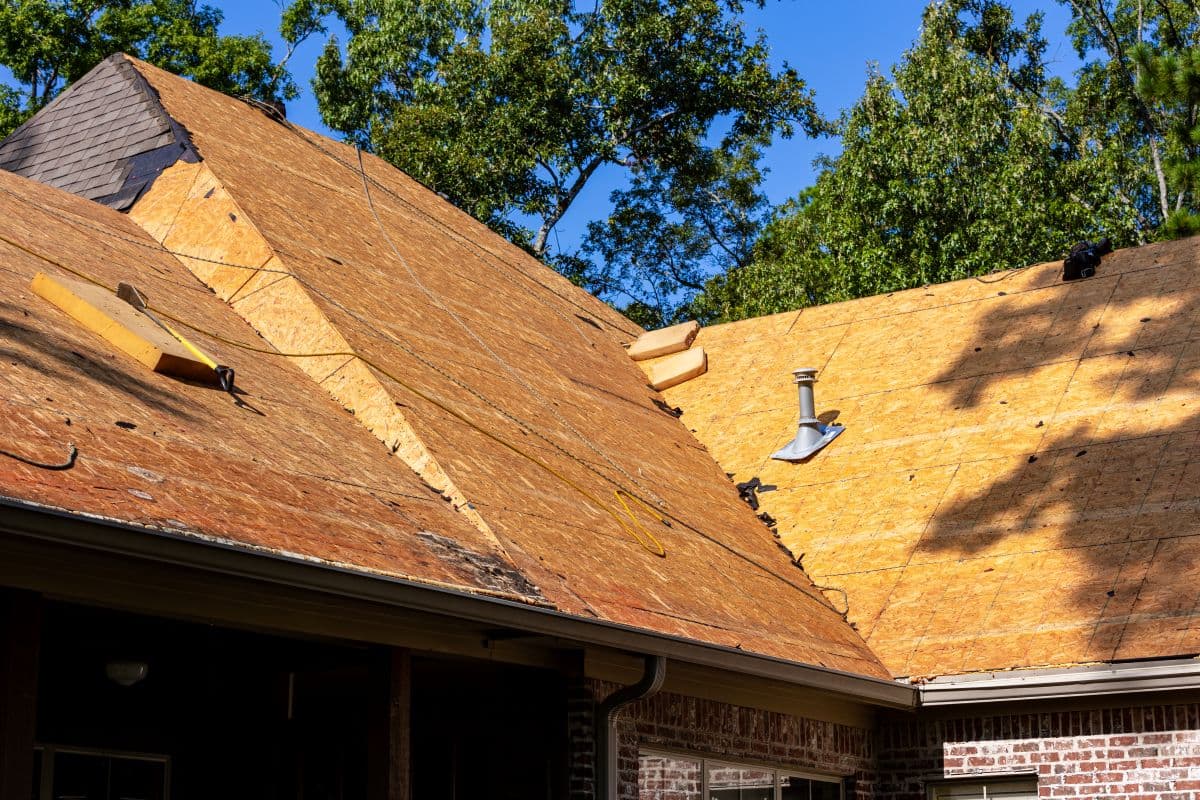
Twin Cities homes built before 2000 often have plywood or OSB sheathing showing age. During tear-off, the carpenter checks every sheet for soft spots, rot, soft fastener pull-through, or moisture damage. Damaged sheets get cut out and replaced before new underlayment goes on.
Typical Twin Cities reroof: 2–6 sheets need replacement at $80–$200 each (cost varies with sheet thickness — 7/16″ vs 5/8″ — and accessibility). Expect $200–$1,200 in deck replacement on a typical 1980s–1990s home. Premium roofs sometimes spec full re-decking ($4,000–$8,000) regardless of existing condition for warranty alignment with synthetic slate or metal roofing.
2. Chimney crown and flashing: $400–$2,500
The chimney crown is the cement cap at the top of a brick chimney. After 20–30 years of Minnesota weather, most crowns develop cracks that allow water through into the chimney itself, ultimately destroying mortar and bricks from the inside. The crown isn’t visible from the ground but the contractor can see it during the reroof.
Crown rebuild: $400–$1,200 depending on chimney size and access. Counter-flashing replacement (the metal that ties the chimney into the roof): $300–$800. Both together when needed: $700–$2,000+. Premium homes with multiple chimneys or stone chimneys can run higher.
3. Ventilation upgrade: $300–$1,200
Most older Twin Cities homes are under-ventilated by current code. Ridge vent, soffit baffles, and proper intake-to-exhaust balance often need to be added during the reroof. Our attic ventilation guide covers the math, but the cost typically runs $300–$1,200 to bring an under-ventilated attic up to spec.
Quality contractors include this in the base bid for any home that doesn’t already meet 1:300 NFA balance. Cheap bids skip it entirely and the homeowner gets to deal with ice dams and shortened shingle life as a result.
4. Ice and water shield extensions: $400–$1,500
Code-minimum ice and water shield is at the eaves only. Premium installs add it to valleys, around chimneys/skylights, and around plumbing penetrations. Some contractors quote code-minimum and bill the additional coverage as an upgrade. Our ice and water shield cost guide covers full pricing.
The additional coverage is the cheapest insurance on the entire reroof. Don’t skip it.
5. Fascia and soffit repair: $200–$2,500
Older Twin Cities homes often have rotten fascia behind aged drip edge or damaged soffits from poor ventilation. The damage is usually invisible until the old siding or drip edge comes off. Replacement: $200–$2,500 depending on extent.
If the fascia is rotten, the new drip edge can’t be properly attached. This needs to be fixed before the new shingles go on, which means it’s not optional. Budget for it.
6. Plumbing boot and vent stack flashings: $80–$300 each
Rubber plumbing boots fail predictably at 15–20 years. Most Twin Cities reroofs need 2–4 plumbing boot replacements at $80–$200 each. Range hood vent caps, dryer vent caps, and sometimes the metal vent stack flashings themselves also need replacement at similar pricing.
This is rarely included in the base bid because the contractor doesn’t know which boots have failed until the old shingles come off. Expect $200–$800 in vent and pipe boot work on a typical Twin Cities home.
7. Multi-layer tear-off premium: $400–$1,800
Many Twin Cities homes have two or three layers of asphalt shingles installed over the years. Stripping multiple layers takes longer and produces more debris than single-layer tear-off. Most contractors charge a premium of $0.50–$1.50 per square foot for multi-layer roofs.
For a typical 25-square home: $400–$1,800 in additional tear-off cost. Worth knowing before signing if your roof has multiple layers — the bid should specify the assumed layer count.
8. Permit fees and inspection costs: $150–$600
Most Twin Cities cities charge permit fees on reroof projects. The fees vary by city: Edina runs higher, smaller suburbs run lower. Some contractors bake permit fees into the bid; others bill them separately. Either way, plan on $150–$600 in city permit costs depending on your jurisdiction.
The Minnesota Department of Labor and Industry publishes the state contractor licensing requirements; local cities publish their own permit schedules.
What about the items that actually are scams?
Three “extras” that are almost always overcharges, not real cost lines:
- “Storm damage repair” mid-job: if the contractor “discovers” storm damage during the reroof and asks to file an insurance claim against your policy, that’s a flag. Real storm damage gets identified during the initial inspection, not after tear-off.
- “Premium underlayment upgrade”: the bid should specify the underlayment from the start. Mid-job upgrades to “premium synthetic” usually mean the original bid was using cheap felt.
- “Ridge vent surcharge”: ridge venting should be included in the base scope, not billed as an upgrade.
Our contractor red flags guide covers the broader vetting process.
How to budget realistically
For a typical Twin Cities reroof with average home age:
- Base bid: 100% of the contracted price
- Deck replacement contingency: 5% of base bid
- Hidden item contingency (chimney, fascia, plumbing boots): 5–10% of base bid
Plan a total budget of base bid plus 10–15% buffer. On a $25,000 reroof, that’s $2,500–$3,750 in contingency. For most homes, the actual extras come in at $1,500–$3,000, well within that buffer.
Premium reroofs (synthetic slate, metal, complex roofs) carry the same 10–15% contingency but the absolute dollar amounts are higher. On a $90,000 synthetic slate project, plan for $9,000–$13,500 in potential extras.
Get itemized “if needed” pricing on the bid
The single best way to avoid hidden cost surprises is to ask for itemized pricing on the most common surface items before you sign. A quality contractor’s bid will include:
- Per-sheet deck replacement rate
- Plumbing boot replacement rate (per boot)
- Chimney crown rebuild rate
- Fascia replacement rate (per linear foot)
- Multi-layer tear-off premium (if applicable)
With these numbers in writing, when the foreman calls during tear-off to say “we found three soft sheets and a cracked crown,” you already know what those will cost — no surprise, no negotiation, no leverage on the homeowner.
What real homeowners say
“Owl wrote out the per-sheet deck rate and per-boot rate before we signed. During tear-off they called to say we needed four sheets replaced and three plumbing boots — exactly $720 in extras, no negotiation. We ended up at $26,200 total against a $24,800 base bid. That’s how the math should work.” — John Wharton
Frequently asked questions
How much should I budget over the base bid?
10–15% of base bid as contingency. Most reroofs come in at 5–8% over base; the buffer covers the occasional larger surface item.
Are hidden costs the same as scams?
No. Hidden costs are real expenses surfaced by tear-off (deck rot, failed crown, etc.). Scams are fake “discoveries” or unjustified upcharges. The difference is itemized “if needed” pricing in writing — real extras are documented; scams are negotiated mid-job.
Can I avoid all extras with a thorough pre-install inspection?
Some, not all. Visual inspection from the ground misses deck condition under shingles. Even a thorough attic inspection can’t see sheet-by-sheet substrate condition. Some surface items are unavoidable.
What’s the most common hidden cost on Twin Cities reroofs?
Plumbing boot replacement. Almost every home with shingles older than 15 years needs at least 2 boots replaced. Plan on $200–$500 in boot work as a standard line.
Should I avoid a contractor who lists “if needed” pricing?
The opposite — that’s a green flag. It means they’re being transparent about what could surface. Avoid contractors who promise no extras at all; they’re either underbidding or planning to fight about extras later.
Where to start
When you’re collecting reroof bids, ask each contractor to itemize “if needed” pricing for the most common surface items. Compare bids on this basis, not just on the base bid total. The contractor with the most transparent itemization is usually the one with the smallest surprises during the project.
Request a free Owl Roofing quote and we’ll itemize the surface-item pricing in writing. You can also explore our reroof cost guide, our contractor red flags guide, our contractor selection guide, our roofing services, and our brand library.