



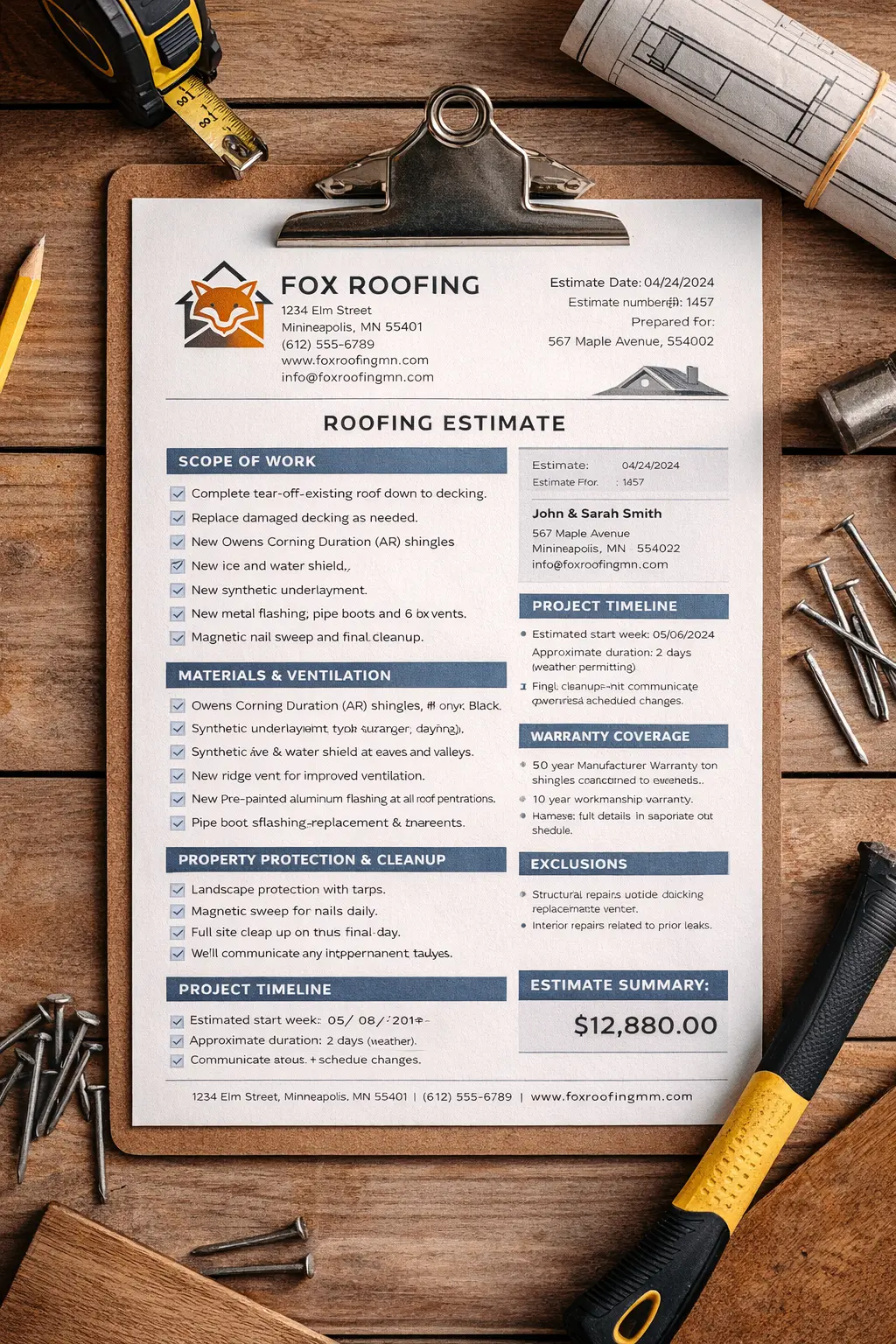
What a Professional Roofing Estimate Should Include
 8min Read
 Posted 12.24.2025
If you’ve ever compared roofing estimates and felt more confused than confident, you’re not alone.
Most homeowners expect an estimate to bring clarity.
Instead, it often raises more questions than it answers.
Different prices.
Different scopes.
Different assumptions.
And very little explanation.
The problem usually isn’t the homeowner.
It’s the estimate.
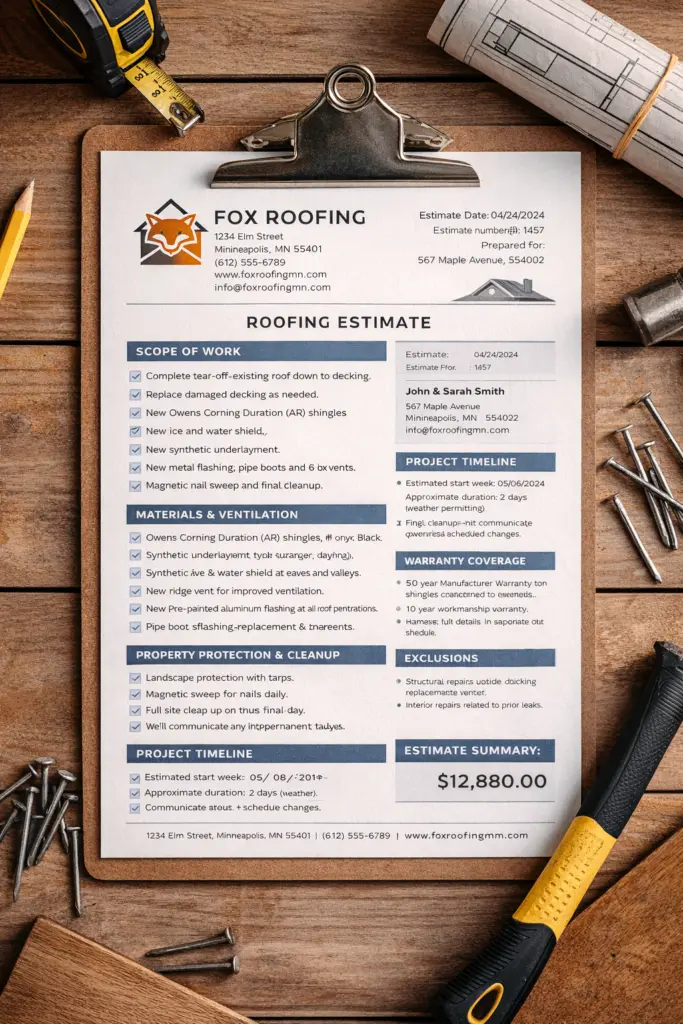
Why Roofing Estimates Are So Hard to Compare
On the surface, roofing estimates look simple. A number at the bottom. A few line items above it.
But roofing estimates are often written to be fast, not clear.
Many are designed to:
- Get a signature quickly
- Leave flexibility for the contractor
- Avoid detailed accountability
That makes it hard for homeowners to know what they’re actually agreeing to.
Two estimates can look similar in price and be completely different in value.
The Biggest Misconception About Estimates
Most homeowners assume an estimate is a promise.
In reality, many estimates are closer to a placeholder.
They list just enough to justify the price, but not enough to fully define the work.
That’s how surprises happen later.
Not always because a contractor is dishonest, but because the scope was never clearly defined in the first place.
Clarity upfront prevents conflict later.
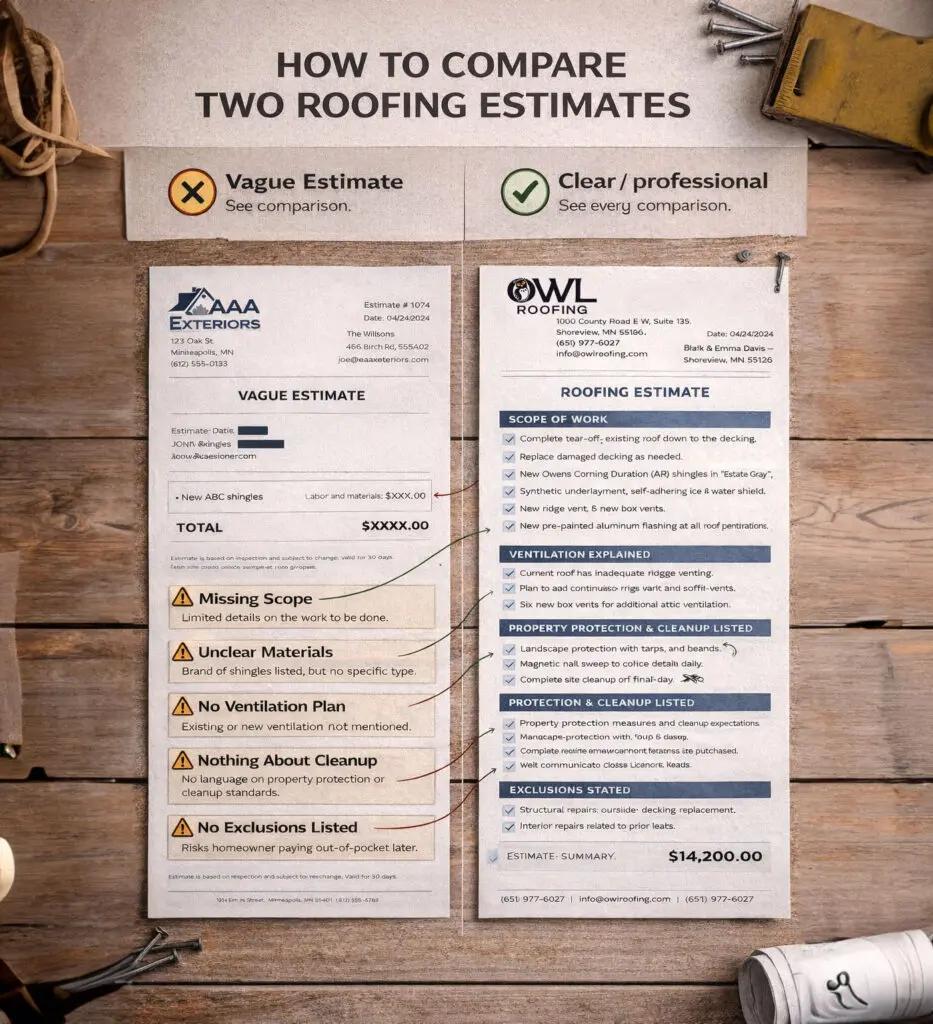
Why “Cheaper” Estimates Often Feel Appealing at First
When you’re staring at large numbers, it’s natural to gravitate toward the lowest one.
But lower estimates often leave out:
- Ventilation details
- Flashing replacements
- Protection for landscaping and property
- Cleanup standards
- Who is responsible if something goes wrong
Those omissions don’t always show up until the job is underway or finished.
At that point, the leverage is gone.
Estimates Are a Window Into How a Company Operates
A roofing estimate doesn’t just describe a project.
It reveals how a company thinks.
Clear estimates usually come from companies that:
- Have defined processes
- Communicate proactively
- Expect to be held accountable
- Plan for details instead of reacting to them
Vague estimates often come from companies that:
- Rely on verbal explanations
- Make decisions as they go
- Avoid committing to specifics
- Expect homeowners not to ask many questions
The document tells a story, even if you don’t realize it yet.
Why “We’ll Figure It Out Later” Is a Risky Approach
Some contractors will reassure you by saying things like:
“We’ll take care of it if it comes up.”
“We’ll cross that bridge when we get there.”
“That’s standard. Don’t worry about it.”
That sounds comforting, but it shifts risk onto you.
A professional estimate anticipates common issues and addresses them before work begins.
Good planning is not pessimism.
It’s respect for your home and your time.
The Homeowner’s Line-by-Line Clarity Checklist
In Part 1, we covered why roofing estimates often create confusion instead of confidence.
Now let’s remove the mystery.
This section walks through what a professional roofing estimate should actually include, so you can review any proposal and understand exactly what you’re agreeing to before you sign.
You don’t need roofing experience to use this.
You just need the estimate in front of you.
1. Clear Scope of Work
Every estimate should clearly explain what work is being done and where.
That includes:
- Which roof areas are included
- Whether tear-off is full or partial
- If damaged decking will be replaced and how it’s handled
- Whether flashing, vents, and pipe boots are replaced or reused
If the scope is vague, assumptions will be made later.
Assumptions almost never favor the homeowner.
2. Materials Listed by Type, Not Just Brand
It’s not enough to list a shingle brand.
A professional estimate should specify:
- Shingle type and class
- Underlayment type
- Ice and water protection locations
- Ventilation components
- Flashing materials
Two roofs using the same brand can perform very differently depending on what’s underneath.
If materials are not listed, ask why.
3. Ventilation Strategy Explained
Ventilation is one of the most commonly skipped explanations in roofing estimates.
A professional estimate should state:
- What ventilation currently exists
- What will be added, removed, or modified
- Why those changes matter for roof performance and longevity
If ventilation is not mentioned at all, that’s a gap worth addressing before moving forward.
4. Property Protection and Cleanup Standards
Your home is more than a roof.
A complete estimate should explain:
- How landscaping will be protected
- What measures are taken to protect siding, windows, and driveways
- Daily cleanup expectations
- Final magnetic sweeps and debris removal
If protection is implied but not described, expectations are unclear.
5. Timeline and Project Expectations
Professional estimates help you plan your life, not just the project.
Look for:
- Estimated start window
- Approximate project duration
- What delays might look like and how they’re communicated
- What you should expect on install day
Clarity here reduces stress more than homeowners realize.
6. Warranty Information in Plain Language
Every estimate should explain:
- Manufacturer warranty coverage
- Workmanship warranty coverage
- What actions could void warranties
- Who to call if an issue arises later
If warranty information is buried, vague, or avoided, ask for it in writing.
7. What Is Not Included
This is one of the most important sections and the most often missing.
A professional estimate should clearly state what is not included so there are no surprises later.
Examples might include:
- Repairs outside the defined scope
- Structural changes beyond decking replacement
- Interior damage not related to roofing work
Clear exclusions protect both sides.
How to Compare Two Estimates the Right Way
Instead of lining up prices, line up scope.
Ask yourself:
- Are both contractors solving the same problems?
- Are materials and ventilation approaches comparable?
- Is one estimate clearer about responsibility and expectations?
The best estimate is rarely the shortest one.
It’s the one that leaves the fewest unanswered questions.
The Final Test Before You Sign
Before moving forward, read the estimate and ask yourself one question.
Do I fully understand what will happen to my home from start to finish?
If the answer is no, slow down and ask for clarification.
A professional contractor will welcome those questions.
Clarity protects everyone.
A roofing estimate is not just a price.
It’s a roadmap for how your home will be treated, how problems will be handled, and how communication will flow.
Wise homeowners don’t rush past the paperwork.
They use it to choose confidence over confusion.
That’s how you protect your nest.
📍 Owl Roofing Serves the Entire Twin Cities Metro
Andover · Anoka · Apple Valley · Arden Hills · Big Lake · Blaine · Bloomington · Brooklyn Center · Brooklyn Park · Burnsville · Champlin · Chanhassen · Chaska · Columbia Heights · Coon Rapids · Cottage Grove · Crystal · deephaven · Delano · Eagan · East Bethel · Eden Prairie · Excelsior · Farmington · Forest Lake · Fridley · Golden Valley · Ham Lake · Hastings · Hopkins · Hugo · Inver Grove Heights · Lake Elmo · Lakeville · Lino Lakes · Mahtomedi · Maplewood · Mendota Heights · Minneapolis · Minnetrista · Mound · Mounds View · New Brighton · New Hope · North Oaks · North St. Paul · Oak Grove · Oakdale · Plymouth · Prior Lake · Ramsey · Richfield · Robbinsdale · Rosemount · Roseville · Saint Paul · Savage · Shakopee · Shoreview · South St. Paul · St. Louis Park · St. Michael · St. Paul · Stillwater · Vadnais Heights · Victoria · Waconia · wayzata · West St. Paul · White Bear Lake · woodbury
Licensed Minnesota roofing contractor · Free inspections · 10-year workmanship warranty · Get a free estimate →

Recent Articles
Explore The Blog