




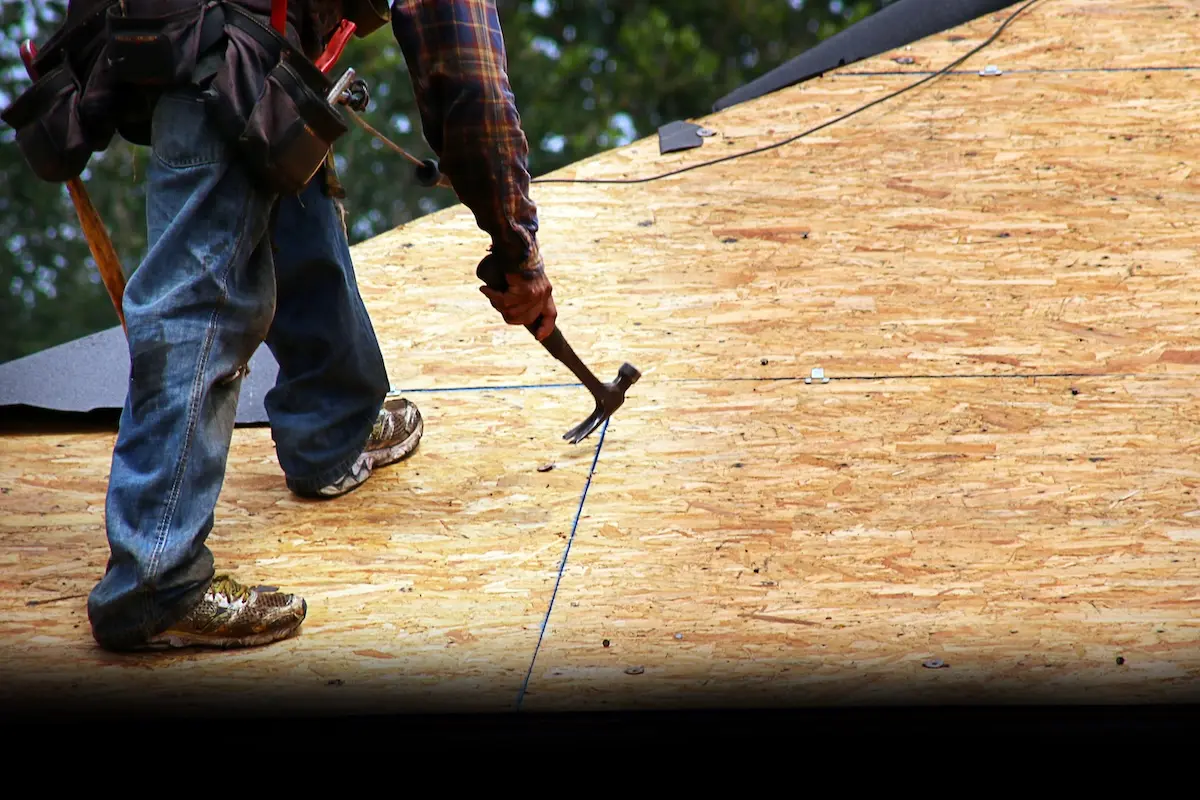
Roof Decking Replacement in Minnesota: When OSB Fails and What to Do
 15min Read
 Posted 4.01.2026
When homeowners in Minnesota think about a roof replacement, they picture shingles. What they don’t see — the plywood or OSB layer underneath — is often what determines whether the new roof lasts 25 years or leaks within five. Roof decking (also called roof sheathing) is the structural wood deck that shingles are nailed into. When it rots, delaminates, or loses its nail-holding ability, the shingles above it can’t do their job no matter how premium the brand.
Minnesota’s climate is uniquely hard on roof decking. Winter ice dams push meltwater under shingles and into the deck. Summer humidity trapped in poorly ventilated attics condenses on the underside of sheathing. Age alone weakens the adhesive bonds in older OSB. This guide walks through when decking needs replacement, OSB versus plywood for our climate, thickness requirements, signs of hidden rot, and how much decking replacement adds to a typical Minnesota re-roof. If you’re seeing decking damage as part of a larger issue, our roof replacement guide covers the full scope.
What Is Roof Decking?
Roof decking is the layer of wood sheets nailed across the roof trusses or rafters. It forms the flat surface everything else sits on: underlayment, ice-and-water shield, then shingles. In Minnesota homes built after 1985, decking is almost always OSB (oriented strand board) — engineered wood made from compressed wood strands and resin. In older homes (pre-1985), you’ll typically find plywood or, in very old homes, solid wood planks with gaps between them called “skip sheathing.”
The decking does three jobs: it provides a nailing surface for shingles, it transfers roof loads (snow, wind, foot traffic) to the trusses, and it acts as a continuous diaphragm that resists racking. When any of those three functions fails, the whole roof assembly is compromised.
The 25% Rule: When MN Code Requires Replacement
IRC R908.3 (adopted by Minnesota) requires that when more than 25% of roof decking over any one plane is damaged, rotten, or structurally unsound, the entire plane must be re-decked — not patched. This is a critical rule that protects homeowners from shortcut re-roofs where a contractor slaps new shingles over questionable wood. If your inspector or roofer flags decking issues, document them with photos before work begins.
| Condition | Code Response | Cost Impact (Typical MN Home) |
|---|---|---|
| Isolated spots (<5%) | Spot replace, reshingle | $150–$600 added |
| Moderate damage (5–25%) | Replace affected sheets | $600–$2,400 added |
| Significant (25%+ on any plane) | Full re-deck that plane | $2,500–$6,000 added |
| Full roof rot | Full re-deck entire roof | $5,000–$12,000 added |
OSB vs Plywood: Which Is Better for Minnesota?
Both OSB and plywood are code-approved and both can last 30+ years when installed correctly and kept dry. The real differences come out in two scenarios: repeated water exposure and long-term humidity cycling — both of which are common in Minnesota attics.
| Attribute | OSB (7/16″ or 1/2″) | Plywood (1/2″ or 5/8″) |
|---|---|---|
| Cost per sheet (MN, 2026) | $22–$32 | $42–$65 |
| Water resistance (short-term) | Good when dry | Good |
| Water resistance (repeated) | Swells, loses edge strength | Delaminates but recovers better |
| Nail holding | Adequate if dry | Superior, even after wet/dry cycles |
| Weight per sheet (4×8, 1/2″) | ~46 lbs | ~50 lbs |
| Span rating (truss spacing) | 24″ OC | 24″ OC |
| Typical lifespan in MN | 30–40 years | 40–60 years |
For most Minnesota re-roofs, OSB at 7/16″ or 1/2″ is the industry standard and meets code. Plywood at 5/8″ is the premium upgrade — typically $800–$1,500 more for an average home — and worth it in two cases: (1) if your existing decking is thinner than 1/2″ and you want to rebuild the roof for the long term, or (2) if you have chronic moisture problems in the attic that you can’t fully solve with ventilation alone. For proper attic moisture control, see our attic ventilation guide.
Decking Thickness: What MN Code Requires
Minimum Thickness by Truss Spacing
| Rafter/Truss Spacing | OSB Minimum | Plywood Minimum | Recommended |
|---|---|---|---|
| 16″ on center | 3/8″ | 3/8″ | 1/2″ |
| 24″ on center | 7/16″ | 1/2″ | 5/8″ |
| 32″ on center (rare) | 5/8″ | 5/8″ | 3/4″ |
Most Minnesota homes built since 1990 have trusses at 24″ on center. The original builder likely used 7/16″ OSB — the bare minimum. When re-decking, upgrading to 1/2″ or 5/8″ adds only modest cost but noticeably improves nail hold (important for impact-resistant shingles) and gives the roof a stiffer feel underfoot. If you’re replacing decking as part of a full roof replacement and installing impact-resistant Class 4 shingles, 5/8″ decking is strongly recommended — the thicker deck helps the entire assembly perform as tested.
Signs Your Roof Decking Needs Replacement
Most decking damage is hidden until shingles are removed. But there are telltale signs you can spot from the attic, from the ground, or when walking the roof. Any one of these warrants a professional inspection before a re-roof:
- Sagging between rafters. Drive-by test: the roof plane should look flat and straight. If you see dips or waves between trusses, the decking has lost structural rigidity — usually from moisture damage.
- Spongy feel underfoot. Walking the roof (or having a roofer walk it), sheathing should feel solid. Soft or bouncy spots indicate rot.
- Dark staining on attic side. Inspect from inside the attic with a flashlight. Look for black or dark brown water stains on the underside of the decking, especially near the eaves, around skylights, and at roof valleys.
- Mold or mildew. Fuzzy growth on decking underside means active moisture — this needs airflow and moisture-source fixes, not just a shingle replacement.
- Nail pops. Shingle nails backing out is often caused by decking that’s softening or has lost its grip on the fastener.
- Visible daylight. If you can see daylight through the decking from inside the attic (not through ridge vent or soffit vents — actual holes or gaps), you have failure points.
- Age over 40 years. OSB from the 1980s is now past its reliable service life. Plywood from the 1970s often has similar issues.
How Ice Dams Destroy Decking
Ice dams are the single biggest cause of premature decking failure in Minnesota. When meltwater backs up under shingles, it soaks into the decking from above. Even if it doesn’t reach the attic and cause visible leaks, the water saturates the sheathing — and OSB in particular loses significant strength when wetted, dried, and re-wetted across multiple winters. Our ice dam prevention guide covers the insulation and ventilation fixes that keep the decking dry.
Ice-and-water shield (required by MN code at least 24″ past the interior wall line, per IRC R905.1.1) helps protect decking at the eaves, but older homes often lack this membrane entirely. When you re-deck, always install modern ice-and-water shield — it’s the single best insurance against future decking rot.
The Re-Decking Process
When decking replacement is needed, the process adds 1–2 days to a typical roof replacement. Here’s the sequence:
- Tear off existing shingles and underlayment. Exposes full decking surface for inspection.
- Map damaged sheets. The crew marks every sheet that shows rot, delamination, or structural compromise.
- Remove old nails from keepers. Sheets that stay get any proud nails pulled or pounded flush.
- Cut out damaged sheets. Using circular saws set to decking thickness, damaged sheets come up cleanly without harming trusses.
- Install new sheets. New OSB or plywood is placed with an 1/8″ gap at ends and edges for thermal expansion, then nailed 6″ on center at edges, 12″ OC in the field (per IRC Table R602.3(1)).
- Inspect trusses. With decking open, any damaged trusses or rafters get repaired before re-covering.
- Install ice-and-water shield, synthetic underlayment, and new shingles. Standard re-roof process resumes.
Cost of Decking Replacement in Minnesota
Decking replacement is typically billed separately from the main shingle job because the amount needed can’t be known until tear-off exposes the deck. Reputable Minnesota roofers quote it as a per-sheet price with a minimum.
| Scope | Per 4×8 Sheet (Installed) | Notes |
|---|---|---|
| Spot replacement (1–3 sheets) | $90–$150 each | Minimum trip charge often applies |
| Moderate (5–15 sheets) | $75–$110 each | Mid-range pricing |
| Full plane re-deck (20+ sheets) | $65–$90 each | Volume pricing |
| Whole-roof re-deck | $55–$80 each | Typical 2,500 sq ft roof: ~80 sheets, $4,400–$6,400 |
| Upgrade OSB to 5/8″ plywood | +$25–$40 per sheet | Over standard OSB pricing |
An important detail for Minnesota homeowners: when decking replacement is required because of storm damage (hail or wind), insurance typically covers it under the same claim as the shingles. If your adjuster’s scope doesn’t include decking line items and your roofer identifies rot after tear-off, a supplemental claim is warranted. Our storm damage guide walks through supplementals. Note that MN Statute 325E.66 prohibits contractors from waiving your deductible — if anyone offers to absorb it, walk away.
Red Flags: When a Roofer Skips Deck Inspection
Some low-bid roofers quote a full roof replacement without any mention of decking. That’s a red flag. A quality quote will always include language like “decking replaced as needed at $X per sheet” or “first 5 sheets included, additional at $X each.” If your quote doesn’t address decking at all, assume the contractor plans to shingle over whatever is there — which creates a latent defect and voids most shingle warranties.
- Quote silent on decking: Ask directly. If the answer is “we’ll just shingle over it,” find another roofer.
- Door-knocker claims “no decking needed, inspected from satellite”: Impossible. Decking condition is only knowable after tear-off.
- Refuses photos: A quality crew documents any replaced decking with timestamped photos before covering.
- Uses 3/8″ OSB: Too thin for 24″ truss spacing in MN. This is a code violation.
- Reuses old decking with visible damage: Nails, shingles, and shield are all less effective on compromised decking.
When hiring, our hiring guide covers the questions that separate quality contractors from shortcut operators. And if you’re comparing roofer quotes, see our Minneapolis roofing overview for local pricing benchmarks.
Decking and Warranty Considerations
Every major shingle manufacturer (GAF, Owens Corning, CertainTeed, IKO) requires decking that meets IRC code as a condition of their warranty. Installing premium shingles over rotten, thin, or damaged decking voids the manufacturer warranty. If a claim arises later, the manufacturer’s inspector will pull shingles to look at the deck — if it’s substandard, the claim is denied.
For manufacturer’s enhanced warranties (GAF Golden Pledge, Owens Corning Platinum, CertainTeed 5-Star), the decking requirements are even stricter: 7/16″ OSB minimum, no gaps greater than 1/8″, no rot, and full ice-and-water shield at eaves. When you’re investing in a premium shingle system, the decking is not the place to save money.
FAQ: Roof Decking Replacement in Minnesota
How do I know if my roof decking needs replacement without tearing off shingles?
You can get strong indicators without a tear-off. Inspect the attic with a flashlight — water stains, mold, or soft spots on the underside of the decking all signal damage. From the ground, look for sagging between rafters or waves in the roof plane. A roofer can walk the roof and identify spongy areas by foot feel. Conclusive assessment only happens after tear-off, which is why quality quotes always include a per-sheet replacement line.
Is OSB okay for Minnesota winters?
Yes, OSB is code-approved and performs well in Minnesota when kept dry. The issue is not the OSB itself — it’s moisture management. With proper attic ventilation (IRC R806 balanced intake/exhaust), adequate insulation (R-49 minimum per IECC Zone 6, R-60 for Zone 7), and ice-and-water shield extending 24″ past the interior wall line, OSB lasts 30–40 years. Where homes have chronic moisture problems, plywood at 5/8″ is a more forgiving choice.
Can I install new shingles over damaged decking?
No, and no reputable roofer will. IRC R908.3 requires replacement when more than 25% of a roof plane is damaged. Even below that threshold, installing shingles over rotten or soft decking voids the shingle manufacturer’s warranty, reduces the roof’s wind rating, and will lead to premature failure. Any decking with rot, delamination, or structural damage must be replaced before new shingles go on.
How much extra should I budget for decking replacement?
For a typical Minnesota home getting a re-roof, budget an extra 5–15% of the base roof cost for potential decking repairs. On a $15,000 roof replacement, that’s $750–$2,250 in reserve. Most re-roofs end up needing $300–$1,500 in decking work. Full re-decks (required if 25%+ of any plane is damaged) add $3,000–$6,000 on top of the base price. Insurance typically covers decking replacement when it’s caused by a covered peril like hail or wind.
What thickness of decking is best for an impact-resistant roof?
For UL 2218 Class 4 impact-resistant shingles, 5/8″ decking is strongly recommended even though 7/16″ meets code. The thicker deck provides better nail hold, which matters during the hail strikes and wind gusts that Class 4 shingles are rated to survive. Some insurers offer premium discounts for Class 4 shingles on 5/8″ decking that they don’t offer for the minimum thickness.
Can decking replacement be done in winter in Minnesota?
Yes, with limits. Decking can be replaced year-round, but the work should happen on days above 20°F with no active precipitation. Frozen, snow-covered decking is hard to assess and dangerous to walk. Most Minnesota roofers prefer to schedule decking work from April through November; winter work is reserved for emergency repairs. If storm damage occurs in January and water is actively entering the home, emergency tarps followed by a thaw-season re-roof are standard.
Does homeowners insurance cover rotten roof decking?
Insurance covers decking damage caused by a covered peril — hail, wind, fallen trees, ice dams (in some policies) — but not damage from neglect, age, or gradual moisture. If a hail storm damages your shingles and the adjuster authorizes a roof replacement, decking replacement needed as part of that work is typically covered. If your decking rotted from years of poor attic ventilation, that’s excluded as “wear and tear.” A Minnesota-licensed roofer can help identify the likely cause and support supplemental claims when decking is found damaged after tear-off.
What Owl Roofing Customers Actually Say
Real, verified Google reviews from real customers Owl Roofing maintains a 5.0 Google rating with 30+ five-star reviews.
Noah is the real deal. After our insurance denied our roof claim and the first roofer walked away, Noah showed up the next day and said he thought he could get us a new roof. He delivered. He got us a roof covered by insurance after it had already been declined. We came up with a nickname for him: “The Roof Whisperer.”
— Tyler Moberg, verified Google review
I am an Independent Insurance Agency owner and have worked with Noah on several roof projects. The homeowners have been extremely satisfied with the quality of work and craftsmanship Noah and his crews have provided. From filing the claim to replacing the roof and cleaning up the job site, Noah and his crew are the best!
— Fred Zappa, Independent Insurance Agency Owner
We used Owl Roofing for a repair on our roof in Brooklyn Park, and I was blown away by how good they were. Every member of the team communicated well about the process. Their price transparency was super helpful. They got the work done very fast, and the team was professional and very kind.
— Matt Brown, Brooklyn Park (verified Google review)
Noah and his team are outstanding! His clear communication, professionalism, and workmanship are top-notch. I recommend Owl Roofing to all my clients, friends, and family.
— Christine Westlund, verified Google review
It didn’t feel like dealing with a big company — it felt like working with people who actually care about the homes and community in the North Oaks and Shoreview area. Great people, great communication, and really solid work.
— Cody Warren, verified Google review
