



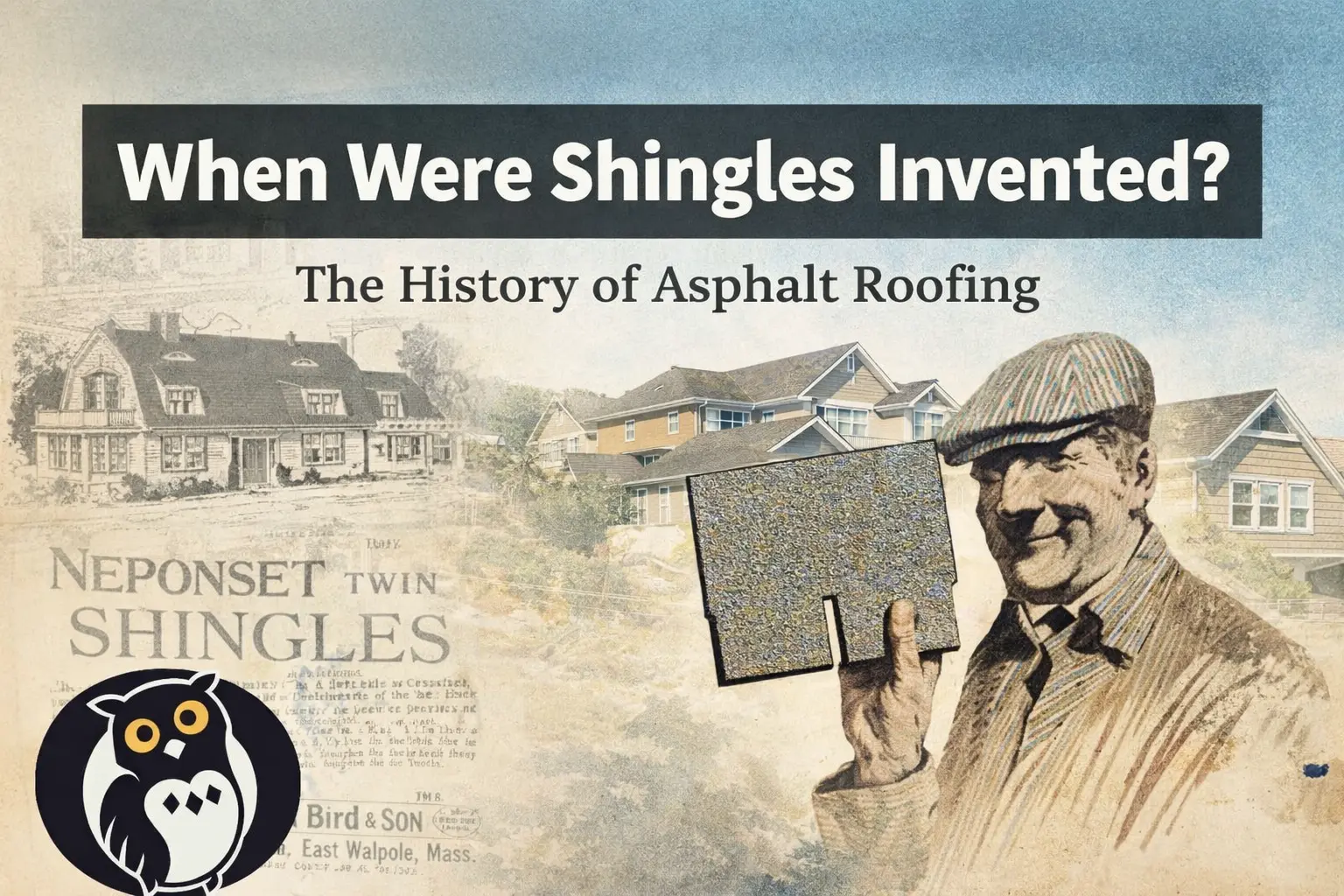
When Were Shingles Invented? a Calm Look at the History of Asphalt Roofing—and Why It Matters Today
 8min Read
 Posted 4.04.2026
Homeowners often ask practical questions about their roofs: How long will this last? Is this material proven? Has this system been around long enough to trust it?
Those questions usually lead to a deeper one that doesn’t get asked often enough:
When were shingles invented?
Understanding when shingles were invented—and how they evolved—helps explain why modern asphalt roofing looks the way it does today, why it performs as it does, and why it remains the most widely used roofing system in North America. This isn’t trivia. It’s context. And context builds confidence.
Let’s walk through the story calmly and clearly.
Roofing Before Shingles: Why a Better Solution Was Needed
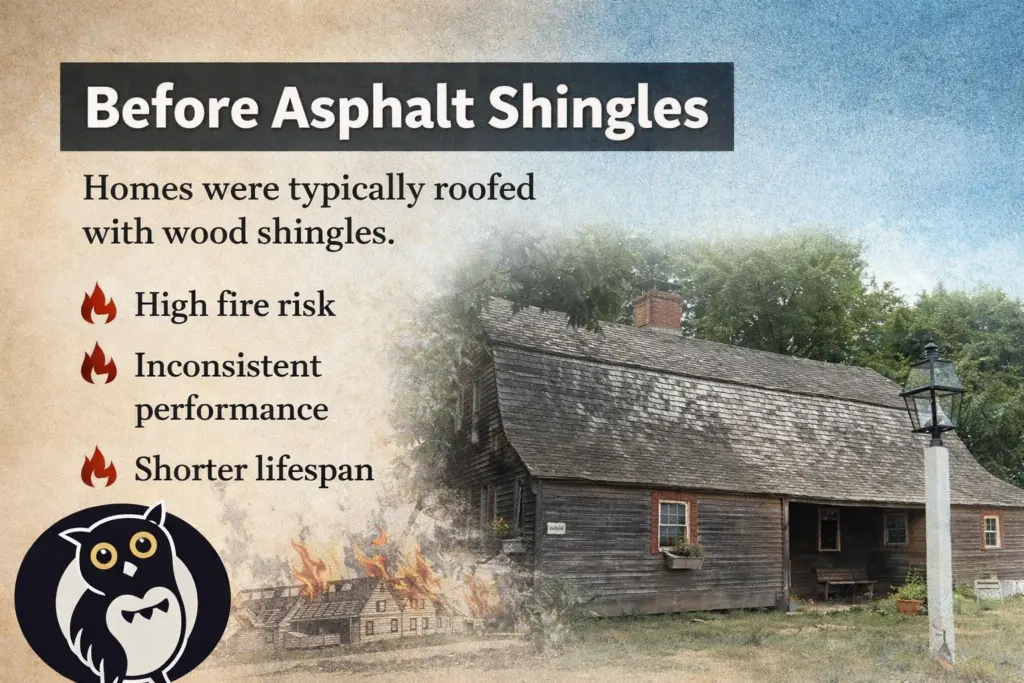
Before asphalt shingles existed, most homes were protected by wood shingles or shakes. While visually appealing, wood roofing had serious drawbacks:
- High fire risk
- Inconsistent performance
- Variable thickness and water resistance
- Shorter lifespan in harsh climates
As cities grew denser in the late 1800s, fires became more devastating. Insurance companies, builders, and homeowners all began searching for safer, more predictable roofing materials. Roofing needed to become standardized, fire-resistant, and reliable.
That pressure set the stage for one simple but powerful innovation.
When Were Shingles Invented? The 1903 Breakthrough
So—when were shingles invented in the form we recognize today?
The widely accepted answer is 1903.
In that year, a roofing contractor named Henry M. Reynolds of Grand Rapids, Michigan began cutting large rolls of asphalt-saturated, stone-surfaced roofing into smaller individual pieces. Instead of installing roofing in long rolls, Reynolds created manageable, repeatable units that could be overlapped in a consistent pattern.
This moment matters because it marks the transition from roofing as a craft experiment to roofing as a system.
When homeowners ask when were shingles invented, this 1903 innovation is the clearest and most defensible answer.
Why the Invention of Shingles Mattered
Reynolds wasn’t trying to revolutionize an industry. He was solving a jobsite problem.
Early asphalt shingles offered:
- Improved water shedding through layered overlap
- Better fire resistance than wood
- More consistent installation results
- Easier repairs and replacements
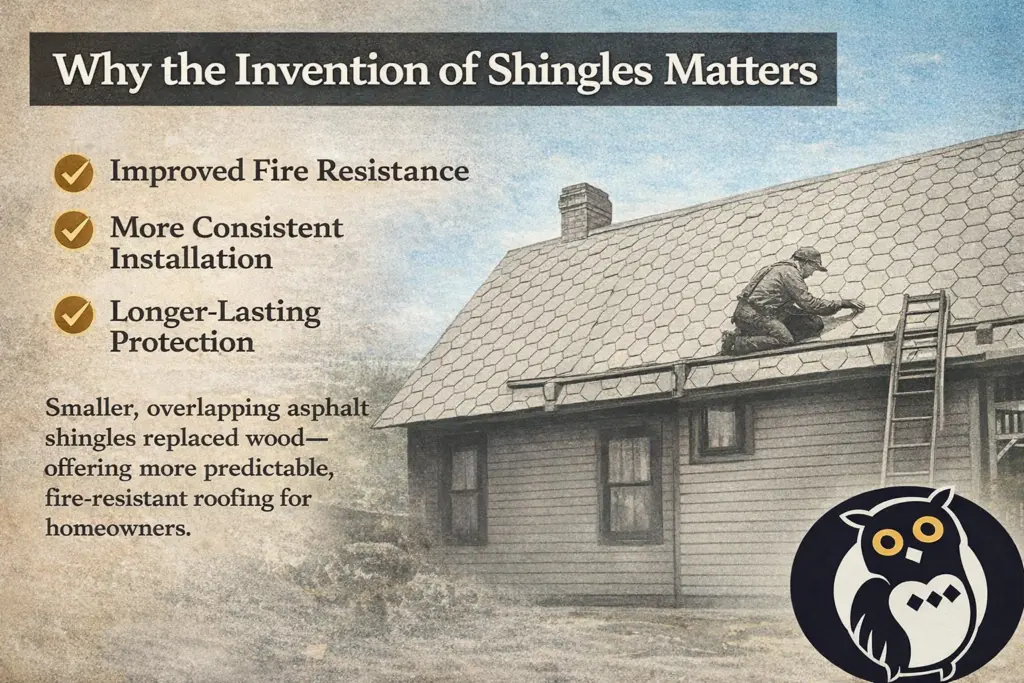
These early shingles were typically hand-cut rectangles or hexagons, often around 8″ x 16″. They were made from organic felt saturated with asphalt and topped with mineral granules for protection.
The simplicity of the idea is part of why it lasted.
From Hand-Cut to Mass-Produced: The 1910s Shift
Once the concept proved useful, manufacturers stepped in.
By the 1910s, companies began automating the production of individual asphalt shingles. This allowed for:
- Consistent sizing
- Improved quality control
- Wider adoption across the country
Asking when were shingles invented is only part of the story. Just as important is when they became widely trusted. That trust came as production became standardized and predictable.
By 1915, machine-cut shingles were becoming the norm.
Fire Safety, Insurance, and Rapid Adoption
In the 1920s, asphalt shingles surged in popularity for a very practical reason: fire prevention.
The U.S. National Board of Fire Underwriters actively discouraged wood shingles due to the fire risk they posed, especially in urban and suburban neighborhoods. Asphalt shingles—already proving themselves as safer and more uniform—became the preferred alternative.
This moment cemented asphalt shingles as the dominant residential roofing material in North America.
So when homeowners wonder when were shingles invented, the better question might be: When did they become the standard?
The answer is the 1920s.
The Role of Early Manufacturers in Shingle Evolution
While Henry Reynolds is credited with the invention, manufacturers were responsible for refinement.
One of the most influential was GAF, whose roots trace back to the late 1800s under the name Standard Paint Company. Long before individual shingles were mass-produced, the company developed early asphalt roll roofing products like Ru-ber-oid, which laid the groundwork for shingle development.
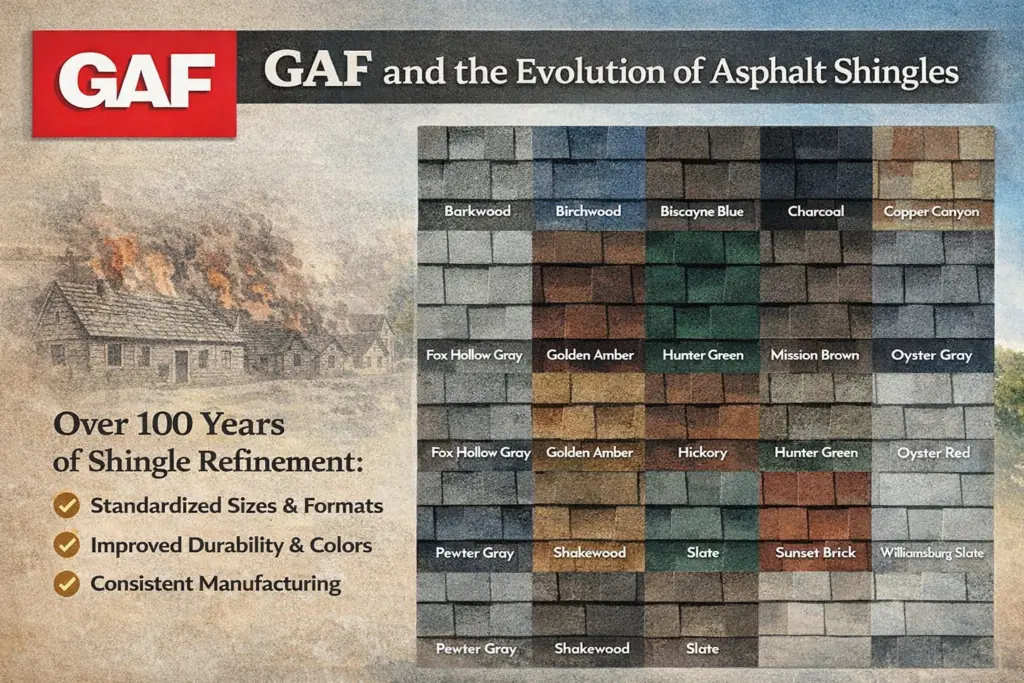
GAF and similar manufacturers helped improve:
- Granule adhesion
- Weather resistance
- Manufacturing efficiency
- Long-term durability
This is an important distinction: Reynolds invented shingles; manufacturers refined them.
That partnership between practical jobsite innovation and industrial refinement is why the system endured.
Competing Innovations in the Early 1900s
The early asphalt shingle era—roughly 1890 to 1910—was crowded with experimentation. Several manufacturers founded during this period contributed ideas, products, and variations as the industry matured.
Companies like CertainTeed, founded in 1904, played a role in expanding safer alternatives to wood roofing during this time. This overlap sometimes leads to confusion when people research when were shingles invented, because invention and adoption happened almost simultaneously across multiple players.
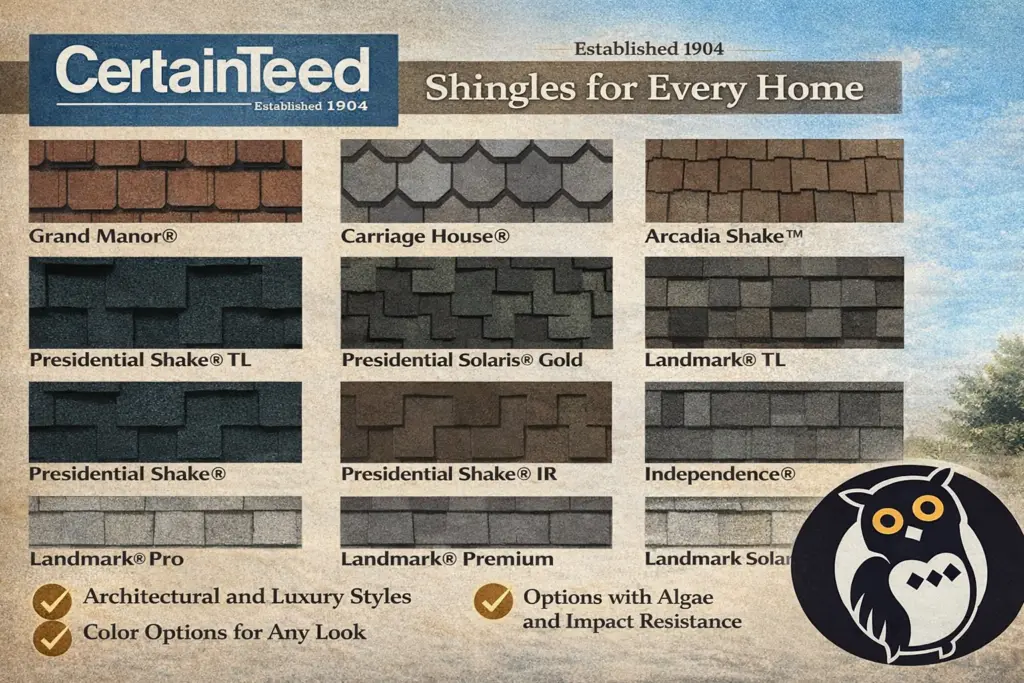
What matters most is that by the 1930s, the asphalt shingle system had stabilized into a reliable, repeatable standard.
The Evolution Into Modern Asphalt Shingles
After the invention phase, progress became more incremental—and more meaningful.
Over the decades, asphalt shingles evolved through:
- Thicker mats
- Better asphalt blends
- Stronger wind resistance
- Architectural (dimensional) designs
- Improved algae resistance
By the late 20th century, architectural shingles became the dominant style, offering better aesthetics and longer service life than earlier 3-tab designs.
Modern shingles are still built on the same fundamental idea introduced in 1903. That’s worth pausing on.
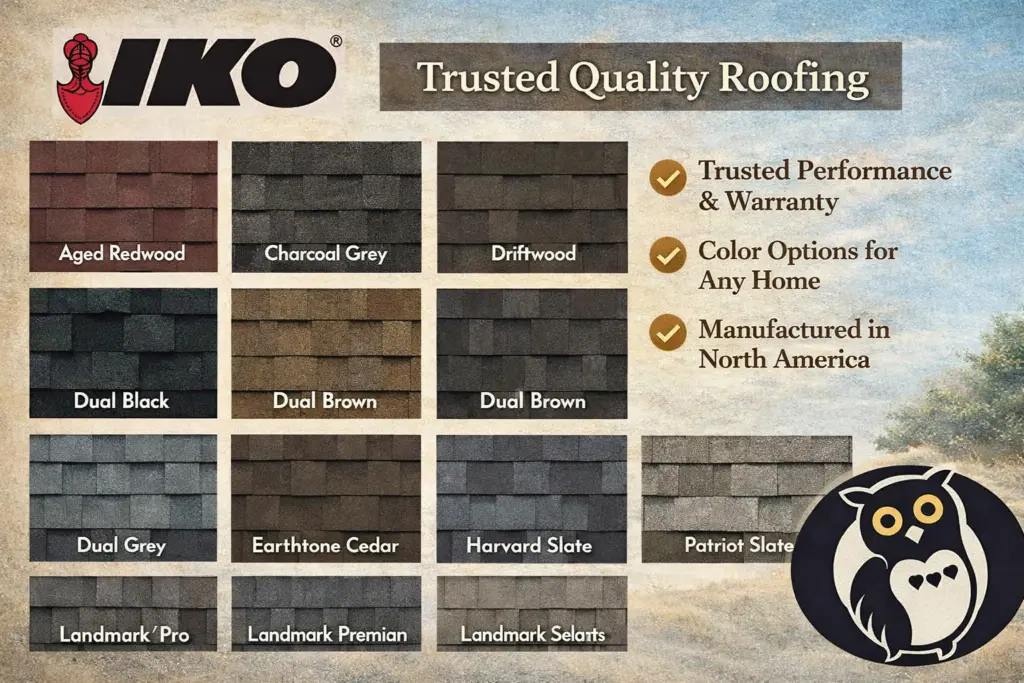
When homeowners ask when were shingles invented, they’re often surprised to learn that the basic system is over 120 years old—and still trusted.
Today’s Shingles: Proven, Not Experimental
Today’s asphalt shingles benefit from more than a century of testing, failure, improvement, and refinement.
Manufacturers like IKO represent the modern era of asphalt roofing—focused on consistent manufacturing, strong warranties, and performance standards that reflect real-world conditions.
What hasn’t changed is the core principle:
A layered, overlapping system designed to shed water safely and predictably.
That principle is why asphalt shingles remain the most common residential roofing choice in North America.
Why the History of Shingles and the Question, When Were Shingles Invented, Matters to Homeowners
Understanding when were shingles invented isn’t about nostalgia. It’s about trust.
A roofing system that’s survived over a century has done so because it works. It has been challenged by storms, fires, heat, cold, and time. Weak ideas didn’t last. Strong ones did.
When installed correctly, modern asphalt shingles represent:
- Proven design
- Predictable performance
- Repairability
- Long-term value
That’s reassuring when you’re making a major investment in your home.
The Bigger Takeaway
So—when were shingles invented?
They were invented in 1903, refined through the early 1900s, widely adopted by the 1920s, and continuously improved ever since.
That long, steady evolution is exactly what homeowners should want from a roofing system: not hype, not shortcuts, but calm, proven progress.
At Owl Roofing, we believe understanding the why behind materials helps homeowners feel confident in the what. Roofing doesn’t need urgency or pressure. It needs clarity.
And sometimes, clarity starts with a simple question—asked honestly and answered well. We hope we have answered your questions around when were shingles invented!
📍 Owl Roofing Serves the Entire Twin Cities Metro
Andover · Anoka · Apple Valley · Arden Hills · Big Lake · Blaine · Bloomington · Brooklyn Center · Brooklyn Park · Burnsville · Champlin · Chanhassen · Chaska · Columbia Heights · Coon Rapids · Cottage Grove · Crystal · deephaven · Delano · Eagan · East Bethel · Eden Prairie · Excelsior · Farmington · Forest Lake · Fridley · Golden Valley · Ham Lake · Hastings · Hopkins · Hugo · Inver Grove Heights · Lake Elmo · Lakeville · Lino Lakes · Mahtomedi · Maplewood · Mendota Heights · Minneapolis · Minnetrista · Mound · Mounds View · New Brighton · New Hope · North Oaks · North St. Paul · Oak Grove · Oakdale · Plymouth · Prior Lake · Ramsey · Richfield · Robbinsdale · Rosemount · Roseville · Saint Paul · Savage · Shakopee · Shoreview · South St. Paul · St. Louis Park · St. Michael · St. Paul · Stillwater · Vadnais Heights · Victoria · Waconia · wayzata · West St. Paul · White Bear Lake · woodbury
Licensed Minnesota roofing contractor · Free inspections · 10-year workmanship warranty · Get a free estimate →

Recent Articles
Explore The Blog