Commercial Roofing in Minneapolis: a Simple, Clear Guide for Owners
 8min Read
 Posted 12.19.2025
Last winter, a Minneapolis business owner called us on a Tuesday morning with a problem that had escalated fast.
A slow drip in the storage area turned into a soaked ceiling tile, then a puddle on the floor, and then two employees slipping around trying to control the mess.
Their roofer had “patched it for now” three times.
The problem wasn’t the patch.
The problem was the roof system itself — old, poorly installed, and never designed for our freeze–thaw rollercoaster.

Commercial roofing issues rarely show up loud at first.
They start as tiny leaks, tiny blisters, or tiny temperature swings — and then they suddenly become revenue problems, safety problems, or weekend-shutdown problems.
That’s why Minneapolis building owners don’t need hype.
They need a partner who understands snow load, ice pressure, thermal movement, flat-roof drainage, and the way water behaves when it freezes and thaws twenty times in a month.
If you want a fast assessment or a second opinion before you sign anything, Owl Roofing can walk your roof, document everything, and give you a clear path forward.
Now let’s break down the essentials.
Why Commercial Roofing in Minneapolis Is Different
Minneapolis buildings deal with conditions that punish commercial roofing systems:
- Constant freeze–thaw cycles
- Heavy snow and drifting
- Spring melt pooling
- Hail and wind storms
- Sub-zero contraction and summer expansion
- Long stretches of UV exposure on flat surfaces
A commercial roof here isn’t just a waterproof layer.
It’s a system that must manage movement, moisture, and load — while keeping operations running safely.
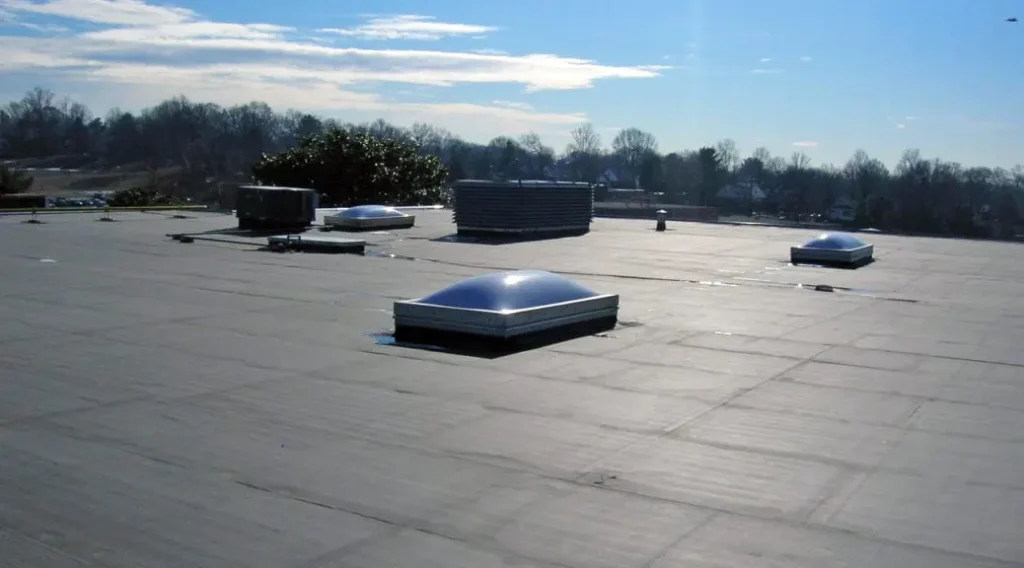
The Main Commercial Roofing Types in Minneapolis (Explained Simply)
TPO Roofing
A flexible, heat-welded membrane used on many modern commercial buildings.
Strengths:
- High reflectivity (helps energy bills)
- Welded seams = strong leak protection
- Good in heat and cold
- Lightweight and cost-effective
Best for: Retail, warehouses, low-slope buildings, multi-unit residential.
EPDM Roofing
A long-lasting rubber membrane known for durability.
Strengths:
- Excellent in cold climates
- Very resistant to UV
- Simple repair process
- Proven 30+ year track record
Best for: Older buildings, industrial facilities, institutional roofs.
PVC Roofing
A premium membrane used where chemicals or grease are present.
Strengths:
- Resistant to chemicals, oils, restaurant exhaust
- Strong welded seams
- Good lifespan
Best for: Restaurants, food production, medical facilities.
Modified Bitumen
A layered asphalt-based system.
Strengths:
- Durable
- Good for foot traffic
- Strong in cold temps
Best for: Smaller commercial roofs, service buildings, older Minneapolis structures.
Metal Roofing (Commercial Grade)
Used for sloped commercial roofs.
Strengths:
- Very long lifespan
- Low maintenance
- Excellent snow-shedding
- High wind resistance
Best for: Churches, retail buildings, office complexes, manufacturing buildings.

How to Know Which Commercial Roof Type You Need
Choosing the right system depends on:
- Roof slope
- Building age
- HVAC placement
- Foot traffic
- Budget
- Ice dam history
- Drainage capability
- Snow load concerns
- Environmental or chemical exposure
- Long-term ownership plans
Most commercial roofing mistakes in Minneapolis happen when a contractor installs a system that looks good on paper but performs poorly under winter stress.
Common Commercial Roofing Problems in Minneapolis
These issues are everywhere across the city:
- Ponding water after snowmelt
- Seams separating from thermal movement
- Cracks forming in cold snaps
- Blisters from trapped moisture
- Punctures from rooftop equipment
- Flashing failures around HVAC units
- Ice pushing water backwards under seams
These are not “cosmetic.”
They are slow-motion failures that cost more the longer they stay ignored.
Repair or Replace? How Minneapolis Building Owners Can Tell
Most commercial roofs can be repaired — the trick is knowing when repairs stop being smart and start becoming wasteful. Here’s the simple decision guide:
You Should Repair When:
- Leaks are limited to one area
- The membrane is still flexible
- Seams are in good shape
- No insulation is saturated
- Drainage still works
- The roof is under 15–20 years old
You Should Replace When:
- Leaks keep shifting to new spots
- The membrane is brittle
- Water is trapped under the surface
- Insulation is soaked
- Flashing failures keep returning
- The roof is near the end of its expected lifespan
- Repairs cost more than 20–30% of replacement
A failing commercial roof doesn’t announce itself.
It gets weaker quietly — then hits your business hard.
Commercial Roof Cost Ranges in Minneapolis (Straightforward Numbers)
Prices vary by material, layout, and building size, but here are normal Twin Cities ranges:
TPO: $20–$24 per sq ft
EPDM: $18–$22 per sq ft
PVC: $22–$26 per sq ft
Modified Bitumen: $18–$22 per sq ft
Metal (Commercial Grade): $10–$18 per sq ft
Extra costs come from:
- Tear-off
- Wet insulation removal
- Parapet work
- Flashing rebuilds
- Drain redesign
- Access limitations
- HVAC coordination
No commercial roof should be quoted without a moisture scan and full documentation. Anything less is guesswork.
The Most Overlooked Part of Commercial Roofing: Drainage
Minneapolis roofs fail more from water that can’t leave than water that enters from above.
Warning signs your drainage isn’t working:
- Water stays on the roof longer than 48 hours
- Roof feels “spongy” under foot
- Stains around drains or scuppers
- Ice builds on the flat areas
- Spring melt leaves shallow pools
When water has nowhere to go, it becomes the enemy.
Drainage is the silent factor that decides whether your roof lasts 30 years or fails in 7.
Flat Roof Maintenance Schedule (Simple, No Nonsense)
A Minneapolis commercial roof should follow this rhythm:
Quarterly:
- Clear drains
- Check seams
- Remove debris
- Look for punctures
- Inspect flashing
Fall:
- Prepare for snow load
- Verify heat cables (if any)
- Inspect insulation ventilation at rooftop units
Spring:
- Check for freeze–thaw cracks
- Evaluate ponding
- Look for membrane stretch or shrinkage
After any major storm:
- Document everything
- Walk the roof for punctures
- Inspect HVAC boots and edges
Skipping maintenance costs more in the long run.
One hour today prevents five days of chaos later.
How Minneapolis Contractors Cut Corners (That You’ll Pay For Later)
These shortcuts are common in the city:
- Using thinner membranes to lower bids
- Ignoring wet insulation during tear-off
- Leaving old flashings in place
- Overusing adhesives instead of proper welding
- Skipping moisture scans
- Not fixing slope issues
- Hiding ponding instead of solving it
The cheapest commercial bid is usually the one that avoids the real work.
FAQ: Commercial Roofing in Minneapolis
How long do commercial roofs last?
TPO: 20–30 years
EPDM: 25–30 years
PVC: 25–30 years
Metal: 40+ years
Modified bitumen: 15–25 years
What’s the biggest risk to flat roofs here?
Freeze–thaw cycles and drainage failures.
Do commercial roofs need ventilation?
Yes — especially roofs with interior humidity or heavy mechanical equipment.
Does snow load matter?
Yes. Snow adds weight and often blocks drains, causing ponding when it melts.
How often should I inspect my roof?
Quarterly, plus after big storms.
What’s the best roofing material for Minneapolis?
Most buildings do well with TPO or EPDM. Buildings with chemical exposure often need PVC. Sloped structures do well with metal.

How Owl Roofing Helps Minneapolis Building Owners
Building owners want accountability. They want documentation. They want clear timelines, quick reports, and guidance that doesn’t force them into a system that won’t serve their building.
Owl Roofing gives you:
- Full walk-throughs with photos
- Moisture scans
- Straight recommendations
- Repair options before replacement
- Clear explanations of TPO, EPDM, PVC, and metal
- A plan that fits your building, not a generic template
- Ongoing support so you don’t deal with the same leak twice
Minneapolis deserves commercial roofers who protect businesses, not just roofs.
Your roof shouldn’t disrupt operations. It should support them — quietly, reliably, year after year.
📍 Owl Roofing Serves the Entire Twin Cities Metro
Andover · Anoka · Apple Valley · Arden Hills · Big Lake · Blaine · Bloomington · Brooklyn Center · Brooklyn Park · Burnsville · Champlin · Chanhassen · Chaska · Columbia Heights · Coon Rapids · Cottage Grove · Crystal · deephaven · Delano · Eagan · East Bethel · Eden Prairie · Excelsior · Farmington · Forest Lake · Fridley · Golden Valley · Ham Lake · Hastings · Hopkins · Hugo · Inver Grove Heights · Lake Elmo · Lakeville · Lino Lakes · Mahtomedi · Maplewood · Mendota Heights · Minneapolis · Minnetrista · Mound · Mounds View · New Brighton · New Hope · North Oaks · North St. Paul · Oak Grove · Oakdale · Plymouth · Prior Lake · Ramsey · Richfield · Robbinsdale · Rosemount · Roseville · Saint Paul · Savage · Shakopee · Shoreview · South St. Paul · St. Louis Park · St. Michael · St. Paul · Stillwater · Vadnais Heights · Victoria · Waconia · wayzata · West St. Paul · White Bear Lake · woodbury
Licensed Minnesota roofing contractor · Free inspections · 10-year workmanship warranty · Get a free estimate →

Recent Articles
Explore The Blog