Roof Ventilation Types: a Simple Guide Every MN Homeowner Needs
 10min Read
 Posted 12.20.2025
In beautiful Shoreview MN, a homeowner called in with a mystery problem.
Her upstairs felt like a sauna, her AC was losing the fight, and the bedroom walls had a faint, sour smell she couldn’t place.
Everyone she asked blamed “old insulation,” “bad windows,” or “Minnesota humidity.
It wasn’t any of that.
Her roof just couldn’t breathe.

Once our Roofing Pro checked her attic, the real issue jumped out in minutes: zero airflow. No intake. No exhaust. Just trapped heat and moisture cooking the house from the inside out. One simple vent upgrade fixed problems she’d been chasing for years.
If your home feels stuffy, uneven, or mysteriously damp, you may be in the same spot — and fixing ventilation is one of the smartest things you can do to protect your home, extend roof life, and stop temperature swings. If you want help diagnosing it fast, Owl Roofing can check your attic and vents at no cost.
Let’s make the world of roof ventilation simple.
Why Ventilation Matters More Than Most Homeowners Realize
Good ventilation protects your home by:
- Moving hot air out
- Bringing cool air in
- Balancing attic temperature
- Preventing moisture buildup
- Stopping mold
- Lowering energy costs
- Reducing ice dams
- Extending roof lifespan
When ventilation fails, the symptoms show up everywhere:
- High utility bills
- Musty upstairs rooms
- Ice dams forming early
- Shingles aging fast
- Attic insulation getting damp
- Paint peeling on ceilings
- Strange temperature swings
These aren’t “random home issues.”
They’re ventilation problems disguised as household quirks.

The Common Ventilation Mistakes That Hurt Minnesota Homes
Most homes don’t suffer because a homeowner ignored maintenance.
They suffer because the original builder:
- Added vents randomly
- Mixed incompatible systems
- Didn’t create balanced airflow
- Installed vents too small
- Forgot about intake entirely
- Used outdated aluminum vents
- Put baffles in the wrong places
- Vented bath fans into the attic
- Cut corners on soffit openings
Ventilation isn’t about adding more vents.
It’s about making the entire system work together.
Before we break down the vent types, here’s the most important rule:
Your roof needs intake + exhaust — both, balanced, working in sync.
Every problem starts when one is missing.

Types of Roof Vents: What Actually Works (And What Doesn’t)
Below is the clean, simple breakdown every homeowner should get before choosing a system.
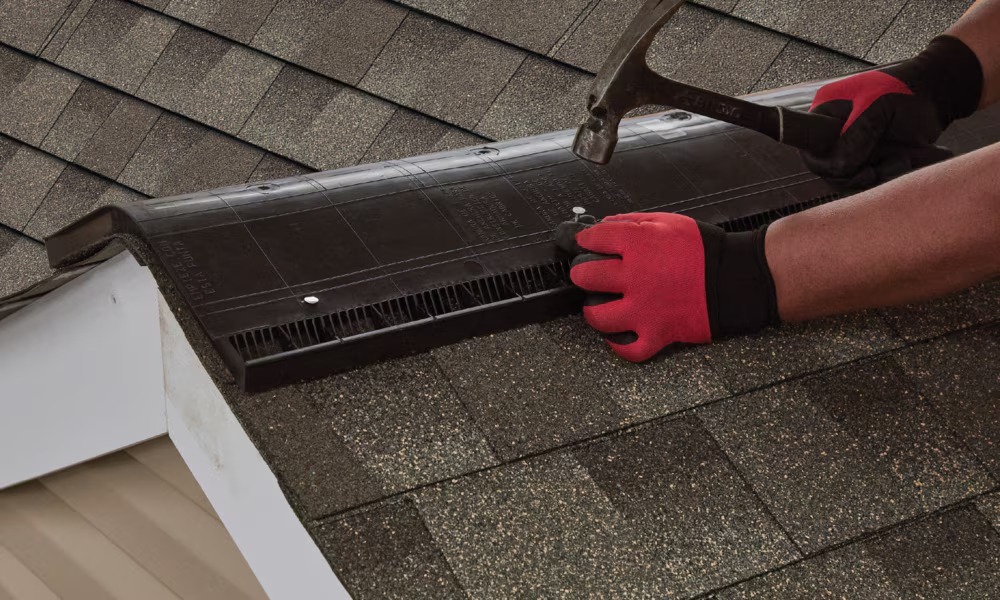
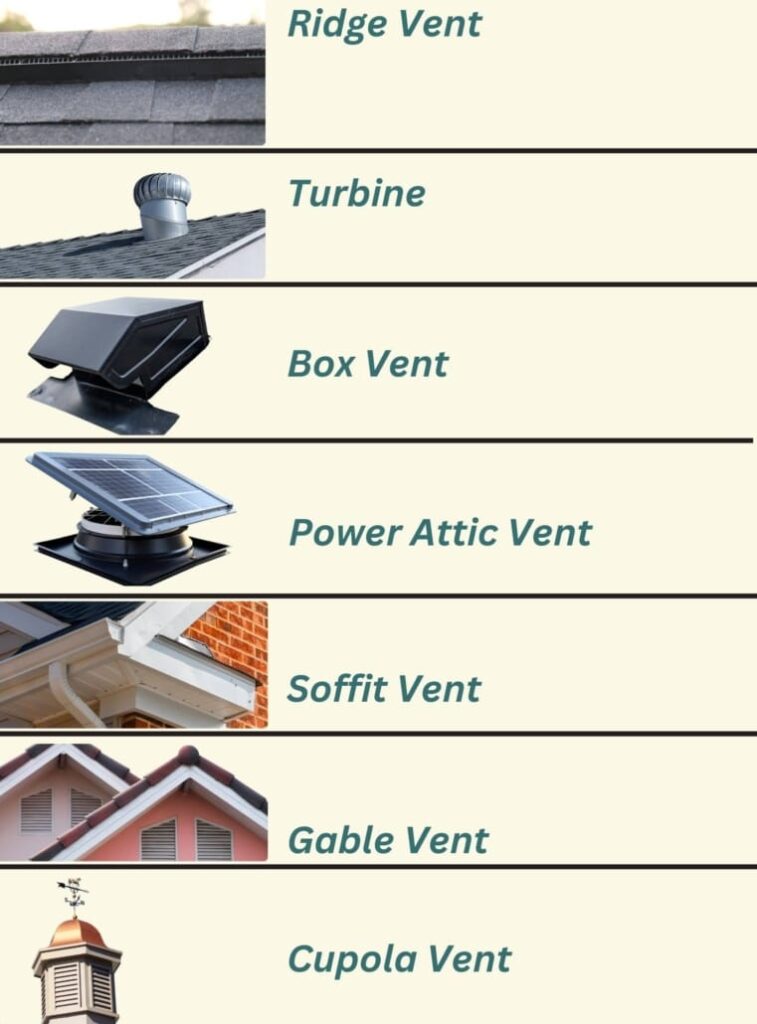
Ridge Vents
These run along the peak of your roof and allow warm air to escape evenly.
Why they’re smart:
- Continuous airflow
- Low profile
- Excellent for Minnesota freeze-thaw cycles
- Work quietly, invisibly, efficiently
They work best paired with soffit intake.

Soffit Vents (Intake)
These sit underneath the eaves and pull cool, outside air into the attic.
Why they matter:
- They’re the lungs of your roof
- Without intake, nothing exhausts properly
- Prevent ice dam pressure and moisture issues
Most homes need more soffit vents than they have.
Box Vents (Static Vents)
Small, square vents placed near the top of the roof.
Strengths:
- Simple
- Reliable
- Inexpensive
Limitations:
- You need many to equal a ridge vent
- Easy to misplace, making airflow uneven
Gable Vents
Triangle-shaped vents on the sides of a home.
Great for older houses but:
- They don’t mix well with modern systems
- Can short-circuit attic airflow
- Work better when the attic is completely open
Turbine Vents (Whirlybirds)
Spin with the wind to pull air out.
Upsides:
- Move a lot of air
- Self-driven
Downsides:
- Noisy
- Prone to winter freeze
- Not ideal for heavy snow zones
Powered Attic Fans
Electric or solar fans that force hot air out.
Pros:
- Tons of airflow
Cons:
- Can pull conditioned air from your home if intake is weak
- Increase energy usage
- Often oversold as cure-all solutions
Off-Ridge Vents
Small ridge-style vents placed below the peak.
Solid in certain roof shapes but not ideal as a primary system.
The Most Common Ventilation Setup That Actually Works
For most Minnesota homes, the winning combo is simple:
Ridge vent exhaust + wide-open soffit intake.
This gives smooth airflow, protects against winter moisture, and helps prevent ice dams.
Anything else is usually a workaround for a roof shape that doesn’t allow this setup.
The Vent Combinations That Work (And the Ones That Cause Chaos)
Best Combo for Most Minnesota Homes
Ridge Vent + Soffit Intake
This is the gold standard. Smooth airflow. Even temperatures. Lower energy bills. Strong protection against ice dams. Works for most modern roof shapes.
Runner-Up (For Hip Roofs or Complex Shapes)
Box Vents + Soffit Intake
Not as sleek as ridge vents, but effective when installed in the correct quantity and pattern.
Good for Older Homes
Gable Vents + Soffit Intake
Still works on older, open-attic designs, but avoid mixing with ridge vents.
Situational Use Only
Powered Attic Fans
Best when:
- The attic is extremely hot
- Intake is strong
- Proper air sealing is done
Worst when:
- Intake is weak (can pull A/C from your home)
- The roof is already well-ventilated
- Winter frost is a concern
Avoid These Mixes at All Costs
Ridge Vents + Gable Vents Together
This combo short-circuits airflow and reduces overall ventilation.
Powered Fans + Ridge Vents
Fans steal air directly from ridge vents instead of pulling from soffits. Airflow collapses.
Turbines + Ridge Vents
Too many exhaust points = no stable pattern of airflow.
When in doubt: keep it simple and keep it balanced.
How Much Ventilation Do You Actually Need? (The 1:150 Rule in Plain English)
Most homeowners never hear this part. Ventilation is measured by Net Free Area (NFA). The standard rule:
For every 150 square feet of attic space, you need 1 square foot of ventilation — split evenly between intake and exhaust.
You don’t need to memorize the math. You just need the logic:
- Half the airflow comes in (soffits)
- Half the airflow goes out (ridge or box vents)
- When those numbers match, the system breathes properly
If intake is blocked, everything fails.
If exhaust is weak, nothing moves.
If they’re unbalanced, you waste energy and shorten roof life.
This is why so many homes suffer. Most ventilation is installed by eye, not by calculation.
Real Minnesota Ventilation Problems (And What Solved Them)
The “Hot Upstairs” Home in Arden Hills
Problem: Upstairs always 10–15 degrees hotter than the main level.
Cause: Soffits painted shut thirty years ago.
Fix: Opened soffits, added baffles, installed ridge vent.
Result: Upstairs cooled dramatically within 48 hours.
The “Mystery Mold” Home in White Bear Lake
Problem: Black spots forming on roof sheathing.
Cause: Bathroom fan vented into attic + poor exhaust.
Fix: Re-ran vent outside, added ridge vent, removed saturated insulation.
Result: Mold gone, attic dry.
The “Ice Dam Every Winter” Home in Shoreview
Problem: Recurring ice dams despite roof raking.
Cause: Weak intake, oversized insulation blocking airflow.
Fix: Cleared soffits, added continuous intake vents, improved airflow.
Result: Roof stayed cold and ice dams vanished.
These kinds of stories repeat across Minnesota because ventilation mistakes are built into many homes from day one.
Common Ventilation Myths Homeowners Have to Unlearn
“Adding more vents solves everything.”
No — more vents often disrupt airflow if not balanced.
“My attic isn’t supposed to be cold.”
In winter, your attic should be the same temperature as outside. That’s how you stop ice dams.
“I’ll just install a powered fan to fix my heat issue.”
A powered fan with poor intake will pull your conditioned air into the attic.
“My home is new, so the builder did it right.”
Not always. Ventilation shortcuts are common in new builds.
FAQ: Roof Ventilation Types
What’s the easiest vent to add on an existing home?
Soffit intake. It’s the most impactful upgrade.
Do I need a ridge vent?
If your roof shape allows, yes. It’s the most efficient exhaust.
Can I mix vent types?
Only when designed by someone who understands airflow. Random combinations cause problems.
How do I know if my attic is under-ventilated?
Look for heat imbalance, musty smells, frost in winter, or fast shingle aging.
Do vents reduce ice dams?
Yes. Better airflow = a colder attic = fewer ice dams.
Should my attic be insulated more instead of vented?
You need both. Insulation slows heat transfer. Ventilation removes excess heat and moisture.
Can ventilation lower my energy bill?
Absolutely. Balanced airflow reduces attic heat load, helping your AC and furnace work less.
Why Ventilation is One of the Most Overlooked Parts of Roofing
Most roofing companies focus on shingles because shingles are easy to sell.
Ventilation isn’t flashy.
It isn’t fun to talk about.
It takes skill to diagnose.
It takes time to explain.
But nothing protects your roof more.
Ventilation affects lifespan, comfort, energy efficiency, and winter performance more than any other factor.
Good shingles installed over a bad ventilation system still fail early.
Where Owl Roofing Steps In
Homeowners deserve someone who cares about the whole system, not just the sale. Owl Roofing checks attic airflow on every inspection, explains intake and exhaust in plain language, and designs vent setups that fit Minnesota homes — not generic templates.
You get photos.
You get clear recommendations.
You get honest math behind the airflow.
You get the kind of communication that makes everything simple.
Because your home should breathe properly.
And because protecting your nest starts with the things you can’t see but feel every day.
📍 Owl Roofing Serves the Entire Twin Cities Metro
Andover · Anoka · Apple Valley · Arden Hills · Big Lake · Blaine · Bloomington · Brooklyn Center · Brooklyn Park · Burnsville · Champlin · Chanhassen · Chaska · Columbia Heights · Coon Rapids · Cottage Grove · Crystal · deephaven · Delano · Eagan · East Bethel · Eden Prairie · Excelsior · Farmington · Forest Lake · Fridley · Golden Valley · Ham Lake · Hastings · Hopkins · Hugo · Inver Grove Heights · Lake Elmo · Lakeville · Lino Lakes · Mahtomedi · Maplewood · Mendota Heights · Minneapolis · Minnetrista · Mound · Mounds View · New Brighton · New Hope · North Oaks · North St. Paul · Oak Grove · Oakdale · Plymouth · Prior Lake · Ramsey · Richfield · Robbinsdale · Rosemount · Roseville · Saint Paul · Savage · Shakopee · Shoreview · South St. Paul · St. Louis Park · St. Michael · St. Paul · Stillwater · Vadnais Heights · Victoria · Waconia · wayzata · West St. Paul · White Bear Lake · woodbury
Licensed Minnesota roofing contractor · Free inspections · 10-year workmanship warranty · Get a free estimate →

Recent Articles
Explore The Blog