What Is the 25% Rule in Roofing? (Minnesota Code, Insurance Claims & Repair Limits Explained)
 12min Read
 Posted 2.21.2026
If you’ve had a roofer inspect storm damage in Minnesota lately, there’s a good chance you heard a number thrown around: 25%. It sounds arbitrary, but it’s actually one of the most important thresholds in residential roofing — and it can be the difference between a $1,800 patch job and a full roof replacement covered by your insurance.
The “25% rule” is a building code provision adopted (in some form) by every state that follows the International Building Code, including Minnesota. It governs how much of a roof a contractor is allowed to repair before the entire roof has to be brought up to current code. For homeowners, it has also become shorthand for when insurance carriers start treating a damaged roof as a replacement claim instead of a repair claim.
Here’s what the rule actually says, how it’s enforced in Minnesota, why insurers care about it, and what it means for you if you’re staring down a damaged roof this spring.
What the 25% Rule Actually Says
The rule traces back to Section R908.3 of the International Residential Code (IRC) and its commercial counterpart in the International Building Code (IBC). In plain English, it states: if more than 25% of a roof covering is replaced, repaired, or recovered within any 12-month period, the entire roof must be brought into compliance with current code.
In Minnesota, that code is the 2020 Minnesota State Building Code, which adopts the IRC with state-specific amendments through the Minnesota Department of Labor and Industry. So while the 25% threshold is a national benchmark, it’s written into our state code too.
What this means practically:
- If a contractor repairs 24% of your roof, they can patch it and stop.
- If they cross 25%, they’re legally required to tear off the entire existing roof system, install current code-required ice-and-water shield, drip edge, underlayment, and ventilation, and bring the whole assembly up to current standard.
That’s why the 25% rule matters financially: crossing the threshold triples or quadruples the scope of the job.
Why the 25% Rule Exists
The rule isn’t arbitrary. It exists for three concrete reasons:
Structural integrity. A roof is designed as a system — shingles, underlayment, ice barrier, flashing, ventilation, and decking all work together. When you patch half of a roof, you end up with two different-aged systems trying to do one job. Patches over old decking or mismatched underlayment are common leak points.
Manufacturer warranties. Most shingle manufacturers (GAF, CertainTeed, Owens Corning, Malarkey) require that repairs not exceed a small percentage of the roof for warranty coverage. Once you cross their threshold, the warranty voids. The 25% code limit closely tracks manufacturer limits.
Insurance pool risk. Insurers price claims based on expected longevity of repaired roofs. Partial repairs fail at higher rates than full replacements, driving more recurring claims. By codifying the 25% cutoff, regulators and carriers aligned on a number that discouraged risky patch jobs from being sold as cheaper alternatives.
How the 25% Rule Applies in Minnesota Specifically
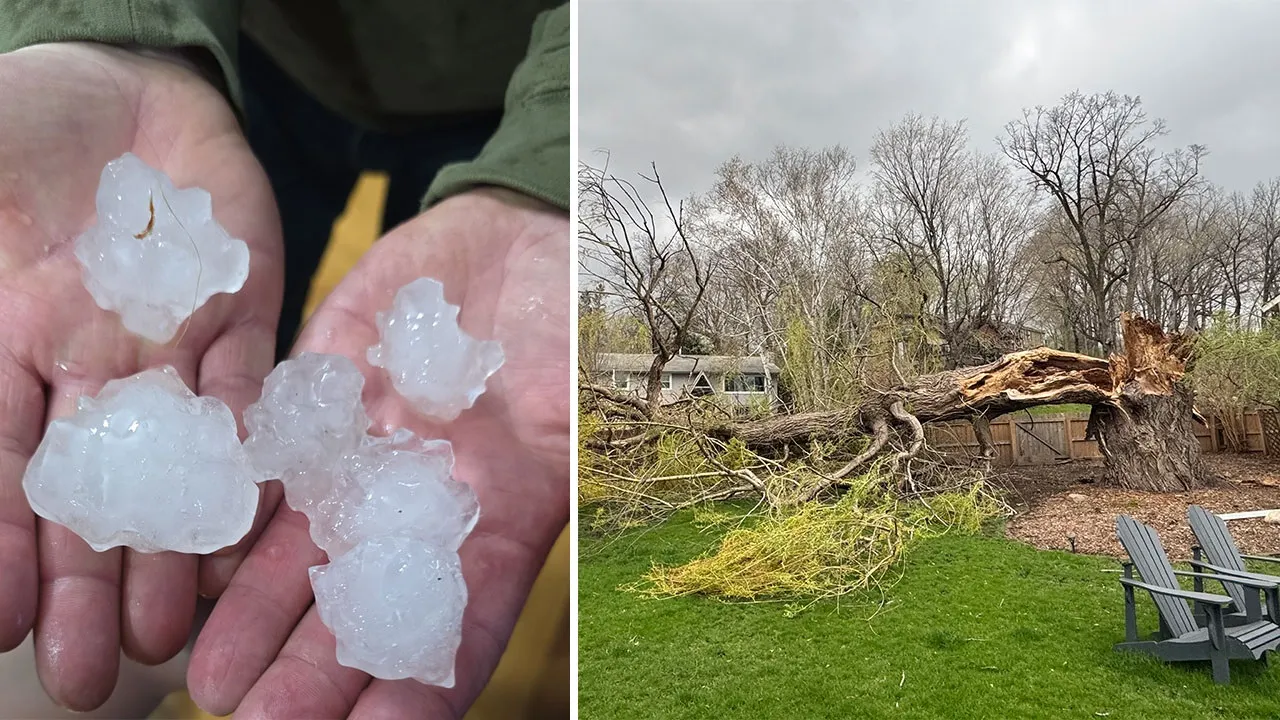
Minnesota’s climate makes the rule especially relevant. According to NOAA’s Storm Events Database, Minnesota logs over 300 severe hail events annually, with the Twin Cities metro alone averaging 8–10 damaging storms per year. That’s a lot of insurance claims, and a lot of roofs sitting right at the 25% threshold. If you’re curious how inspectors measure damage, our guide on how to identify hail damage on shingles walks through what qualifies as “functional damage” versus cosmetic.
The Minnesota Department of Labor and Industry clarifies that 25% is measured per roof section, not per total roof area. A “roof section” is defined as any continuous plane separated by a ridge, valley, or wall. So:
- A simple gable roof with two planes = two sections.
- A complex cut-up roof with 6 planes = six sections, each measured separately.
If more than 25% of any single section is damaged, that section requires a full tear-off. This is a critical nuance many homeowners miss when they get bids — and it’s why understanding what size hail actually damages a roof matters for accurate damage counts.
Additionally, Minnesota code requires that any new roof installation (including tear-offs triggered by the 25% rule) include ice-and-water shield extending at least 24 inches inside the exterior wall line, drip edge on all eaves and rakes, adequate ventilation per R806, and proper nailing patterns. So when the 25% rule kicks in, your project cost includes not just tear-off and new shingles, but ice barrier, ventilation upgrades, decking repair if needed, and permit fees.
How Insurance Carriers Use the 25% Rule
While the 25% rule is a building code rule, insurance carriers have absorbed it into their claim decisions. Here’s how it typically works:
- Your adjuster inspects the roof and counts damaged shingles (for hail), wind-blown shingles (for wind), or affected slopes.
- If damage is localized to under 25% of any section, they typically pay for a repair — often called a “spot repair” — which replaces the damaged shingles but leaves the rest intact.
- If damage exceeds 25% of a section, they’re obligated under Minnesota code to pay for a full replacement of that section (or often the whole roof, since matching old shingles to new is difficult).
- If the existing shingles are discontinued and can’t be matched, some Minnesota insurers invoke the “matching statute” (Minn. Stat. § 65A.10) to pay for replacement of adjacent sections for aesthetic uniformity.
This is why accurate damage mapping matters so much. For a deeper dive on insurance specifics, see our post on whether insurance will pay for a new roof.
Repair vs. Replacement: How the Math Plays Out
Here’s a side-by-side of how the 25% threshold changes the scope and cost of a typical Minnesota roof claim:
| Factor | Under 25% Damage (Repair) | Over 25% Damage (Replacement) |
|---|---|---|
| Scope | Localized shingle replacement | Full tear-off + new system |
| Typical Cost (2,000 sq ft roof) | $800 – $2,500 | $9,000 – $18,000 |
| Warranty Impact | May void manufacturer warranty | Full new warranty (25–50 yrs) |
| Code Upgrade Required | No | Yes (ice barrier, ventilation, drip edge) |
| Insurance Treatment | Actual Cash Value (ACV) basis | Replacement Cost Value (RCV) basis |
| Expected Remaining Roof Life | 0–7 years (depending on age) | 25+ years |
| Future Claim Risk | Higher (patches fail first) | Lower (uniform new system) |
What to Do If You’re Near the 25% Threshold
If a contractor tells you your damage is “right around 25%,” stop and do three things:
- Get a second opinion. Have a different licensed roofer perform their own damage count. Contractors sometimes differ by 5–10% depending on methodology (e.g., whether they count “functional damage” like granule loss or only fractures).
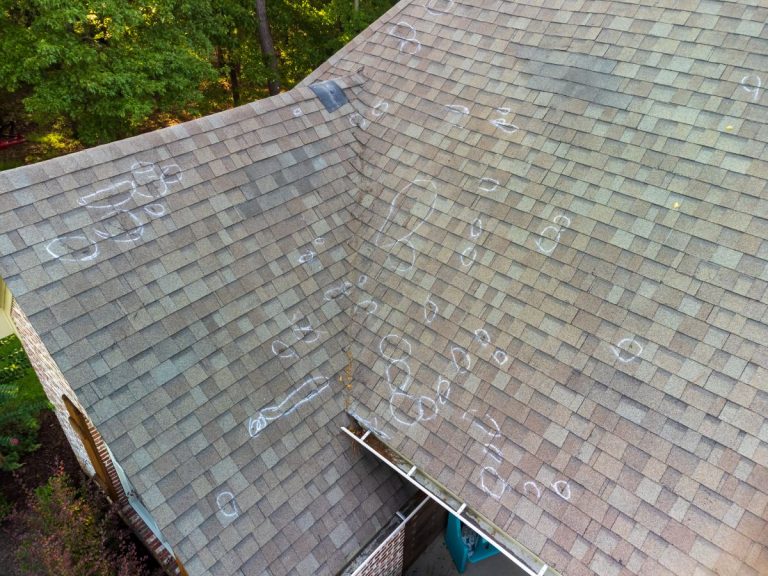
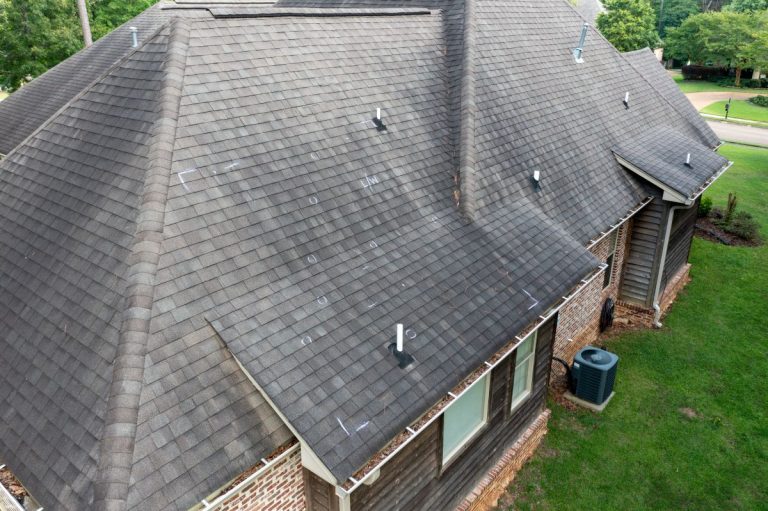
- Require a roof diagram. A reputable contractor will deliver a marked-up roof diagram showing every damaged shingle, with a total damage count and percentage calculation per slope. This is your documentation if your insurer disputes the finding.
- Ask your adjuster to re-inspect. In Minnesota, you have the right to a re-inspection if you disagree with the initial damage count. Bring your contractor’s diagram.
The Insurance Institute for Business and Home Safety recommends homeowners document damage independently (photos with a measuring tape, timestamped) within 48 hours of a storm to protect against disputes. The final decision between repair and replacement also depends on factors beyond the 25% rule — age, material type, and climate exposure — which we cover in our guide on roof repair vs. replacement.
Common Scenarios We See in the Twin Cities
Scenario 1 — The hail storm borderline. An April storm drops 1″ hail across Shoreview. Your north and west slopes show dense hits; your south and east slopes are untouched. The contractor measures 32% damage on the north slope and 28% on the west. Both qualify for replacement under the 25% rule. Because of the matching statute, the insurer often authorizes a full roof replacement to preserve uniform appearance.
Scenario 2 — The partial wind event. A straight-line wind storm tears off 18% of shingles on one slope only. The contractor can repair without crossing 25%, so the insurer pays ACV for shingle replacement. No code upgrade is triggered, but the patched slope will show a color mismatch if the original shingles are weathered.
Scenario 3 — The age-plus-damage case. A 19-year-old roof sustains moderate hail damage (22% on two slopes). Because it’s under 25%, the insurer pays for a repair — but the shingles are at end of life anyway. Many homeowners pay out of pocket to finish the replacement. For a broader view of how insurance treats older roofs, read does home insurance cover roofs.
How the 25% Rule Interacts with Other Code Requirements
Minnesota code also caps the number of shingle layers at two (R908.3). If you already have two layers, the 25% rule doesn’t apply the same way — any repair crossing the threshold triggers a full tear-off regardless, because you can’t add a third layer. If you’re not sure how many layers are on your roof, a contractor can check from the attic or during a drip-edge inspection.
The Bottom Line for Minnesota Homeowners
The 25% rule isn’t just a technicality. In a state that sees as many hail storms as Minnesota does, it’s the deciding line between a short-term fix and a full new roof — and it’s the reason documentation during inspection matters so much. If you’re unsure whether your roof is over or under the threshold, a second licensed opinion is almost always worth the cost of the call.
Contact Owl Roofing for a free inspection and damage mapping. We’ll document your slope-by-slope damage and tell you exactly where you stand relative to the 25% threshold — before your insurance adjuster does.
What Owl Roofing Customers Actually Say
Real, verified Google reviews from real customers Owl Roofing maintains a 5.0 Google rating with 30+ five-star reviews.
Noah is the real deal. After our insurance denied our roof claim and the first roofer walked away, Noah showed up the next day and said he thought he could get us a new roof. He delivered. He got us a roof covered by insurance after it had already been declined. We came up with a nickname for him: “The Roof Whisperer.”
— Tyler Moberg, verified Google review
I am an Independent Insurance Agency owner and have worked with Noah on several roof projects. The homeowners have been extremely satisfied with the quality of work and craftsmanship Noah and his crews have provided. From filing the claim to replacing the roof and cleaning up the job site, Noah and his crew are the best!
— Fred Zappa, Independent Insurance Agency Owner
We used Owl Roofing for a repair on our roof in Brooklyn Park, and I was blown away by how good they were. Every member of the team communicated well about the process. Their price transparency was super helpful. They got the work done very fast, and the team was professional and very kind.
— Matt Brown, Brooklyn Park (verified Google review)
Noah and his team are outstanding! His clear communication, professionalism, and workmanship are top-notch. I recommend Owl Roofing to all my clients, friends, and family.
— Christine Westlund, verified Google review
It didn’t feel like dealing with a big company — it felt like working with people who actually care about the homes and community in the North Oaks and Shoreview area. Great people, great communication, and really solid work.
— Cody Warren, verified Google review
Frequently Asked Questions
Does the 25% rule apply to commercial roofs?
Yes. The International Building Code applies the same 25% threshold to commercial low-slope roofs, though the measurement methodology differs (typically square feet affected rather than shingles).
Can a contractor legally repair more than 25% without tearing off the roof?
No. In Minnesota, exceeding the 25% threshold without pulling a tear-off permit is a code violation. A contractor who does this exposes both themselves and the homeowner to liability and warranty issues.
Does insurance pay for the 25% rule’s extra code requirements?
Most Minnesota policies include “ordinance or law” coverage (Coverage C) that pays for code-required upgrades like ice barrier and ventilation when a covered loss triggers them. Check your specific policy — limits vary.
How is the 25% calculated — by number of shingles or by area?
By area, per roof section. A roof section is a single continuous plane. Damaged shingles are counted and multiplied by shingle size to calculate affected square footage, then divided by total section square footage.
What if my damage is 24% — am I just unlucky?
Close calls are worth a second opinion. A 2% difference can represent just 10–15 shingles on a typical slope — easily within the margin of inspection variance. If a reputable second roofer finds you over 25%, you can request a re-inspection.

Recent Articles
Explore The Blog