





Flat Roof Lifespan and Maintenance Tips
 12min Read
 Posted 10.20.2025
Flat Roof Lifespan and Maintenance Tips
Here’s a stat that might make you wince: 73% of homeowners don’t inspect their roof until they see visible damage—usually a water stain spreading across the ceiling. If you’ve got a flat roof on your Twin Cities home (common on additions, garages, and mid-century ramblers around here), that wait-and-see approach could cost you thousands.
The problem? Flat roofs are sneaky. Unlike sloped roofs where missing shingles wave at you from the street, flat roof damage hides in plain sight—pooling water, tiny membrane cracks, seams quietly separating. By the time you notice something’s wrong inside, the damage has been brewing for months. And in Minnesota, where we freeze, thaw, freeze again, and then dump two feet of snow on top? Those small issues become big ones fast.
But here’s the promise: with the right care and a little attention, a flat roof can protect your home for 15 to 30 years—sometimes longer. We’ve got the data to back it up, from the National Roofing Contractors Association (NRCA) and the Insurance Institute for Business & Home Safety (IBHS). By the time you finish reading this, you’ll know exactly what your flat roof needs to hit the upper end of that lifespan—and how to avoid becoming part of that 73%.
Why Your Flat Roof Deserves More Attention Than It Gets
Let’s be real: nobody thinks about their roof until it fails. It’s not exactly a glamorous home improvement topic. But consider this—according to the National Association of Realtors (NAR), a new roof can recover approximately 107% of its cost at resale. That’s not a typo. Your roof is one of the few home upgrades that can actually pay for itself and then some.
And it’s not just about resale value. The IBHS reports that a well-maintained roof can reduce storm damage by up to 30%. In the Twin Cities, where we get hammered by everything from summer hail to winter ice dams, that 30% is real money staying in your pocket instead of going to emergency repairs.
Think of flat roof maintenance like oil changes for your car. Skip them, and sure, nothing happens immediately. But eventually? You’re looking at engine damage that costs way more than a few $50 oil changes would have. Same principle applies here—except we’re talking about the thing keeping rain, snow, and ice out of your living room.
Understanding Flat Roof Lifespan: The Numbers
How Long Should Your Flat Roof Actually Last?
The short answer: 15 to 30 years, depending on the material and how well you take care of it. That’s a pretty wide range, right? The difference between 15 and 30 years usually comes down to two things: what your roof is made of, and whether anyone’s been paying attention to it.
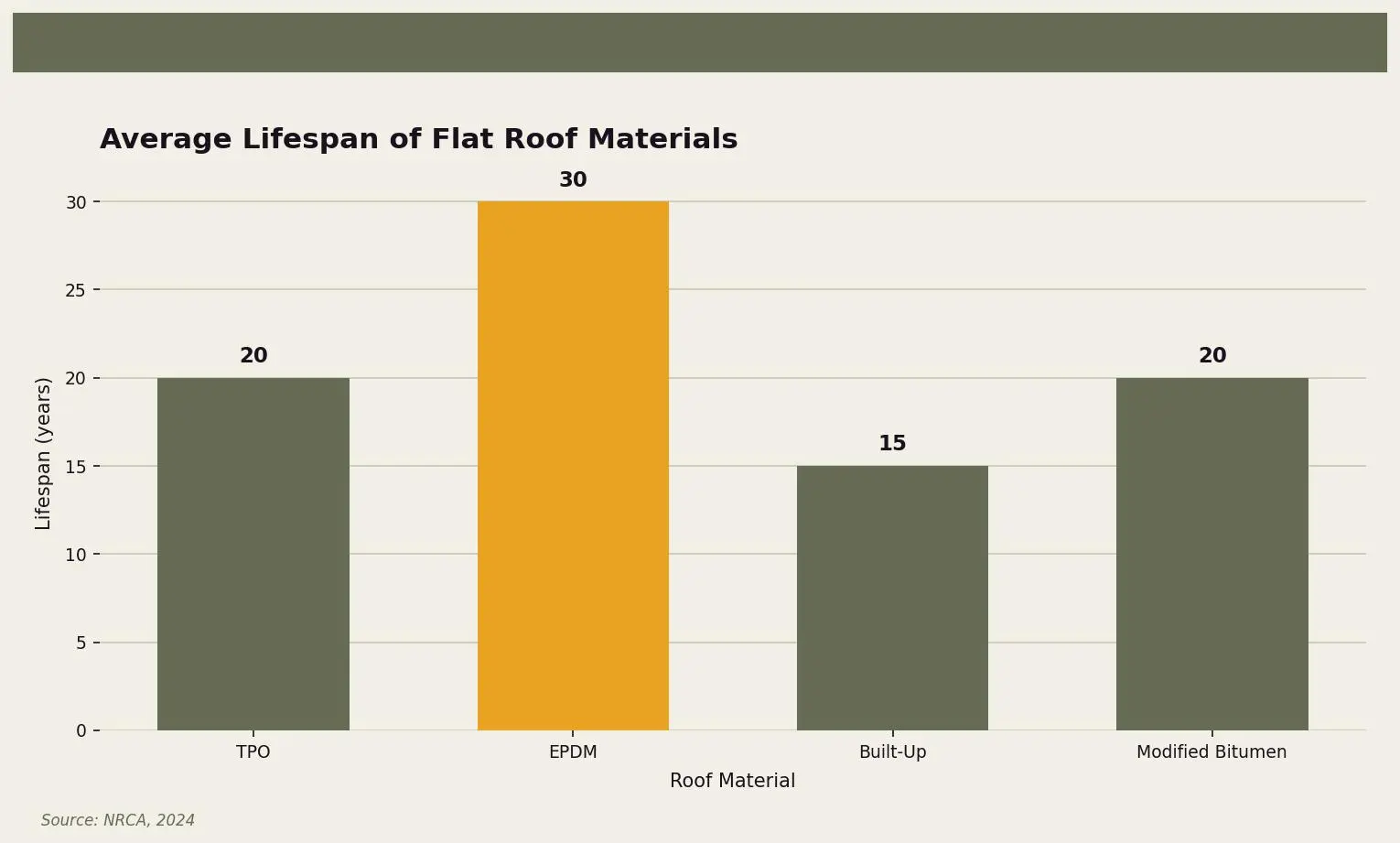
Here’s how the most common flat roof materials stack up, according to NRCA data:
- TPO (Thermoplastic Olefin): 15-20 years. Popular for its energy efficiency and UV resistance. White TPO reflects heat, which can lower cooling costs—though in Minnesota, we’re usually more worried about heating bills.
- EPDM (Ethylene Propylene Diene Monomer): Up to 30 years. The workhorse of flat roofing. This black rubber membrane handles extreme temperatures like a champ, which is exactly what you need when it’s -15°F in January and 95°F in July.
- Built-Up Roofing (BUR): Around 15 years. The old-school option—layers of tar and gravel. Still works, but requires more maintenance than modern alternatives.
- Modified Bitumen: About 20 years. Think of it as built-up roofing’s upgraded cousin. Better flexibility, easier to repair.
Those numbers assume proper installation and regular maintenance. Neglect your roof, and you can easily shave 5-10 years off any of those figures.
What Actually Determines How Long Your Roof Lasts
Material matters, but it’s not the whole story. Here’s what else affects your flat roof’s lifespan:
Installation quality. A flat roof installed by someone who knows what they’re doing will outlast a bargain-basement job every time. Seams need to be properly sealed. Flashing around vents and edges needs to be watertight. Drainage has to be planned correctly. Cut corners here, and you’ll pay for it later.
Climate stress. We’ll get into Minnesota-specific challenges in a minute, but the basic principle is simple: extreme temperatures and moisture are hard on roofing materials. The more stress your roof faces, the more maintenance it needs.
Drainage. Flat roofs aren’t actually flat—they have a slight slope to direct water toward drains. If that drainage gets blocked or the slope wasn’t done right, water pools on the surface. Standing water is enemy number one for flat roofs. It accelerates membrane breakdown, adds weight stress, and eventually finds its way inside.
Maintenance (or lack thereof). This is the factor you have the most control over. Regular inspections catch small problems before they become expensive disasters. It’s really that simple.
Flat Roof Maintenance: What Actually Needs to Happen
The Bi-Annual Inspection Rule
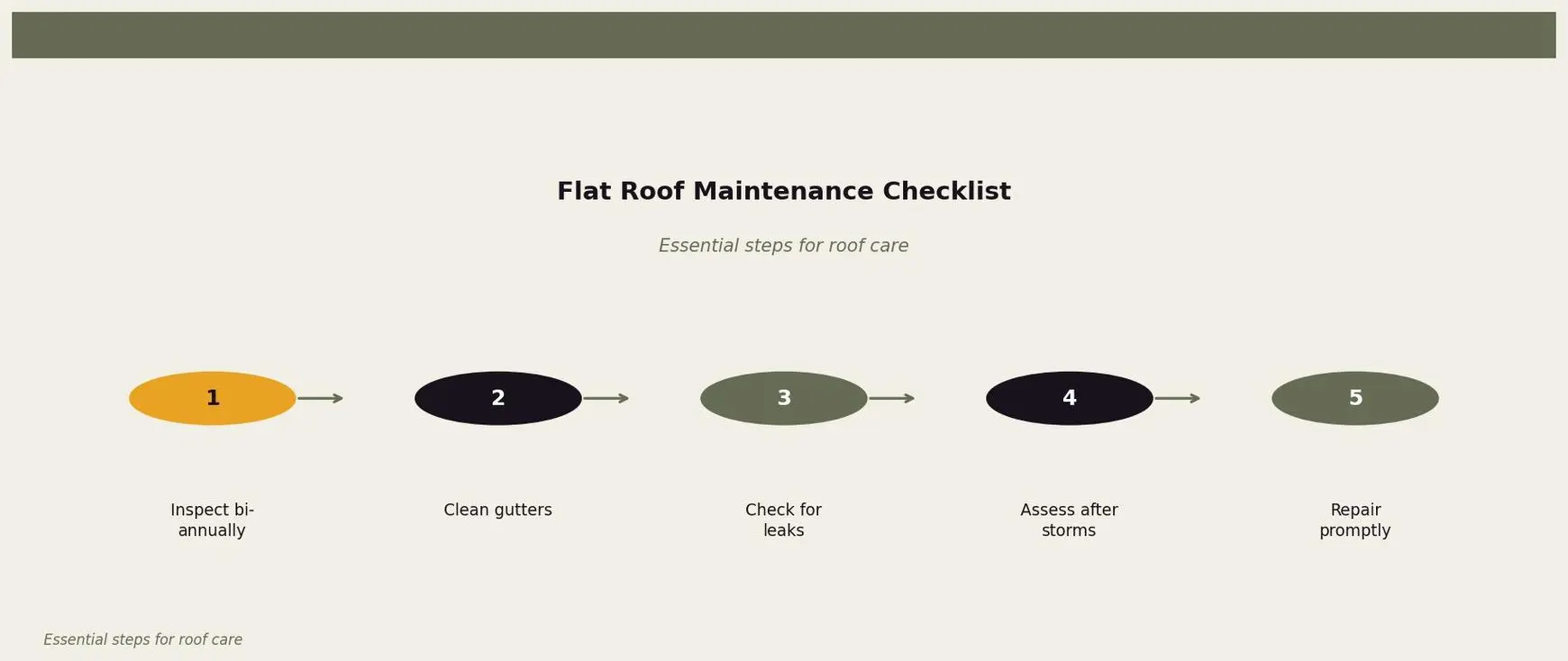
The NRCA recommends inspecting flat roofs twice a year—once in spring and once in fall. Spring catches any damage from winter’s ice and snow. Fall prepares you for what’s coming. Think of it as a roof physical: you’re looking for early warning signs before symptoms turn serious.
Here’s what a good inspection covers:
- Membrane condition: Look for cracks, blisters, punctures, or areas where seams are separating. Even small damage lets moisture in.
- Ponding water: After rain, water should drain within 48 hours. If you’ve got puddles sitting longer than that, you have a drainage issue.
- Flashing integrity: The metal pieces around edges, vents, and penetrations take a beating. Check for rust, gaps, or lifting.
- Debris accumulation: Leaves, branches, and random stuff blown onto your roof can trap moisture and clog drains. Clear it out.
- Gutter and drain function: Water needs somewhere to go. Clogged gutters cause backup, which causes pooling, which causes leaks.
Post-Storm Checks: Non-Negotiable in Minnesota
After any significant weather event—hailstorm, heavy snow, high winds—your roof deserves a look. You don’t necessarily need to climb up there yourself (in fact, please don’t if you’re not comfortable with heights or walking on a flat roof safely). But you should at least check for obvious signs of trouble: new leaks inside, debris on the roof visible from ground level, or damaged flashing you can see from a distance.
Hail is particularly sneaky on flat roofs. It can create small punctures in the membrane that aren’t visible from the ground but will absolutely cause problems when the next rainstorm hits.
TPO vs. EPDM: Different Materials, Different Needs
If you have a TPO roof, plan on more frequent inspections—the seams on TPO roofs can be a weak point, especially as the material ages. The upside? TPO is highly reflective and energy-efficient, and repairs are relatively straightforward when caught early.
EPDM roofs are more forgiving. The rubber membrane handles temperature swings well and tends to be more durable overall. That said, EPDM seams are held together with adhesive or tape, which can fail over time. Check those seams carefully during inspections.
The best material for your home depends on your budget, your roof’s specific situation, and how much maintenance you’re willing to do. There’s no universal “best” choice—just the right choice for your circumstances.
Minnesota Weather vs. Your Flat Roof: A Tough Matchup
Let’s talk about what our climate does to flat roofs, because it’s not gentle.
The freeze-thaw cycle. This is the big one. Water gets into tiny cracks or under seams. It freezes. Ice expands. The crack gets bigger. It thaws. More water gets in. Repeat this dozens of times over a Minnesota winter, and a hairline crack becomes a leak. According to the IBHS, roofs in cold climates like ours are 20% more susceptible to weather-related damage than roofs in milder regions.
Snow load. Flat roofs hold snow differently than sloped roofs—it just sits there. Most flat roofs are engineered to handle typical snow loads, but a particularly heavy winter (or snow drifting against a parapet wall) can stress the structure. And when that snow melts? All that water needs somewhere to go.
Ice dams. You’ve probably heard about ice dams on sloped roofs, but flat roofs can develop their own version—ice buildup around drains and edges that blocks water flow. When water can’t drain, it backs up and finds another way out. Usually through your ceiling.
Summer heat. Minnesota summers might not rival Arizona, but we get our share of 90°F+ days. That heat beats down on your roof membrane, causing expansion during the day and contraction at night. Over years, this thermal cycling fatigues the material.
The takeaway? Minnesota is genuinely harder on flat roofs than many other places. That means maintenance here isn’t optional—it’s essential.
Your Flat Roof Action Plan
Enough background. Here’s exactly what to do to maximize your flat roof’s lifespan:
Step 1: Get a professional inspection. If you don’t know the current condition of your roof, start there. A qualified roofer can identify existing issues you might not spot yourself and give you a realistic assessment of your roof’s remaining lifespan.
Step 2: Fix small problems immediately. That tiny blister or minor seam separation? Address it now. Small repairs cost a fraction of what you’ll pay if water damage spreads. Procrastination is expensive.
Step 3: Establish a maintenance routine. Mark your calendar for spring and fall inspections. Clean gutters and drains at least twice a year—more if you have trees nearby. Check the roof after every major storm.
Step 4: Know your materials. Find out what your flat roof is made of and learn its specific maintenance needs. TPO, EPDM, and built-up roofs each have their quirks.
Step 5: Plan for the future. If your roof is approaching the end of its expected lifespan, start thinking about replacement before it fails. Emergency roof replacements are stressful and often more expensive than planned ones.
Being proactive with your flat roof isn’t complicated. It just requires actually doing it—which, if that 73% statistic is accurate, most homeowners don’t.
Protect Your Flat Roof—And Your Peace of Mind
Here at Owl Roofing, we’ve seen every stage of flat roof life—from brand-new installations to “I really should have called someone about this three years ago” situations. No judgment either way. We’re a family-owned company based right here in Shoreview, and we serve homeowners across the Twin Cities.
If you’re wondering about your flat roof’s condition, or you just want someone to take a look and tell you straight what it needs, give us a call at 651-977-6027 or visit owlroofing.com/. We’ll do an honest inspection, explain what we find in plain English, and help you figure out the smartest next step—whether that’s a simple repair, ongoing maintenance, or planning for a future replacement.
We’re not storm chasers passing through town, and we’re not a franchise reading from a corporate script. We’re your neighbors, and we’re here when you need us. Protect Your Nest.
📍 Owl Roofing Serves the Entire Twin Cities Metro
Andover · Anoka · Apple Valley · Arden Hills · Big Lake · Blaine · Bloomington · Brooklyn Center · Brooklyn Park · Burnsville · Champlin · Chanhassen · Chaska · Columbia Heights · Coon Rapids · Cottage Grove · Crystal · deephaven · Delano · Eagan · East Bethel · Eden Prairie · Excelsior · Farmington · Forest Lake · Fridley · Golden Valley · Ham Lake · Hastings · Hopkins · Hugo · Inver Grove Heights · Lake Elmo · Lakeville · Lino Lakes · Mahtomedi · Maplewood · Mendota Heights · Minneapolis · Minnetrista · Mound · Mounds View · New Brighton · New Hope · North Oaks · North St. Paul · Oak Grove · Oakdale · Plymouth · Prior Lake · Ramsey · Richfield · Robbinsdale · Rosemount · Roseville · Saint Paul · Savage · Shakopee · Shoreview · South St. Paul · St. Louis Park · St. Michael · St. Paul · Stillwater · Vadnais Heights · Victoria · Waconia · wayzata · West St. Paul · White Bear Lake · woodbury
Licensed Minnesota roofing contractor · Free inspections · 10-year workmanship warranty · Get a free estimate →
