Types of Roof Vents: a Homeowner’s Guide to Proper Roof Ventilation
 7min Read
 Posted 1.22.2026
When homeowners search for types of roof vents, what they’re really trying to understand is how their attic breathes, how moisture escapes, and how their roof system stays healthy for decades instead of years. Ventilation isn’t a flashy topic, but it’s one of the most important—and most misunderstood—parts of a properly installed roof.
At Owl Roofing, we approach roof ventilation the same way we approach everything else: calmly, thoroughly, and with the homeowner’s long-term peace of mind in mind. Before we ever recommend specific types of roof vents, we start with the fundamentals—because no vent works if the attic itself isn’t set up correctly.
How Owl Roofing Evaluates a Properly Ventilated Roof
Before talking about products or profiles, we physically get into the attic. This step is non-negotiable. Many roofing issues blamed on “bad shingles” are actually caused by poor ventilation that was never addressed.
Here’s what we’re checking every time:
- Moisture or mold on the underside of roof sheathing
- Bathroom or kitchen exhaust fans venting into the attic instead of outside
- Blocked or clogged intake areas at the eaves
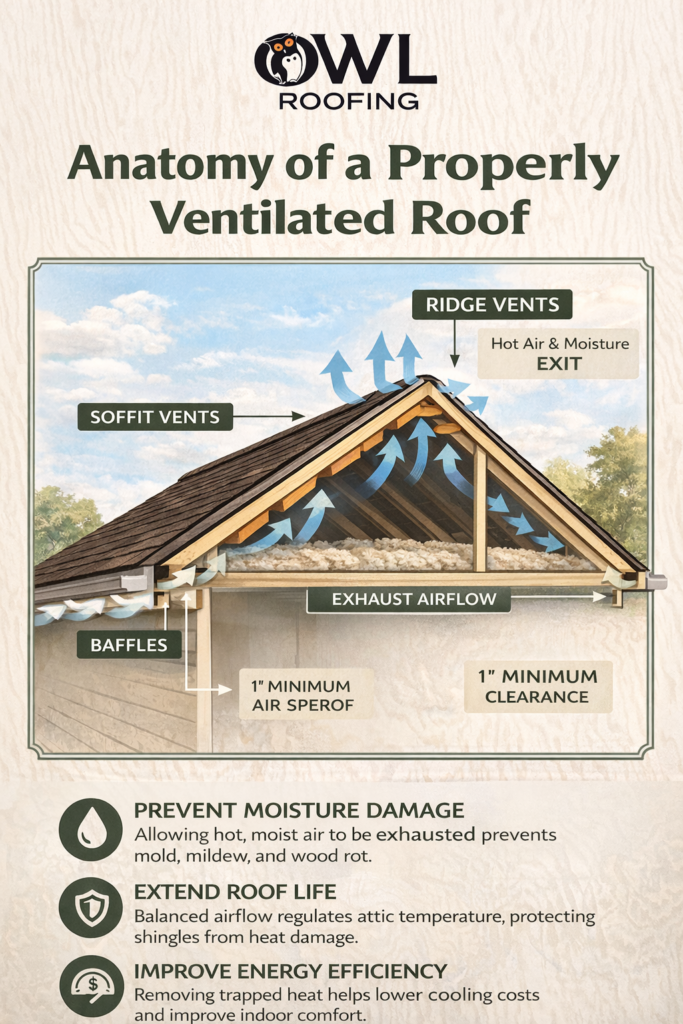
- Insulation clearance, ensuring there is at least 1 inch of airspace between insulation and roof sheathing
If air can’t enter the attic freely at the eaves, no exhaust system—regardless of the types of roof vents installed—will work correctly. Intake is just as important as exhaust, and skipping this step leads to long-term damage that homeowners don’t see until it’s expensive.
Why the Right Types of Roof Vents Matter
Once the attic conditions are confirmed, we evaluate your roofline. Roof pitch, ridge length, eave length, and shared attic spaces all influence which types of roof vents will actually perform well on your home.
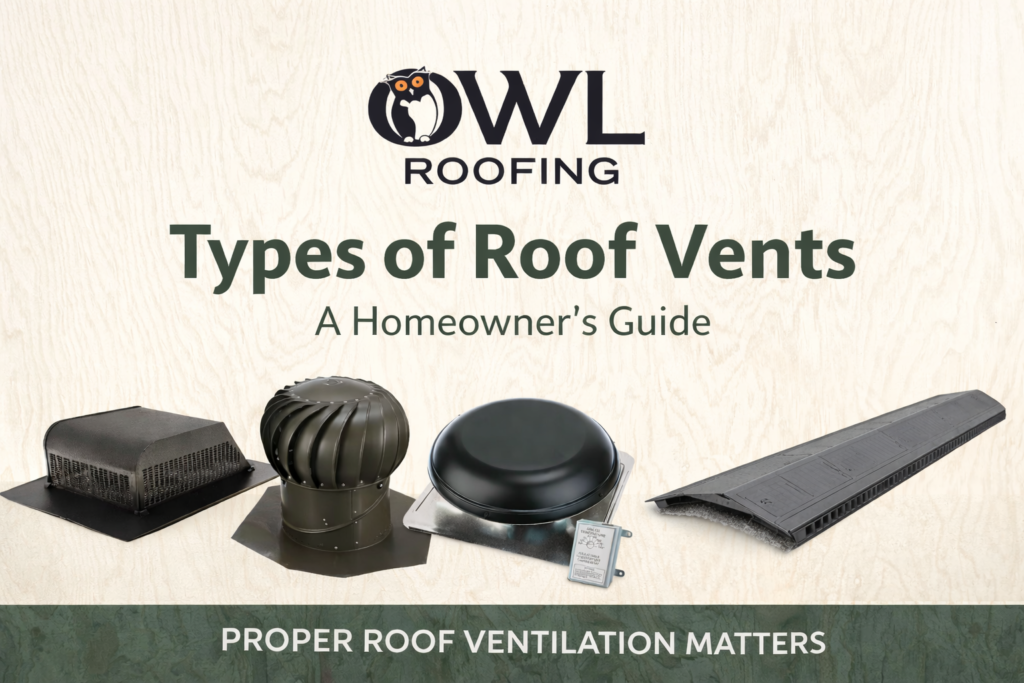
A key rule we follow is balance. Proper ventilation means your intake is within about 10% of your exhaust capacity. The closer you can get to a true 50/50 airflow balance, the better your attic performs. Too much exhaust without enough intake can actually trap moisture, pulling air from the wrong places instead of from the soffits.
This is where choosing between different types of roof vents becomes critical.
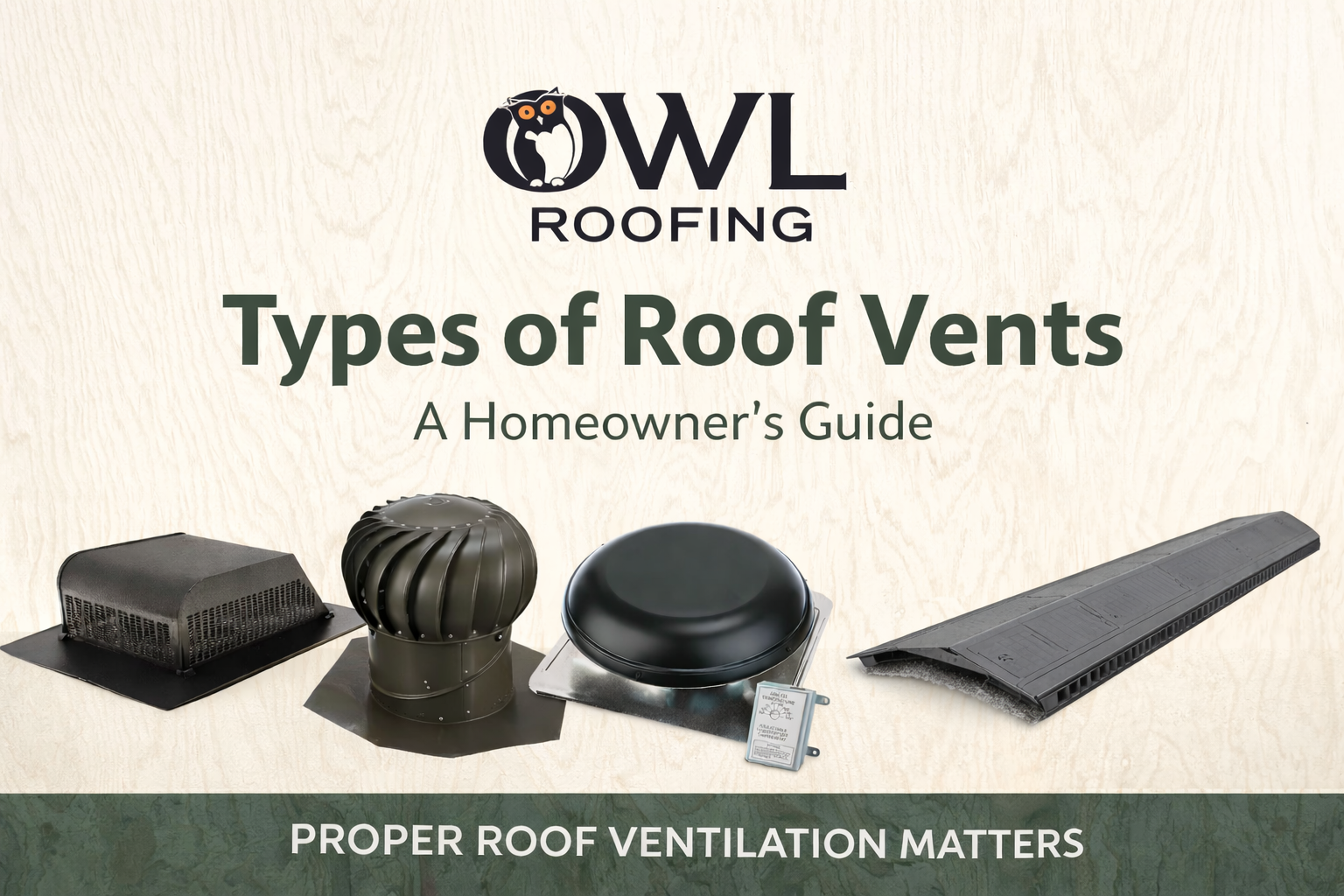
Box Vents (Also Known as Turtle Vents)
Box vents are one of the most common types of roof vents used today.
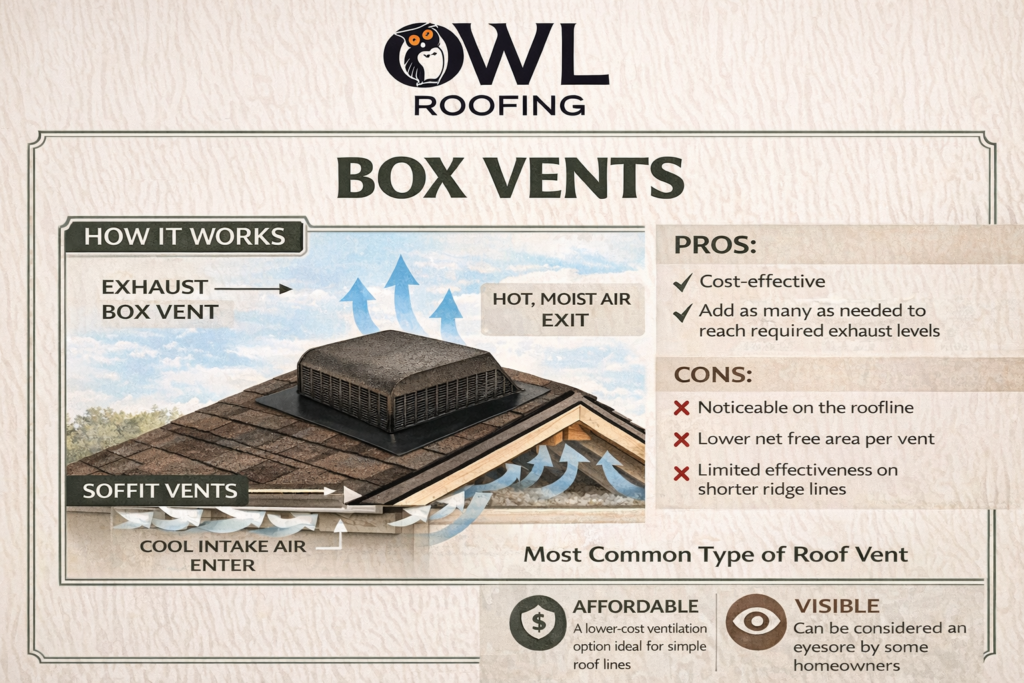
Pros:
- Cost-effective
- Easy to add in quantity to reach required exhaust levels
- Simple, proven design
Cons:
- Visually noticeable and often considered unattractive
- Lower net free area per vent
- Limited effectiveness on roofs with short ridge lines
Box vents work best on simpler roof designs where appearance is less of a concern and enough vents can be installed to achieve proper exhaust. They are functional, but rarely the most elegant solution.
Whirly Birds (Turbine Vents)
Whirly birds are among the most recognizable types of roof vents, thanks to their spinning turbine design.
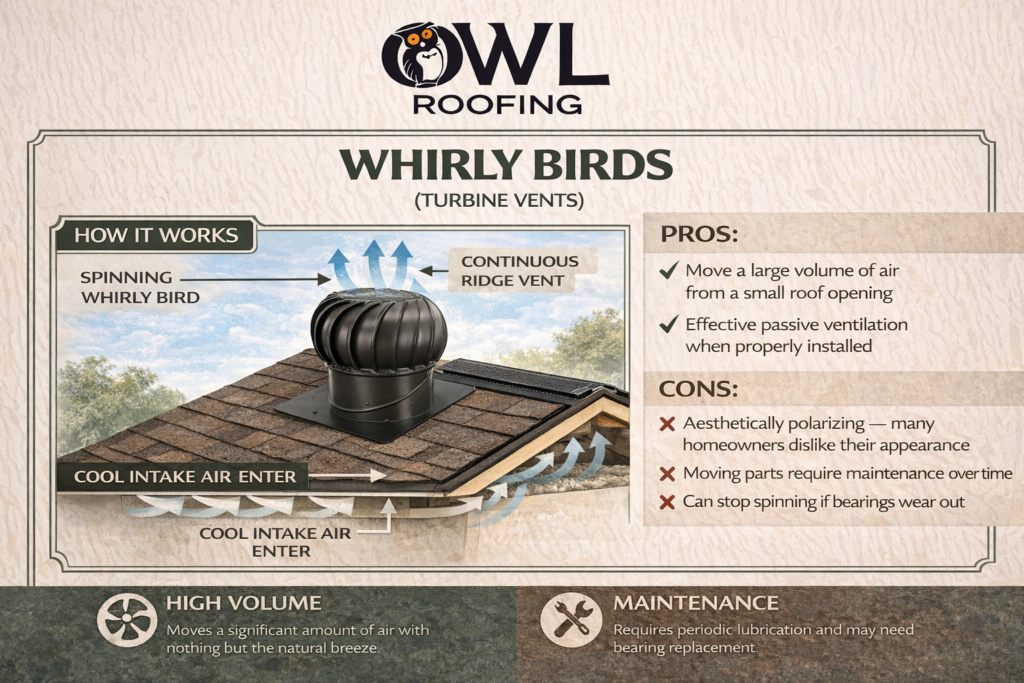
Pros:
- Move a large volume of air from a small roof opening
- Effective passive ventilation when properly installed
Cons:
- Aesthetically polarizing—many homeowners dislike their appearance
- Moving parts require maintenance over time
- Can stop spinning if bearings wear out
Whirly birds can be effective, but they must be installed correctly and maintained. Without upkeep, their performance drops significantly.
Power Attic Fans
Power attic fans are the most aggressive option among common types of roof vents.
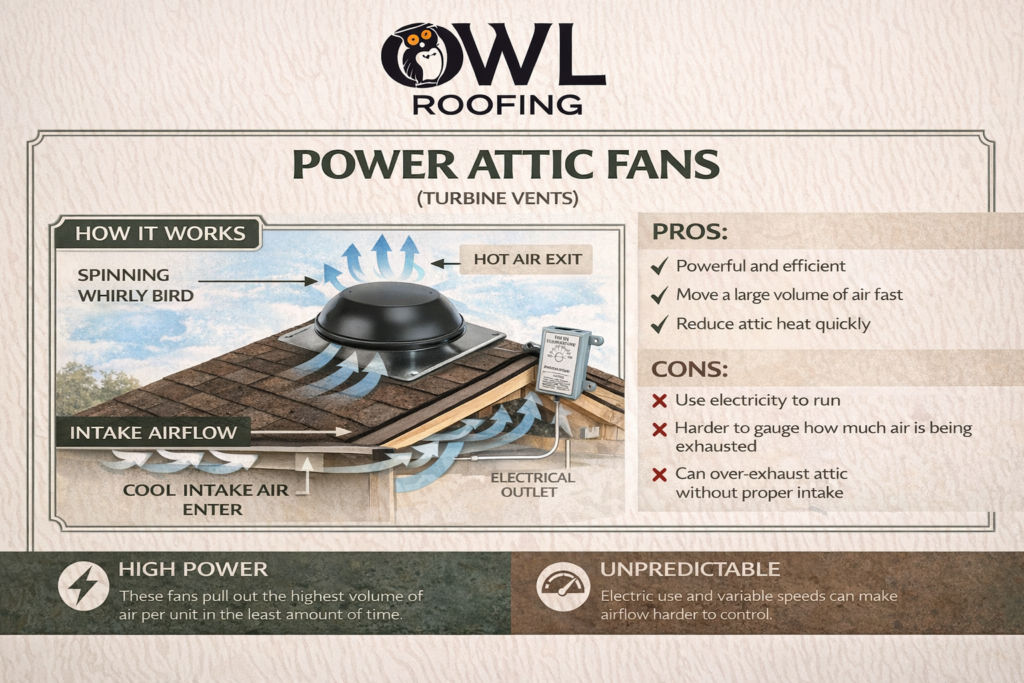
Pros:
- Extremely strong exhaust capacity
- Fewer units needed to move large amounts of air
Cons:
- Use electricity
- Motors can burn out over time
- Harder to precisely measure airflow
- Risk of over-exhausting the attic
Power fans must be carefully sized and paired with adequate intake. Without that balance, they can pull conditioned air from the home instead of fresh air from the soffits.
Ridge Vents (Increasingly Popular)
Ridge vents have become one of the most requested types of roof vents over the last five years, and for good reason.

Pros:
- Clean, low-profile appearance
- Continuous exhaust along the entire ridge
- Easy to calculate balanced airflow when paired with continuous soffit venting
Cons:
- Limited effectiveness if ridge length is short
- Can underperform when eave length greatly exceeds ridge length
When a home has continuous soffit intake and a fully vented ridge, ridge vents are often the simplest and most balanced solution available.
Intake, Exhaust, and Why Mixing Vent Types Is a Problem
One of the most important code-related rules with types of roof vents is this:
You can only use one type of exhaust ventilation per attic space.
Mixing whirly birds with box vents—or adding ridge vent alongside both—creates competing airflow paths. The strongest vent begins pulling air from the weaker one instead of from the soffits. When that happens, only a small portion of the attic breathes, defeating the entire purpose of ventilation.
Whatever types of roof vents are selected must be consistent across all shared attic spaces. Continuity matters more than volume, and we use a great ventilation calculator tool by Lomanco that helps us figure out the proper amount of vents to use.
Choosing the Right System for Your Home
There is no universal “best” option when it comes to types of roof vents. The right solution depends on your roofline, attic layout, intake capacity, and long-term goals for the home.

At Owl Roofing, our role is to guide—not push. We measure, calculate, inspect, and explain so you understand exactly why a specific venting system is recommended. That clarity removes anxiety and prevents costly mistakes down the road.
Ventilation Is About Peace of Mind
Understanding types of roof vents helps homeowners make informed decisions, but proper installation and balance are what truly protect the home. Ventilation isn’t about selling hardware—it’s about keeping moisture out, energy costs down, and your roof system healthy for decades.
If you’re unsure whether your attic is ventilated correctly, or if different types of roof vents have been mixed over the years, a professional evaluation can bring clarity fast.
A calm, dry, well-ventilated attic protects your roof—and your nest. Reach out today!
📍 Owl Roofing Serves the Entire Twin Cities Metro
Andover · Anoka · Apple Valley · Arden Hills · Big Lake · Blaine · Bloomington · Brooklyn Center · Brooklyn Park · Burnsville · Champlin · Chanhassen · Chaska · Columbia Heights · Coon Rapids · Cottage Grove · Crystal · deephaven · Delano · Eagan · East Bethel · Eden Prairie · Excelsior · Farmington · Forest Lake · Fridley · Golden Valley · Ham Lake · Hastings · Hopkins · Hugo · Inver Grove Heights · Lake Elmo · Lakeville · Lino Lakes · Mahtomedi · Maplewood · Mendota Heights · Minneapolis · Minnetrista · Mound · Mounds View · New Brighton · New Hope · North Oaks · North St. Paul · Oak Grove · Oakdale · Plymouth · Prior Lake · Ramsey · Richfield · Robbinsdale · Rosemount · Roseville · Saint Paul · Savage · Shakopee · Shoreview · South St. Paul · St. Louis Park · St. Michael · St. Paul · Stillwater · Vadnais Heights · Victoria · Waconia · wayzata · West St. Paul · White Bear Lake · woodbury
Licensed Minnesota roofing contractor · Free inspections · 10-year workmanship warranty · Get a free estimate →

Recent Articles
Explore The Blog