Roof Warranties Explained: What They Cover and Differences
 8min Read
 Posted 12.25.2025
Roof warranties are supposed to provide peace of mind.
In reality, they’re one of the most misunderstood parts of a roofing project.
Many homeowners assume that once a new roof is installed, they’re “covered for decades.” Then a problem shows up, a call is made, and the answer is not what they expected.
The issue isn’t bad luck.
It’s misunderstanding what roof warranties actually do.
Why Roof Warranties Create False Confidence
Most roofing conversations mention warranties briefly, often near the end.
“You’ll have a 30-year warranty.”
“These shingles are guaranteed.”
“You’re fully covered.”
Those statements sound reassuring, but they leave out important details.
Roof warranties are not one thing.
They are multiple warranties with different rules, responsibilities, and limitations.
When those differences aren’t explained clearly, homeowners fill in the gaps with assumptions.
The Two Warranties Every Homeowner Has (Whether They Know It or Not)
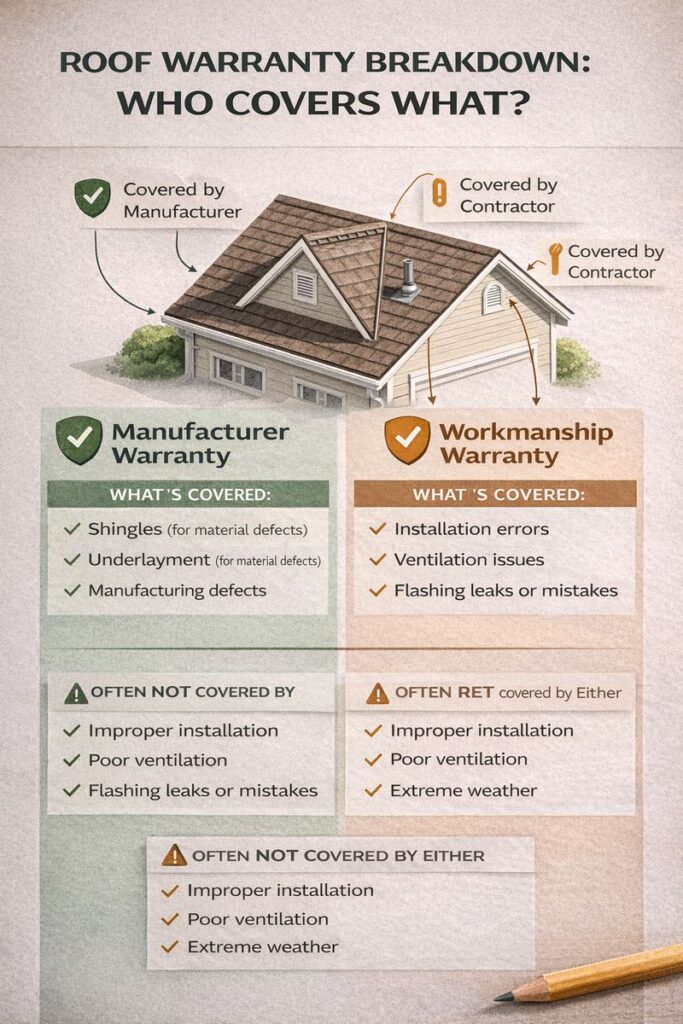
Almost every roofing project includes two separate warranties.
One comes from the manufacturer.
One comes from the contractor.
They protect different things, for different reasons, for different lengths of time.
Problems happen when homeowners assume one warranty covers everything.
It doesn’t.
Manufacturer Warranties Are About Materials, Not Installation
Manufacturer warranties are designed to protect against defects in the roofing materials themselves.
That means they typically cover:
- Shingles that fail prematurely due to manufacturing defects
- Certain material-related issues under specific conditions
They usually do not cover:
- Improper installation
- Ventilation problems
- Flashing errors
- Workmanship mistakes
If a roof fails because it was installed incorrectly, the manufacturer warranty usually doesn’t apply, even if the shingles themselves are still under warranty.
This is where confusion starts.
Workmanship Warranties Are About Installation, Not Products
Workmanship warranties come from the roofing contractor.
They cover issues related to how the roof was installed, including:
- Installation errors
- Flashing details
- Labor-related failures
The strength of a workmanship warranty depends entirely on the contractor.
Its value is tied to:
- How clearly it’s written
- How long it lasts
- Whether the company stands behind it
- Whether the company will still be around to honor it
A long workmanship warranty sounds great, but only if it’s backed by a company with systems, accountability, and longevity.
Why Warranty Length Alone Doesn’t Tell the Story
Homeowners often compare warranties by years.
Twenty years sounds better than ten.
Lifetime sounds better than both.
But length doesn’t equal coverage.
Some long warranties:
- Require strict maintenance
- Have prorated value
- Exclude common failure points
- Shift responsibility back to the homeowner over time
Without understanding the conditions, a “long” warranty can offer very little real protection.
The Most Common Warranty Mistake Homeowners Make
The biggest mistake is assuming:
“If something goes wrong, someone will take care of it.”
Warranties don’t work automatically.
They require:
- Documentation
- Proper installation
- Compliance with manufacturer requirements
- Clear proof of what failed and why
When expectations aren’t set upfront, warranty claims become frustrating fast.
What Coverage Actually Protects You (and What to Confirm Before You Sign)
In Part 1, we covered why roof warranties often create false confidence and how manufacturer and workmanship warranties serve very different purposes.
Now let’s turn that understanding into something practical.
This section will help you verify what protection you actually have, before a problem ever shows up.
What Manufacturer Warranties Typically Cover
Manufacturer warranties focus on defects in the roofing materials themselves.
That usually includes:
- Premature shingle failure caused by manufacturing defects
- Specific material flaws under defined conditions
- Limited coverage windows that change over time
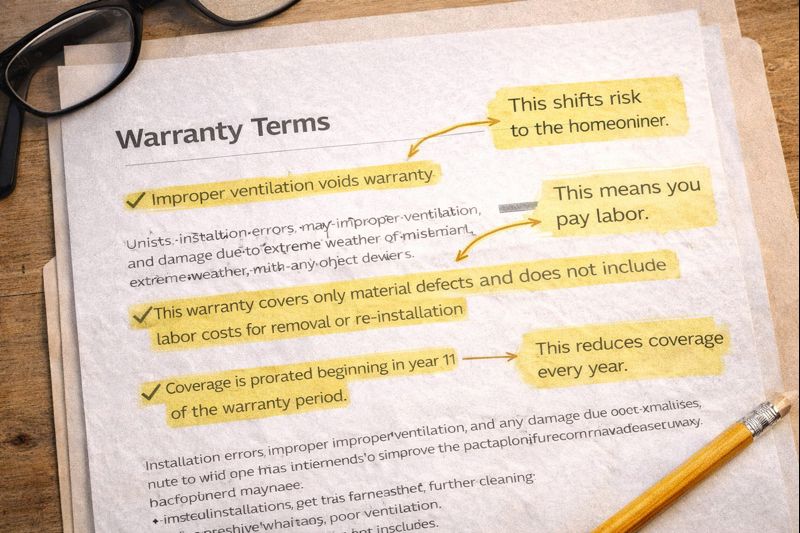
What many homeowners don’t realize is that these warranties often start strong and become more limited as years pass. Coverage may be prorated, meaning the value decreases over time.
Most manufacturer warranties do not cover:
- Labor costs for removal and reinstallation
- Installation errors
- Ventilation-related failures
- Damage caused by improper maintenance
If the issue is not clearly a material defect, the manufacturer may deny the claim.
Why Installation and Ventilation Matter More Than Homeowners Think
Even the best shingles can fail if they are installed incorrectly or placed on a poorly ventilated roof.
Manufacturers often require:
- Specific ventilation ratios
- Approved underlayment systems
- Proper flashing methods
- Correct fastening patterns
If these requirements are not met, warranty coverage can be reduced or voided entirely.
That’s why manufacturer warranties are only as strong as the installation behind them.
What a Strong Workmanship Warranty Should Clearly State
A workmanship warranty should be written, specific, and easy to understand.
At a minimum, it should state:
- What types of issues are covered
- How long the coverage lasts
- Whether repairs or replacements are included
- Who performs the work if a problem occurs
Be cautious of vague language like “we stand behind our work” without details.
A real warranty defines responsibility.
Who Handles Warranty Issues When Something Goes Wrong
This is one of the most important questions homeowners forget to ask.
When an issue arises:
- Do you call the contractor or the manufacturer?
- Who handles paperwork and documentation?
- Who coordinates inspections and repairs?
A trustworthy contractor doesn’t hand you a phone number and walk away.
They help manage the process, explain next steps, and stay involved until the issue is resolved.
Maintenance Requirements You Should Know About
Some warranties require ongoing maintenance to remain valid.
That may include:
- Keeping gutters clear
- Addressing minor issues promptly
- Documenting inspections or repairs
- Avoiding modifications that affect ventilation
If maintenance requirements exist, they should be explained clearly before installation.
Surprises later often come from details that were never discussed.
Questions Every Homeowner Should Ask Before Signing
Before committing to a roofing project, ask these questions and listen carefully to the answers.
What exactly does the manufacturer warranty cover, and what does it exclude?
What does your workmanship warranty cover, and for how long?
What could void either warranty?
Who do I contact if I notice a problem?
Will you help manage warranty claims if something happens?
Clear answers now prevent frustration later.

Roof warranties are not automatic protection.
They are agreements with conditions, responsibilities, and limits.
When homeowners understand:
- Who covers what
- Why installation quality matters
- How claims are handled
- What maintenance is required
Warranties become a real layer of protection instead of a false sense of security.
Wise homeowners don’t just hear the word “warranty.”
They confirm what it actually means.
That’s how you protect your nest.
📍 Owl Roofing Serves the Entire Twin Cities Metro
Andover · Anoka · Apple Valley · Arden Hills · Big Lake · Blaine · Bloomington · Brooklyn Center · Brooklyn Park · Burnsville · Champlin · Chanhassen · Chaska · Columbia Heights · Coon Rapids · Cottage Grove · Crystal · deephaven · Delano · Eagan · East Bethel · Eden Prairie · Excelsior · Farmington · Forest Lake · Fridley · Golden Valley · Ham Lake · Hastings · Hopkins · Hugo · Inver Grove Heights · Lake Elmo · Lakeville · Lino Lakes · Mahtomedi · Maplewood · Mendota Heights · Minneapolis · Minnetrista · Mound · Mounds View · New Brighton · New Hope · North Oaks · North St. Paul · Oak Grove · Oakdale · Plymouth · Prior Lake · Ramsey · Richfield · Robbinsdale · Rosemount · Roseville · Saint Paul · Savage · Shakopee · Shoreview · South St. Paul · St. Louis Park · St. Michael · St. Paul · Stillwater · Vadnais Heights · Victoria · Waconia · wayzata · West St. Paul · White Bear Lake · woodbury
Licensed Minnesota roofing contractor · Free inspections · 10-year workmanship warranty · Get a free estimate →

Recent Articles
Explore The Blog